Outdoor Pitstop

Which kind of bike stand do you need?
"Bike stand" covers a lot of different things. This guide is mainly about the stand that stays on your bike, the kickstand, but it also explains the other kinds in brief:
| Kind | What it does | Where |
|---|---|---|
| Side kickstand | one leg, the bike leans over to the left | on the bike, on the way |
| Double (centre) kickstand | two legs, the bike stands upright | on the bike, on the way |
| Car carrier | holds bikes on the boot, roof or tow bar | on the car |
| Floor stand or rack | holds a wheel, like in a bike shop | garage, shed, hallway |
| Wall hook or wall mount | hangs the bike by a wheel or the frame | garage, shed, at home |
| Upright or two-tier stand | stores bikes vertically or one above the other | garage, bike store |
| Sheffield stand | a metal hoop in the ground to lock to | streets, stations, shops |
Two more kinds are for at home only. A workstand (repair stand) holds the bike off the ground while you clean and fix it: see our guide to bike maintenance. A trainer stand clamps the rear wheel so you can ride indoors as on an exercise bike.
Where a kickstand is mounted
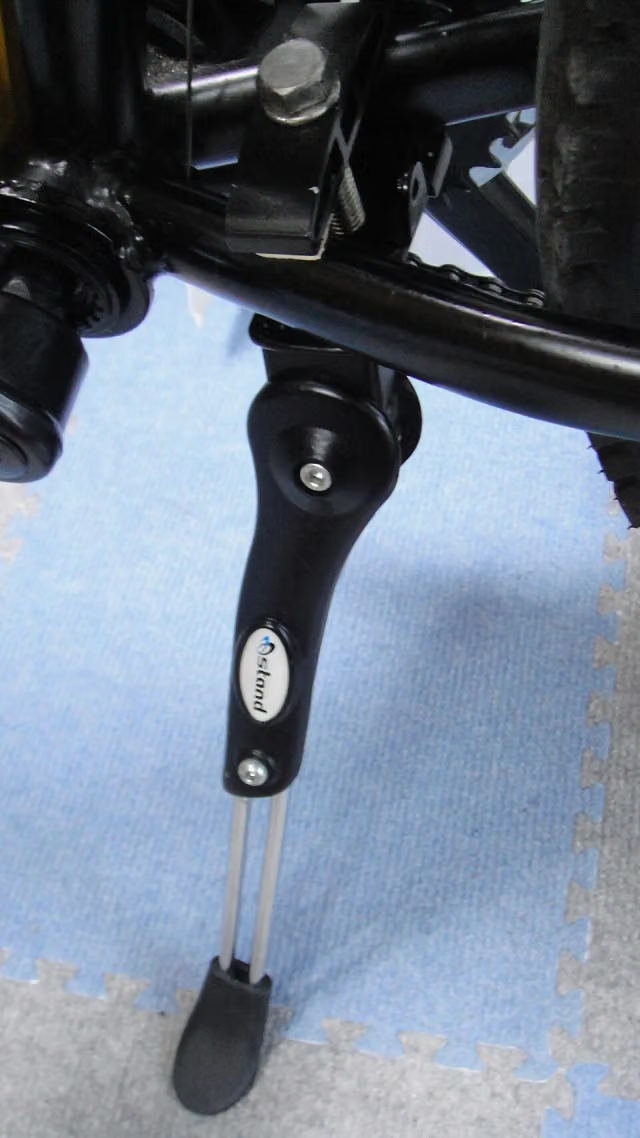
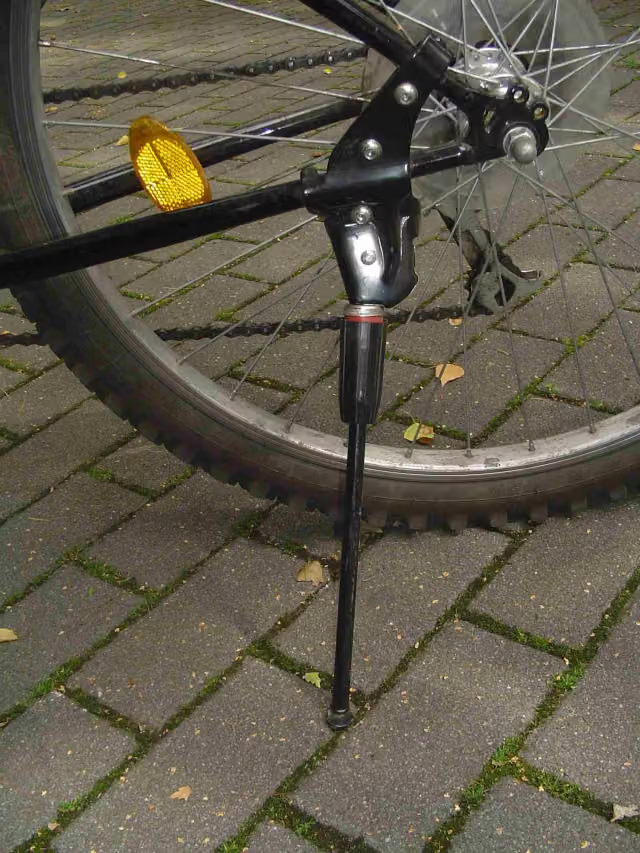
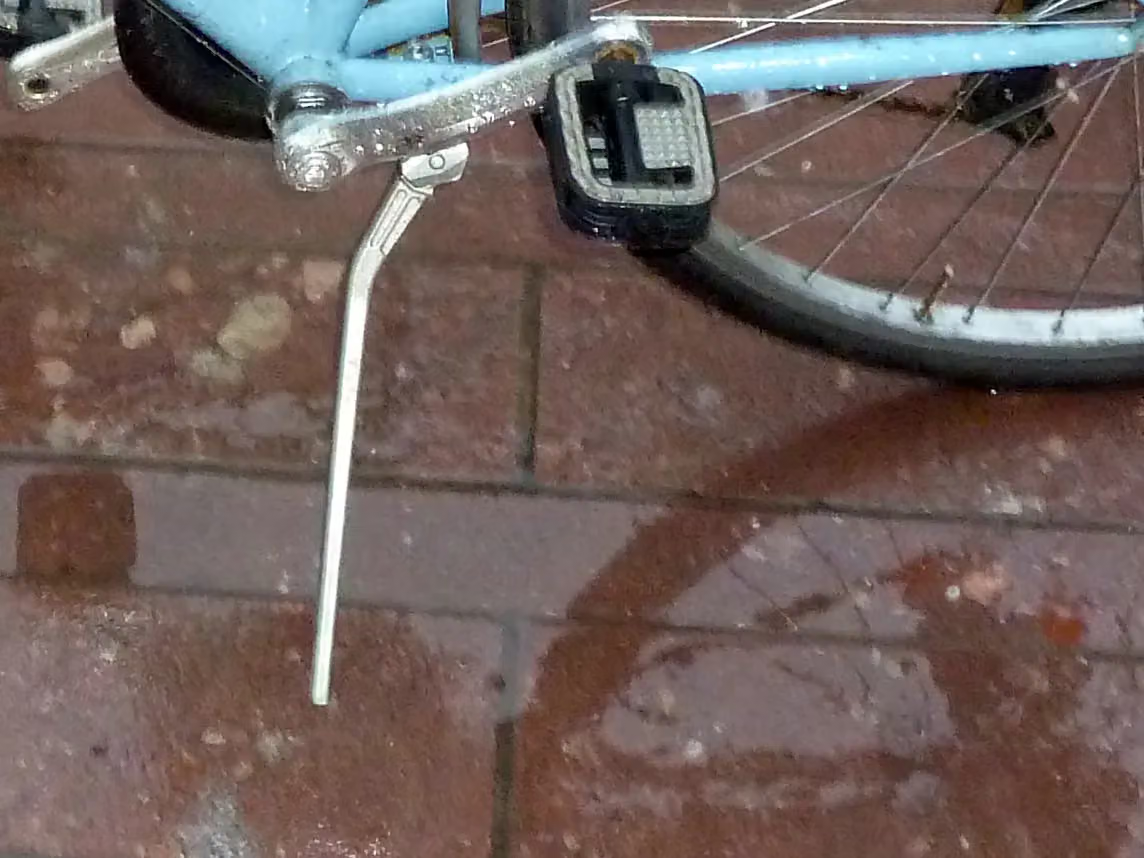
Bike kickstand: side, double or rear-mounted
A kickstand is a prop that holds your bike up when you park it, and it got its name because you work it with your foot. The cycling engineer Sheldon Brown describes four types in his glossary:
- Clamped to the chainstays just behind the bottom bracket, with the bike leaning to the left.
- Bolted to a bracket in the bottom bracket area, also leaning the bike to the left. Many everyday bikes have a small plate there for it.
- A double kickstand behind the bottom bracket, with two legs that fold up under the chainstays. This one holds the bike upright, which helps with full panniers or a child seat.
- Rear-mounted, on the left chainstay and seatstay just in front of the rear hub.
Sheldon Brown points out one difference that matters: the rear-mounted kickstand is the only kind that does not get in the way of a crank. With the others, rolling the bike backwards while the stand is down can damage the stand or the chainstays.
Not every bike takes every kickstand. Trek, for example, publishes a compatibility guide that shows which of its kickstands fit which of its models, including some electric mountain bikes. Check your own bike maker's information before you choose, especially for a heavy e-bike, a mountain bike or a road bike with a light frame.
How to fit and adjust a kickstand
Always follow the instructions that come with the kickstand first; they say which bolt and plate to use and how far you may shorten the leg. The order of work is usually the same:
- Find the mount on your frame: a plate with a bolt hole behind the bottom bracket, bolt holes near the rear hub, or only round tubes.
- Bolt the kickstand on with the plate and bolt supplied, and tighten it firmly.
- Stand the bike on a flat floor and fold the stand out.
- Set the length. An adjustable leg slides in or out; on a fixed leg you may need to cut it shorter. A side kickstand is right when the bike leans over a little, not when it stands almost straight.
- Check that nothing touches: the stand should not hit the chain, the crank or the tyre, folded up or down.
If the bike stands too upright, a gust of wind will tip it over. Check the bolt again after a few rides, because a loose kickstand turns and knocks against the crank.
- Most common mount
- plate behind the bottom bracket
- Upright
- double kickstand
- Clear of the crank
- rear-mounted kickstand
Which kickstand suits your bike?
What do you use your bike for?
Commuting or errands, little luggage
- Light and quick to fold out
- Set the length so the bike leans a little
- A wide foot helps on grass and gravel
Panniers, shopping or a child seat
- The bike stands upright, even when loaded
- Mounted behind the bottom bracket
- Fold it up before you ride off
A heavy e-bike
- Check the bike maker's compatibility list
- Look at the weight the stand is made for
- A wide foot stops it sinking into soft ground
Road bike or mountain bike
- Check that your frame allows a clamp
- At home a floor stand holds the wheel
- On the way, lean the bike against a Sheffield stand
First look at what your frame has: a plate behind the bottom bracket, bolt holes near the rear hub, or neither.
Bike stand for car: boot, roof or tow bar
Cycling UK distinguishes three kinds of car carrier: one strapped to the boot or hatchback, one clamped to roof bars, and one on a tow bar or tow ball.
- Boot-mounted carriers are the simplest, but not every one fits every car: check the maker's list for your model and year. Tighten the straps, then check them again once the bikes are on. Most carry up to three bikes.
- Roof-mounted carriers leave the boot free and the lights and number plate clear, but you have to lift the bikes up high. Remember the bikes are up there before you drive into a car park with a height barrier.
- Tow bar carriers are the most stable and carry up to five bikes, but need a tow bar and a power socket for a lighting board.
Whatever you use, bikes on the back must not hide your lights or number plate; Cycling UK says you may need a lighting board with a number plate to be road legal. The Highway Code says you must secure your load and it must not stick out dangerously. A bike inside the car travels best with the front wheel off and the chain side up, so the rear derailleur does not take the weight.
Bike stand for garage and shed
Cycling UK warns that sheds and garages are where thieves expect bikes, so a locked door alone is not enough. Its advice for a garage or shed:
- Lock the bike to a wall or floor anchor inside, not just lean it against the wall.
- Fix the anchor to something solid, ideally concrete, not the thin wooden wall of a shed.
- Use two good locks: one through the frame and front wheel, one through the frame and rear wheel.
- Check your insurance. A bike in a shed or detached garage may not be covered, while an integral garage is often seen as safer. A photo of how you lock it can help.
A simple floor stand, like those in bike shops, keeps the bike upright but takes floor space. Multi-bike floor racks use the space a little better.
Wall mounted bike stand
Wall hooks are the simplest and cheapest way to store several bikes, says Cycling UK: you hang each bike by a wheel. Hang them nose to tail, alternately by the front and rear wheel, so the handlebars of one bike sit next to the saddle of the next. Indoors, a wall mount that holds the bike by its frame keeps it dry and safe and off the floor of your hallway. A ceiling-mounted rack frees all the floor space, but locking the bike to it takes some thought.
Bike stand vertical: upright and two-tier
Upright multi-bike stands hold two bikes horizontally, one above the other. Cycling UK lists three versions: freestanding, supported by the wall, or wedged between floor and ceiling.
The same idea is used in big bike parks. According to the Department for Transport's design guide, two-tier racks need a ceiling of at least 2.7 metres, and some people find it hard to lift a bike onto the upper tray, even with the spring or gas assistance. Measure your garage or shed before you choose a vertical stand.
Sheffield bike stand: parking on the way
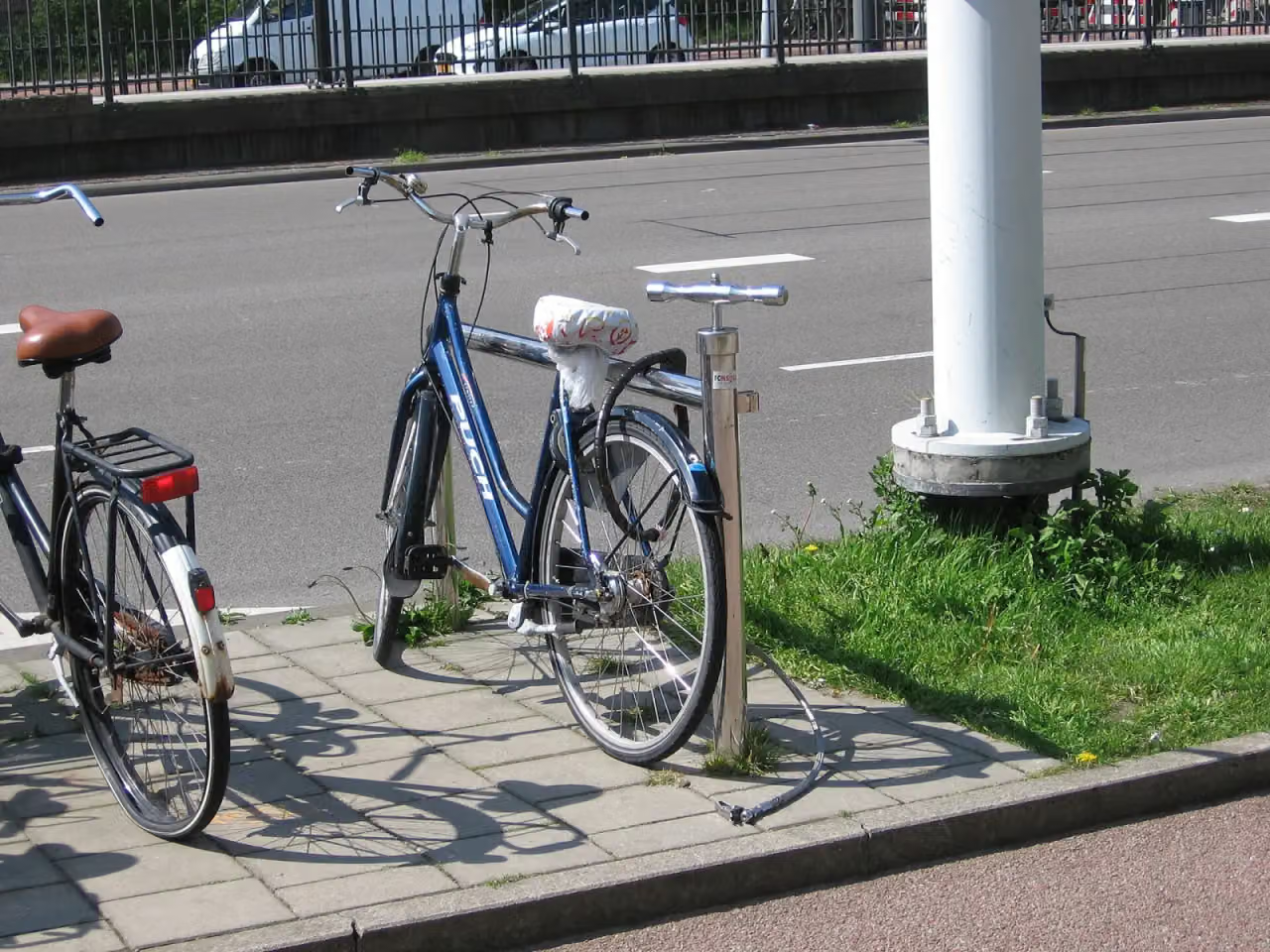
On a ride you will mostly park at a Sheffield stand: a metal tube anchored in the ground at two points. The Department for Transport's cycle design guide, LTN 1/20, calls it the preferred and most common form of cycle parking. One stand takes two bikes, one on each side, and you can lock both wheels and the frame to it, which makes a quick theft harder. An M-shaped variant gives better support to small-wheeled and children's bikes.
The guide asks for at least 1 metre between stands so bikes with panniers or child seats can get in, and 0.6 metres of clearance to a wall. At bigger cycle hubs it suggests pumps and repair tools for quick fixes on the go. Those public bike pumps and repair stations are on our map of the United Kingdom, along with public toilets and water fountains for your break.
In the app I can see 647 public bike pumps in the United Kingdom, 274 of them repair stations with tools.
- Bikes per stand
- two, one each side
- Between stands
- at least 1 m
- To a wall
- at least 0.6 m
From our data
Bike pumps and repair stations in the United Kingdom
- Public bike pumps
- 647
- in the United Kingdom
- Bike repair stations
- 274
- in the United Kingdom
As of 28 November 2026, from the Outdoor Pitstop database. The whole United Kingdom. A repair station is a public bike pump with tools attached.
Cycling with stops along the way
We have no cycling routes for the United Kingdom or Ireland in the app yet. The bike pumps, public toilets and water fountains are already on the map, and every region has its own page.
Pitstops in the United Kingdom →Pitstops in Ireland