Outdoor Pitstop

How to store a bike securely at home: the steps
Police forces and Cycling UK give much the same advice for keeping a bike at home. These are the steps, in order:
- Pick the driest, most hidden place you have. Cycling UK calls storing a bike outside the least good option: the weather wears it down and thieves can see it.
- Fix an anchor to something solid. A ground or wall anchor belongs in concrete or brick, not in the thin wooden wall of a shed, which Cycling UK warns can simply be broken off.
- Lock the bike to it, not just the door. Cycling UK suggests two good locks: one through the frame and front wheel, one through the frame and rear wheel. The PSNI points to locks tested under the Sold Secure scheme, which has four grades for bicycles with Diamond as the highest; for e-bikes it advises Gold or Diamond.
- Secure the building around it. West Yorkshire Police advises two closed-shackle padlocks on a shed door, one a third of the way up and one a third of the way down, mesh or bars behind the windows and lighting from dusk till dawn.
- Record and mark the bike. Write down the make, model, colour and frame number, take a photo, register it on a national database the police can search and use a security marking kit, says the PSNI. The frame number is usually under the bike between the pedals or where the back wheel slots in.
- Check your insurance. The PSNI and Cycling UK both say to check that your policy covers theft from a shed or outbuilding, and Cycling UK suggests keeping a photo of how you normally lock the bike.
- Lock to
- concrete or brick anchor
- Locks
- two, frame plus each wheel
- Record
- frame number and photo
Which bike storage suits your home?
Where will the bike live?
Flat or hallway
- Safest and driest place, says Cycling UK
- A wall mount keeps the floor free
- Check the wall is solid enough to drill into
Shed or garage
- The most common place, and thieves know it
- Anchor to the concrete floor, not a wooden wall
- Two padlocks on the door and lighting outside
Only a garden
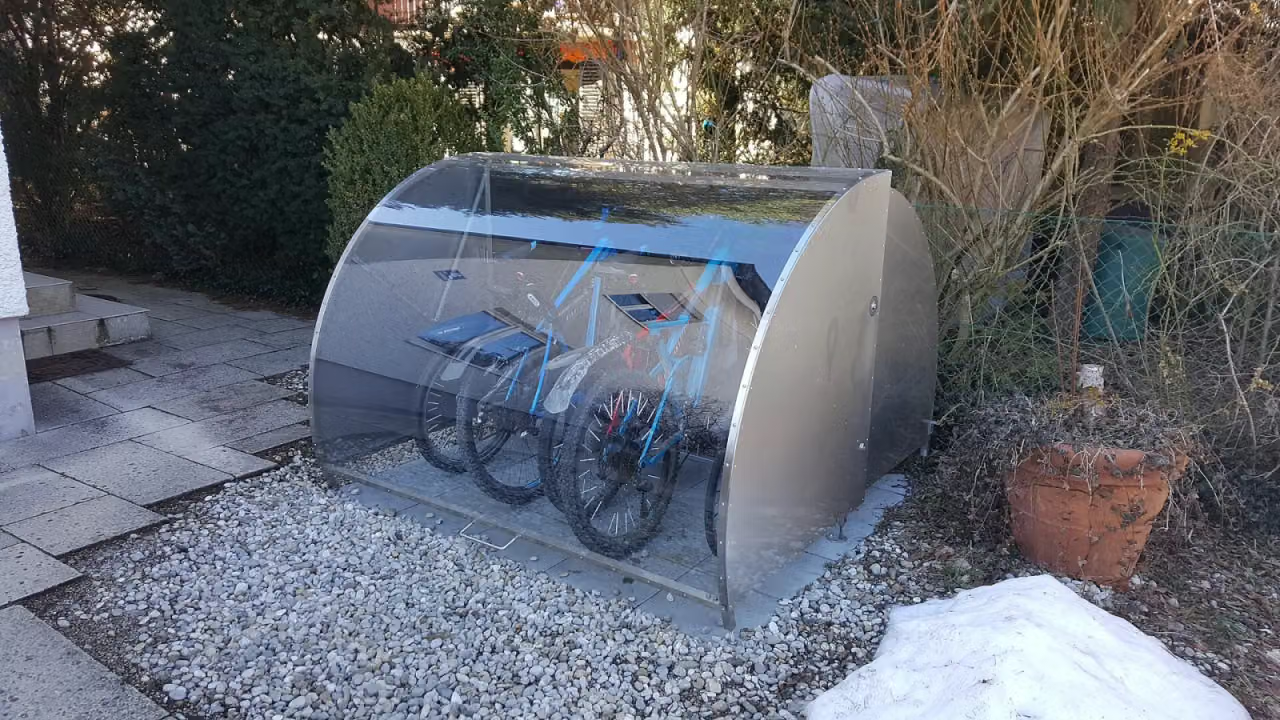
- Lock the bike itself inside any box or store
- Use a cover and take off lights and computers
- No outbuilding in front of the house without checking planning rules
This is advice, not a shop: we do not recommend brands or products. For locks, look for a Sold Secure rating, as the police advise.
Bicycle rack: floor racks and stands for several bikes
A bicycle rack on the floor is the easiest way to park bikes without leaning them against a wall. Cycling UK notes that simple floor stands, like the ones in bike shops, take up floor space, and that racks for several bikes use the room a little better but still need plenty of it.
Upright stands for two bikes hold them one above the other, horizontally. According to Cycling UK they come freestanding, supported by a wall, or wedged between floor and ceiling. Count on enough height: the Department for Transport's cycle design guidance (LTN 1/20) says two-tier racks for public parking need a ceiling of at least 2.7 metres, and that some people find it hard to lift a bike onto the upper tier.
A rack that holds only the front wheel is the weak spot. LTN 1/20 says such slots should not be used for public cycle parking, because many bikes have quick-release wheels and the frame cannot be secured, which raises the risk of theft. At home the same logic applies: lock the frame, not just a wheel.
Bike stands and Sheffield cycle stands
The bike stand you see outside shops and stations is usually a Sheffield stand: a tubular metal hoop anchored into the ground at two points. LTN 1/20 calls it the preferred and most common form of cycle parking. Each stand takes two bikes, one on each side, and you can lock the frame and both wheels to it. An M-shaped variant gives better support to small-wheeled and children's bikes.
If you have a driveway or concrete yard, the same measurements help at home. LTN 1/20 asks for at least 0.6 metres between a stand and a wall, 1 metre of clear space in front to wheel the bike in, and 1.2 metres between stands (1 metre at least). A parked bike takes about 2 metres of length. Placed too close to a wall, a stand makes two-point locking awkward and the bike tends to fall over.
A bike repair stand or bike maintenance stand is something else: it clamps the bike off the ground while you work on it. It is not a place to store or lock a bike; see our guides to bike maintenance.
Bike wall mount and bike hangers for the garage
A bike wall mount frees the floor, which is why it suits flats, hallways and narrow garages. Cycling UK calls wall hooks, with the bike hanging by a wheel, the simplest and cheapest way to store several bikes. Its tip for saving wall space: hang them nose to tail, alternating front and rear wheels, so the handlebars of one bike sit beside the saddle of the next.
Vertical bike storage and ceiling hangers go one step further and clear the floor completely. Cycling UK points out the catch: on a ceiling rack it is harder to lock the bike. In a garage, combine a wall or ceiling hanger with a separate anchor in the concrete floor, which the PSNI recommends because e-bikes are increasingly stolen from garages.
Indoors, Cycling UK sees a bike on the living-room wall as the safest, driest option of all. If you keep an e-bike inside, the London Fire Brigade notes that most e-bike fires start while the battery is charging, so treat charging with care.
Outdoor bike storage: garden stores, sheds and shelters
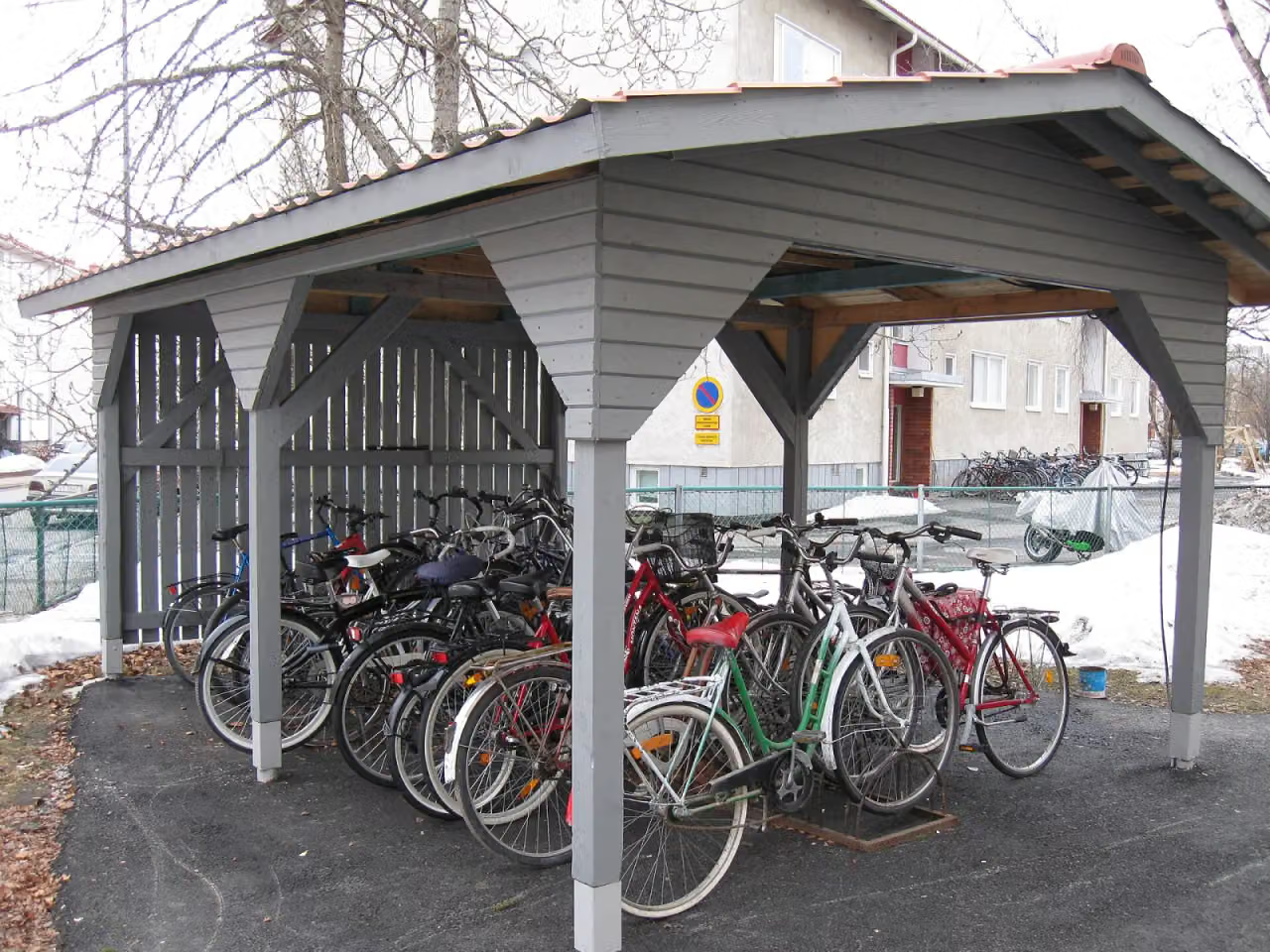
Outdoor bike storage is often the only choice, and the police say it is also where many bikes are taken. The PSNI writes that many bikes are stolen at home, mainly from sheds and garages, and West Yorkshire Police puts bikes at the top of the list of things stolen from sheds. Cycling UK adds that a box or store only hides a bike: inside it, the bike still needs its own lock, and a padlock on a plastic lid is not enough.
Placement matters too. West Yorkshire Police advises turning the shed door towards the house and keeping it away from a boundary wall or gate. A cover keeps the worst of the rain off a bike that has to stand outside, and Cycling UK suggests taking off lights and bike computers. A simple shelter, LTN 1/20 notes, keeps bikes under cover and can have an air pump and tool set beside it.
Planning rules in England. According to the Planning Portal, a garden shed or bike store is usually permitted development, without a planning application, as long as it meets every condition. It may not stand in front of the principal elevation of the house, has a maximum eaves height of 2.5 metres, and must stay under 2.5 metres in total height within 2 metres of a boundary. In national parks, Areas of Outstanding Natural Beauty and World Heritage Sites the limits are stricter, and in the grounds of a listed building an outbuilding is not permitted development at all. The PSNI likewise tells readers to check with the council before putting a bike store in a front garden. If you live outside England, check the rules with your council.
From our data
Bike pumps and repair stations in the United Kingdom
- Public bike pumps
- 647
- in the United Kingdom
- Bike repair stations
- 274
- in the United Kingdom
As of 28 November 2026, from the Outdoor Pitstop database. Public bike pumps and repair stations come from OpenStreetMap and from reports by our users.
From the shed to the road: pumps and repair stations on the way
A bike that has stood in a shed for a few weeks often comes out with soft tyres. At home you pump them up before you leave; on the road, a public bike pump or repair station saves the ride. LTN 1/20 mentions that cycle hubs at stations may include pumps and repair tools, and that a simple cycle shelter can have an air pump and tool set beside it.
In the app you find those pumps and repair stations on the map, along with drinking water and public toilets for a longer ride. All pitstops in the UK are on Outdoor Pitstop in the United Kingdom; riding in Ireland, see Outdoor Pitstop in Ireland.
In the app I see 647 public bike pumps and 274 repair stations in the United Kingdom.