Outdoor Pitstop

Best bike lock: what the Sold Secure ratings mean
In the UK the yardstick for a bike lock is Sold Secure, the testing scheme run by the Master Locksmiths Association, which grades locks by how long they hold out against the tools thieves use, such as bolt croppers, saws, drills and angle grinders. Its pedal cycle ratings run like Olympic medals, with Diamond on top:
| Rating | Resists | Sold Secure suggests it for |
|---|---|---|
| Diamond | the most determined thief, with heavy tools and some power tools | very high-value bikes in very high-risk areas |
| Gold | the dedicated thief, with heavy-duty tools | a high-value bike, or a big city or university town |
| Silver | a more determined thief | a lower-value bike in a medium-risk place, like a local town centre |
| Bronze | the opportunist, with one small hand tool | a short stop in a low-risk place, like a café |
So the best bike lock is not one product: it is the highest rating that suits the value of your bike and where you leave it. Cycling UK's guide puts it in time terms: Gold if your bike draws second looks and stands for more than an hour, Silver for small towns and stops under an hour.
Two checks before you choose. Insurers often name the grade they require in the policy, so read yours first. And look the lock up in Sold Secure's approved product search: its list is updated daily, and a lock that loses its rating is changed there. You may still see the old name "Bicycle" rating; Sold Secure renamed it "Pedal Cycle" in 2022 and the grades are the same.
- Highest rating
- Diamond
- Then
- Gold, Silver, Bronze
- Check
- your insurance policy
- E-bike
- Powered Cycle rating
D lock: the strong lock for your frame
A D lock, also called a U lock, is a rigid steel shackle with a lock body across the open end. Sold Secure rates D locks alongside chains, folding locks, disc locks, ground anchors and cable locks, so any type can carry a rating.
A D lock is stiff, so you need a stand or post close to the frame. Cycling UK's guide says a shorter, narrower shackle is harder to attack than a big one, even if it is more awkward to fit around some stands. Cycling UK's writer carries hers attached to the frame while riding, with a second, easy-to-carry lock.
D lock bike: how to lock it properly
How you fit a D lock matters as much as which one you buy. These steps follow Cycling UK and Secured by Design, the police crime prevention initiative:
- Choose the spot. Pick a purpose-built stand in a busy, well-lit place, ideally covered by CCTV. Do not use an open-ended post such as a signpost: a thief lifts the bike over the top.
- Get close to the stand. Park the bike right against it, so there is little room to slip a tool in for leverage. Avoid locking against a wall or gate, which thieves use for leverage too.
- Lock low. Put the shackle round the stand and the frame low down, near the bottom bracket or seat post, rather than over the top tube.
- Fill the shackle. Get as much bike and stand inside the D as you can, leaving as little space as possible.
- Include the rear wheel. Cycling UK locks in order of value: frame first, then the rear wheel, then the front.
- Lift it off the ground, keyhole down. Cycling UK advises the keyhole facing down, and Secured by Design says a lock touching the ground is more vulnerable.
- Add a second lock through the front wheel, frame and stand. Secured by Design calls double locking the best protection for any bike.
Never lock only the front wheel to the stand: with a quick-release wheel a thief takes the wheel out and leaves you just that wheel.
- Lock
- frame, rear wheel, front wheel
- Height
- off the ground
- Keyhole
- facing down
Types of bike lock
Bike chain lock: flexible round awkward stands
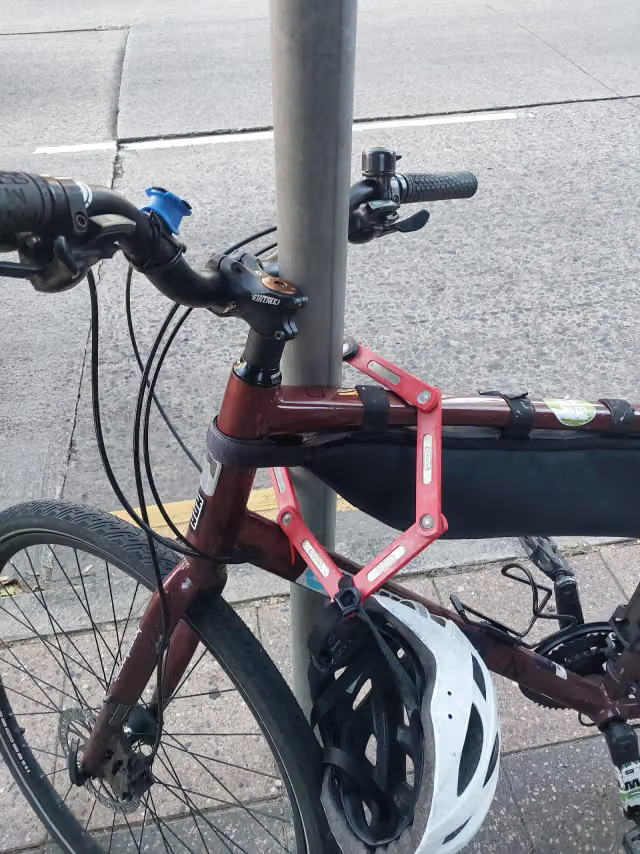
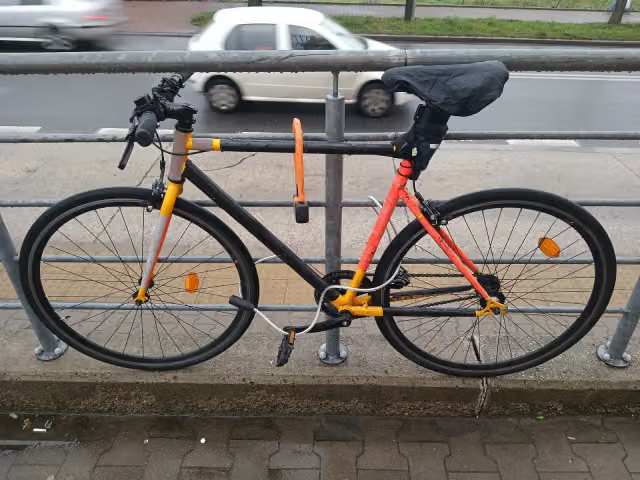
A bike chain lock is a chain of steel links closed with a padlock or a built-in lock. Its strength is flexibility: it reaches round thicker posts, railings and awkward stands that a rigid D lock will not fit. Sold Secure rates chains and padlocks on the same pedal cycle scale, so compare the rating, not the thickness you see in the shop.
Cycling UK's tip for any flexible lock, chain or cable: wrap it so it stays fairly taut, which makes it harder to attack with cutters or bolt croppers. Keep it off the pavement too; Secured by Design says locks that touch the ground are more vulnerable.
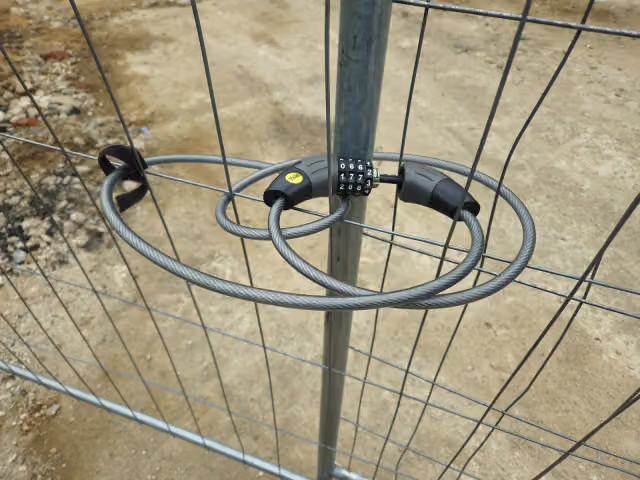
Bike lock cable and combo bike lock: only as an extra
A cable lock is light and easy to carry, but Secured by Design warns that cheap cable locks can be removed in seconds and will not stop a thief. Use one as a second lock, for example through the front wheel, or for a quick stop where you can see the bike.
A combo bike lock opens with a code of numbers or letters instead of a key, so there is no key to lose. The code is easy to forget, so write it down somewhere safe. Whether a combination or a key lock, the same rule applies: what counts is the rating, not how it opens.
Ebike lock: which rating for an electric bike?
For an e-bike Sold Secure recommends a lock with its Powered Cycle rating, the scale it also uses for motorcycles. A Pedal Cycle Diamond lock offers the same security as Powered Cycle Gold, because both are tested with the same tools, methods and time limits. Secured by Design advises the highest-rated lock for a high-value e-bike, ideally one built to resist battery-powered angle grinders.
Secured by Design also suggests taking the battery with you when you leave an e-bike in public parking, as battery locks are easy to overcome, and not leaving it in the same place every day, so it does not get noticed and stolen to order.
Angle grinder resistant bike lock and alarms
No lock is angle grinder proof. Cycling UK says nothing gives 100% protection, and that a thief with large bolt croppers or a small bottle jack can break even some Gold-rated locks in under a minute, without power tools. Locks marketed as angle grinder resistant aim to buy time; Sold Secure's Diamond test includes some power tools.
The aim of every lock is to make your bike look like more work than the one next to it. A bike lock with alarm or a separate bike security alarm adds noise to that; Sold Secure has a separate rating for audible accessory alarms. It does not replace a good lock.
Which bike lock suits your bike?
Where do you leave your bike?
Short stop in a village
- Folding lock or compact D lock in a frame bracket
- Lock the frame and rear wheel to a stand
- Keep the bike where you can see it
City or station
- D lock low round frame and stand
- Second lock through the front wheel
- Busy, well-lit stand with CCTV
E-bike
- Check the grade your insurer names
- Take the battery with you
- Vary where you park
Day ride on a road bike
- Lightweight cycle lock that fits a pocket or bag
- Not for leaving the bike out of sight for long
- Take valuables with you
The more your bike is worth and the longer it stands, the higher the rating. Always check the rating in Sold Secure's approved product search, and the grade in your insurance policy.
Bicycle security beyond the lock: record and register
A lock is one part of bike security. Secured by Design advises recording the make, model, size, colour and frame number of your bike, usually found underneath between the pedals, and taking a photo. Register the bike on a national database recognised by Secured by Design: the police check these when they recover bikes, and a visible registration label puts thieves off.
BikeRegister, the National Cycle Database, says it is used by all UK police forces and passed one million registered bikes in January 2021. Cycling UK adds that more than half of bike thefts happen at the owner's home, so lock the bike in the shed or garage too, for example to a ground or wall anchor. If your bike is stolen, report it to the police.
From our data
Stops on a ride in the United Kingdom
- Public toilets
- 13,915
- in the United Kingdom
- Water points
- 2,923
- in the United Kingdom
- Public bike pumps
- 647
- in the United Kingdom
- Bike repair stations
- 274
- in the United Kingdom
As of 28 November 2026, from the Outdoor Pitstop database. Public toilets, water points, bike pumps and repair stations from OpenStreetMap and reports by our users: places where you leave your bike for a moment.
Locking your bike at a stop on the way
On a day ride the risky moments are the short ones: a public toilet, a tap to fill your bottle, a café. That is when it is tempting to leave the bike unlocked. Cycling UK's advice is simple: always lock it, even for a few minutes. With a light second lock in your bag, a quick stop takes seconds longer, not minutes.
Plan the stops before you set off, so you know where there is a toilet or water and can look for a solid stand when you arrive. See the public toilets in the United Kingdom and the water fountains and refill points in the United Kingdom. Riding in Ireland? See the public toilets in Ireland. More on what to fit to your bike is in the guide to bike accessories.
In the app I see 13,915 public toilets, 2,923 water points and 647 bike pumps in the United Kingdom: the places where I would lock my bike for a moment.