Outdoor Pitstop

Bike lights: what the law says in the UK
The rules for bike lights come from the Road Vehicles Lighting Regulations, and the Highway Code sums them up in rule 60. In short, for riding on a public road:
- Between sunset and sunrise your bike must have a white front light and a red rear light, switched on. Cycling UK adds that they must be clean and working properly.
- Reflectors are part of the rules too: a red rear reflector, and amber pedal reflectors on bikes made after 1 October 1985.
- The lights must be fixed to the bike. A light on your helmet or rucksack can help, but on its own it does not meet the law, Cycling UK points out.
- Flashing lights are allowed, but the Highway Code recommends a steady front light where there is no street lighting.
You do not need lights when the bike is standing still or when you push it along the side of the road. One rule surprises many riders: according to Cycling UK, bikes are not legally required to light up in fog or other poor visibility during the day. It is still sensible to do so.
- Front light
- White
- Rear light
- Red
- When
- Sunset to sunrise
- Flashing
- Allowed
- Reflectors
- Red at the rear, amber on the pedals
The parts of your bike lighting
Front bike light: white, and aimed at the road
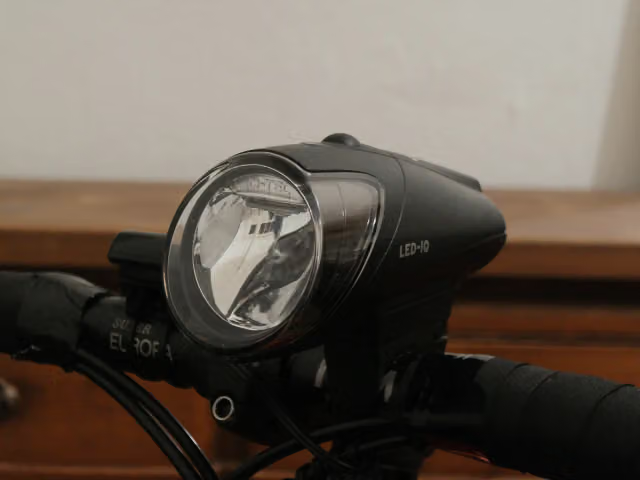
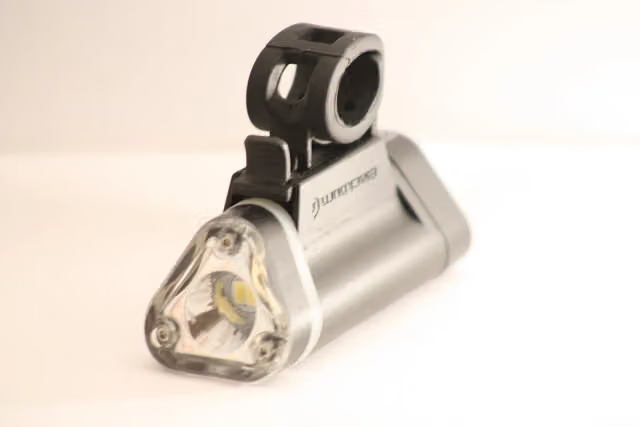
The law asks for at least one front bike light showing white, fitted in the middle or on the offside (the right-hand side of the bike) and no higher than 1.5 metres from the ground, says Cycling UK. A light that can shine steadily should carry the British Standard mark BS 6102/3 or an equivalent European mark; a light that can only flash must give at least 4 candelas.
What you need in practice depends on where you ride. In town, under street lights, a bicycle front light is mainly there so that others see you. On an unlit lane, a towpath or a country road you also want to see the way yourself: potholes, gravel, a bollard in the middle of the path. That is why the Highway Code advises a steady front light where there is no street lighting.
Most lights are sold with a number of lumens. Cycling UK reckons one candela is roughly 12 lumens, so the tiny flashing lights of around 25 lumens are not enough on their own. Look at the shape of the beam as well as the number: a light that throws its beam down onto the road lights your way without dazzling people coming towards you.
Rear bike light: red, and at the right height
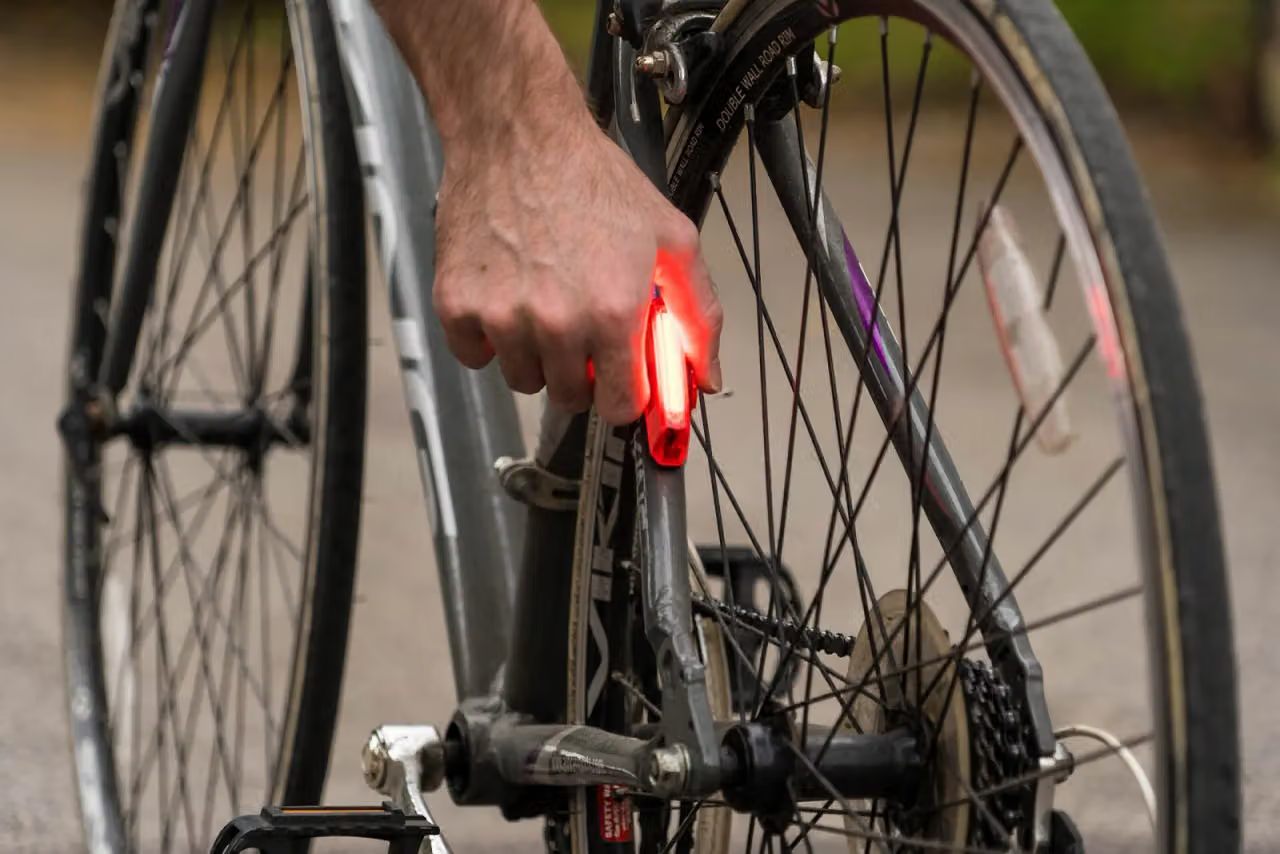
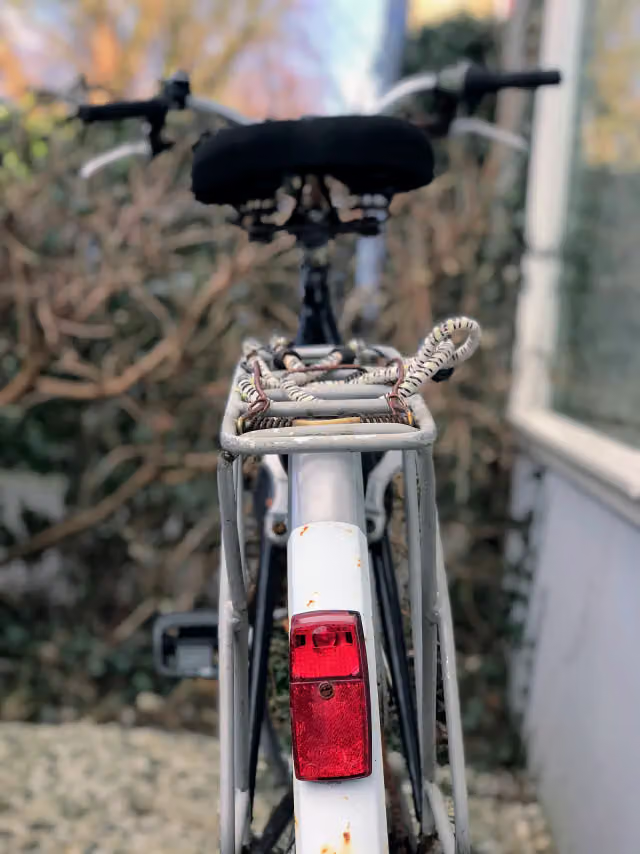
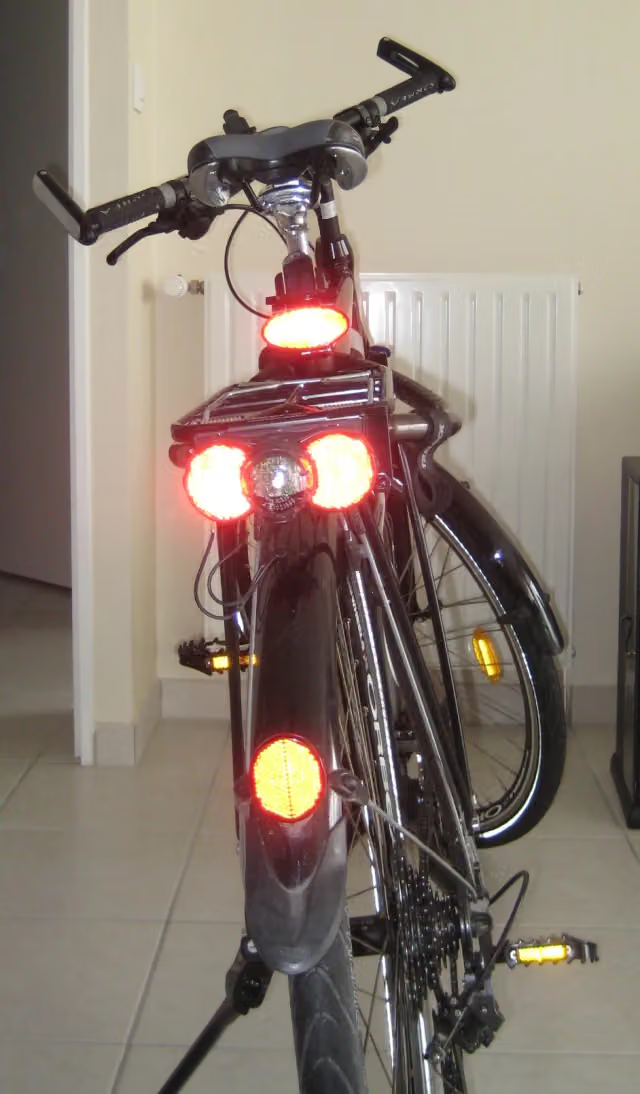
A rear bike light shows red, faces straight back and sits in the middle or on the offside of the bike, between 35 centimetres and 1.5 metres from the ground, according to Cycling UK. The same marking rules apply as at the front, and a light that can only flash must give at least 4 candelas.
Rear lights usually have far fewer lumens than front lights. That is fine: Cycling UK explains that a rear light does not need to light the road, and that our eyes see red differently, so a 50-lumen rear light looks about as bright as a 200-lumen front light.
Keep the rear light clear. A full pannier, a coat over the rack or a saddlebag can easily hide it. Rechargeable rear bike lights clip to the seat post or a bag and come off when you lock the bike; check the battery before an evening ride.
Reflectors: the part riders forget
Reflectors work even when a battery runs flat, because they bounce back the light of others. Cycling UK lists what the law requires:
- one red rear reflector, between 25 and 90 centimetres from the ground, in the middle or on the offside;
- four amber pedal reflectors, one facing forwards and one facing backwards on each pedal.
Clipless pedals often have no room for reflectors. Cycling UK notes that, strictly, such pedals should then not be used in the dark; reflective ankle bands help you to be seen but do not meet the legal requirement. Bikes made before October 1985 do not need pedal reflectors. The Highway Code adds that a white front reflector and spoke reflectors also help you to be seen. More about reflective clothing is in the guide to being seen on a bike.
Flashing or steady bike lights?
Since 2005 a flashing light may be your only light, front or rear, as long as it flashes between 60 and 240 times a minute. Cycling UK adds a catch: most flashing lights also have a steady mode, and in that mode they should meet the British Standard, which very few lights on sale in the UK do. So, Cycling UK says, you will probably need a second, approved light as well.
Extra lights are allowed as long as they have the right colour and position. You must never show a red light to the front or a white light to the rear, and triangular rear reflectors belong on trailers only. A bike trailer needs its own rear light and a triangular reflector.
MTB bike lights and riding on unlit lanes
On a trail in the woods or a lane between fields there is no street light at all, and MTB bike lights have a different job: they must show you the ground in front of the wheel. The lighting rules are written for public roads, but the Highway Code's advice for unlit areas, a steady front light, is just as useful off-road.
A light on your helmet shines wherever you look. Cycling UK calls helmet lights useful, but a helmet light alone does not meet the law, so keep a fixed white front light and a red rear light on the bike for the ride to and from the trail. A bike light bar or a second bracket on the handlebar gives room for an extra light. On a long night ride, take a spare light or charge your lights at a stop.
Dynamo bike light or rechargeable USB bike lights?
There are two common ways to power your lights:
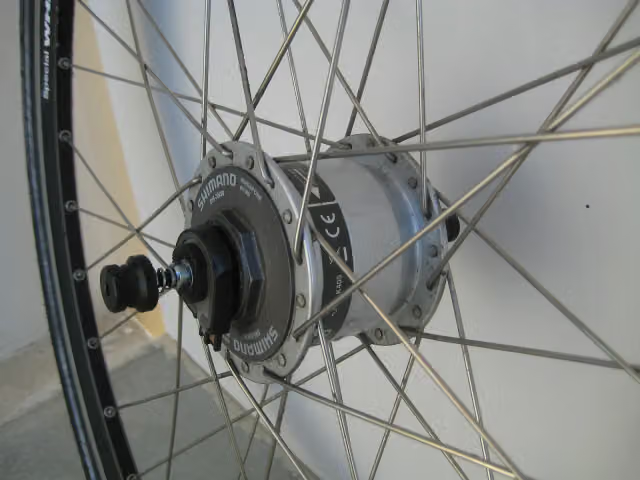
- A dynamo makes power while you ride. Cycling UK says hub dynamos, built into the front wheel, have become more efficient with less drag than the bottle type that runs on the tyre. Dynamo lights are legal even if they go out when you stop, and many modern ones have a standlight that stays on for a while.
- Rechargeable or battery bike lights clip on and off. They are light, you take them with you when you lock the bike, and you charge them with a USB cable. The catch is that they can run flat.
If you ride every day, fixed dynamo lights are always ready. On a road bike or mountain bike without a dynamo, USB bike lights are the usual choice: a small front light on the bars and a rear light on the seat post. Pick a bracket that clamps firmly, so the light does not turn and point the wrong way on a bumpy road.
Best bike lights for your rides: a choice helper
Where do you ride in the dark?
In town
- A white front light and a red rear light, fixed to the bike
- Steady or flashing, 60 to 240 flashes a minute
- A red rear reflector and amber pedal reflectors
Unlit lanes and roads
- A steady front light, as the Highway Code advises
- A beam aimed down at the road, not into eyes
- A spare light or charged battery
Road bike or mountain bike
- A small USB front light and rear light
- A bracket that stays put on bumps
- A helmet light only as an extra
Daily commuting
- Dynamo lights fixed to the bike
- A rear light not hidden by a pannier
- Reflective ankle bands if your pedals take no reflectors
Every choice has to meet the same rules on the road: white at the front, red at the rear, fixed to the bike, and the right reflectors. We do not recommend brands or shops.
Bike lights in Ireland
In Ireland the rules differ slightly, says Citizens Information, the government's information service. Lights must be on during lighting-up time, from half an hour after sunset until half an hour before sunrise:
- a front light showing white or yellow, visible for a reasonable distance;
- a rear light showing red, fitted at the back of the bike.
A red rear reflector must be on every bike used on a public road, day and night, except on a child's bike ridden in daylight. Flashing front and rear lights are legal, and riding without proper lights can lead to a fixed charge notice from the Gardaí.
From our data
Bike pumps and repair stations for your evening ride
- Public bike pumps
- 647
- in the United Kingdom
- Bike repair stations
- 274
- in the United Kingdom
As of 28 November 2026, from the Outdoor Pitstop database. Repair stations have tools as well as a pump, handy for tightening a light bracket that has worked loose.
Before you ride in the dark: five checks
A short check before an evening ride:
- Switch on the front and rear light and see that both work.
- Aim the front light at the road, not up into the eyes of others.
- Check that the reflectors are clean and whole, at the rear and on the pedals.
- Charge clip-on lights, or put a spare light in your bag.
- Check your tyres. A soft tyre is harder to notice in the dark.
What else to check before a ride is in the guide checking your bike before a ride. If you need air or a tool on the way, the public bike pumps and repair stations are on the map in the app and on our United Kingdom page.
In the app I can see 647 public bike pumps and 274 repair stations with tools in the United Kingdom.