Outdoor Pitstop

Why wear cycling shoes?
Most cycling shoes are made for clipless pedals: a cleat bolted under the sole clicks into a sprung mechanism on the pedal, and you release it by turning your heel outwards.
The main gain, according to the cycle-to-work scheme Cyclescheme, is that your foot cannot slip off the pedal, which helps when you sprint, pedal fast or ride in rain and mud. Shimano adds that a clip-in shoe holds your foot in the same position every ride.
Which shoe you need depends first on the holes under the sole:
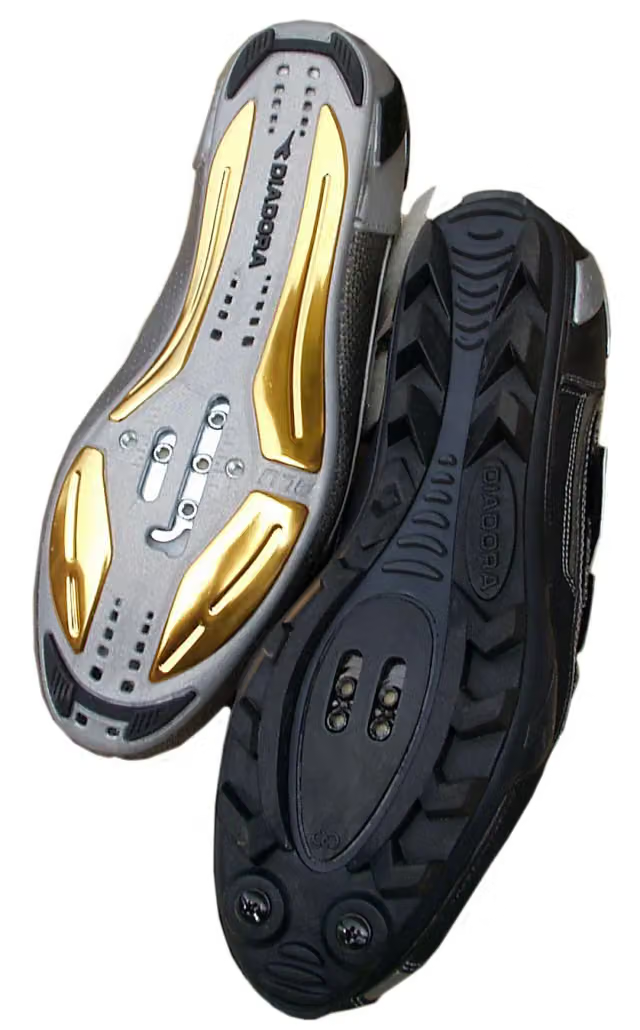
- Three bolts for road pedals, with a large cleat that stands proud of the sole.
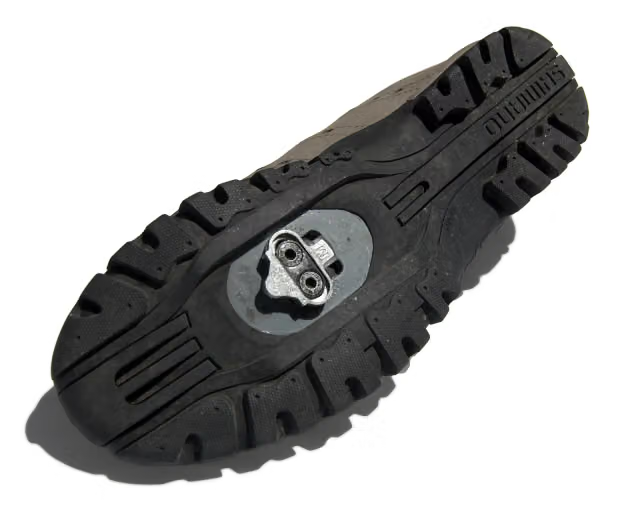
- Two bolts for mountain bike, gravel, touring, commuting and indoor pedals, with a small cleat set into a recess.
- No holes for flat pedals.
Some shoes take both patterns. Cyclescheme notes that cleats only fit their own make of pedal. More about the pedals themselves is in our guide to pedals and clipless pedals.
- Three-bolt cleat
- road, stands proud
- Two-bolt cleat
- MTB, gravel, touring, recessed
- Flat sole
- no cleat, flat pedals
- Overshoe
- against wind, cold and rain
Road bike shoes: three bolts and a stiff sole
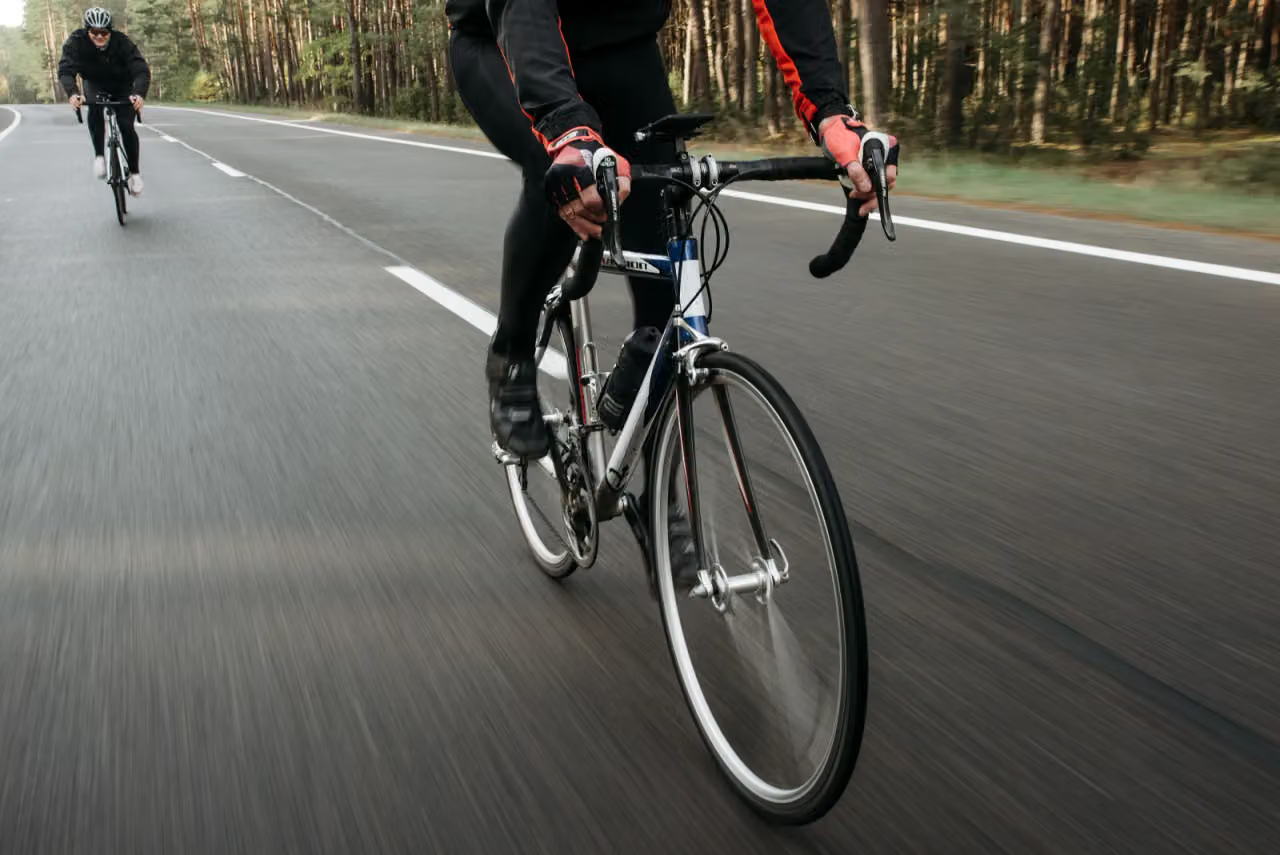
Road bike shoes are built for long spells of seated pedalling with little walking. Shimano describes its three-bolt road system as having a larger cleat and a broad contact area with the pedal, which gives a stable platform under the foot. Cycling UK says that broad contact area is more comfortable on the feet on long rides, and that this kind of shoe suits racing, sportives and club runs.
The drawback is the cleat. It sticks out under the sole, so you walk on it. Cyclescheme calls road shoes difficult to walk in and dangerously slippery on hard surfaces such as tiles or stairs. Road pedals also have less float, the small sideways movement of a clipped-in foot.
SPD shoes for gravel, touring and commuting
SPD is Shimano's name for its two-bolt system, and many other makers build pedals that take the same cleat, so "SPD shoes" has become shorthand for two-bolt shoes in general. The cleat is small and sits in a recess, so the rubber sole touches the ground when you walk.
That makes two-bolt shoes the usual choice for:
- gravel bike shoes and touring, where you walk into a café, a shop or a museum;
- commuting, where you stop at lights and walk into work;
- indoor cycling, where many studio bikes take two-bolt cleats; Shimano advises checking which system your studio uses before you buy.
Cycling UK calls recessed cleats a good starting point and better for beginners: they are easier to walk in. Cyclescheme adds that metal two-bolt cleats wear much more slowly. Two-bolt pedals fit a road bike too, which suits riders who stop a lot.
Mountain bike shoes: clipless or flat
Clipless mountain bike shoes use the same two-bolt cleat, set into a sole with tread or lugs. Shimano says that tread lets you walk, run, push the bike or move over technical ground. Cycling UK suggests double-sided two-bolt pedals for mountain bikers.
Not all MTB shoes are alike. Shimano points out that a stiff cross-country race shoe and a flexible touring shoe can both use the same cleat and still feel very different off the bike.
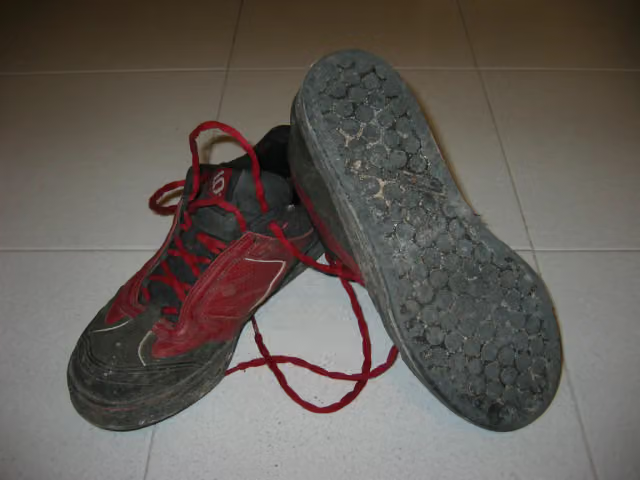
Flat mountain bike shoes have no cleat at all. They are for riders who want to put a foot down quickly or move it around on the pedal. Cyclescheme notes that on flat pedals you can place your feet as you like and change position as you ride, and that flat pedals with metal pins, made for mountain biking, grip most rubber or synthetic soles well.
The soles side by side
Which cycling shoes suit you?
How do you ride most?
Road bike
- Stiff sole and a large cleat
- Broad, stable contact with the pedal
- Hard to walk in; not for frequent stops
MTB and gravel
- Small cleat set into the sole
- Tread for walking and pushing
- Stiffer for racing, softer for trails
Touring and commuting
- Walk like an ordinary shoe
- A slightly more flexible sole
- Also fit many indoor bikes
Flat pedals
- Flat, grippy rubber sole
- Grip on pedals with metal pins
- A foot on the ground in a moment
Unsure between two and three bolts? Cycling UK calls recessed two-bolt cleats better for beginners: you can walk in them, and two-bolt pedals fit a road bike too.
Cycling shoes for men and women
Cycling shoes for men and cycling shoes for women differ less than the labels suggest. Shimano describes its women's fit as a lower-volume shape for slimmer feet, next to a standard fit and a wide fit with more room around the ball of the foot, and it says plainly that these categories are about foot shape and volume, not about gender.
So choose by your foot, not the label: broad feet may need a wide fit, narrow, low-volume feet a women's fit, whoever wears them.
How should cycling shoes fit?
A cycling shoe should be snug but not tight. Shimano's fitting advice: the heel held with little movement, the midfoot supported without being squeezed, room for the ball of the foot and toes that are not pushed against the front. Pinching or pressing toes mean the shoe is too small or the wrong shape.
Sizes vary by brand and model, so treat your everyday size as a starting point. This is how to try them:
- Try them later in the day, when your feet have swollen a little, as they also do on a long ride.
- Wear the socks you ride in.
- Close the shoe without overtightening it. Shimano notes that a dial can fine-tune a shoe of the right size but cannot fix one that is too short or too narrow.
- Between sizes, do not simply go bigger. If the length is right but the forefoot pinches, a wide version solves that better than a longer shoe.
Cycling UK advises trying several pairs, starting with the cleat below the ball of the foot, and notes that cleats can change your saddle height. If your knees or feet ache, see our guide to bike fitting.
Cycling overshoes and winter bike shoes
Most cycling shoes are made for mild weather. Cyclescheme notes that feet get colder on a bike than on foot: they hardly move, and wind chill is worse at cycling speed.
Cycling overshoes (also sold as shoe covers) go over your shoes, with openings underneath for the cleat. Most are made of neoprene, which Cyclescheme says keeps insulating even when wet. For cool rather than cold days, toe covers keep your toes warm. Thin Lycra shoe covers are made for aerodynamics in races, not for weather.
Winter bike shoes or cycling boots come up over the ankle and are usually insulated and waterproof or water-resistant. Cyclescheme says they are warmer through the sole, more common for two-bolt cleats, and that half a size or a size bigger leaves room for thicker socks. Try them with those socks on. More on cold-weather kit is in cycling clothing for winter.
How to learn to clip in and out
Cycling UK says most riders get the hang of clipless pedals within hours or days, but also that most take a tumble or two while learning. Practise before you ride in traffic:
- Loosen the spring tension of the pedals as far as it goes, so your foot comes free easily.
- Lean against a wall, or use a turbo trainer, and practise: push the cleat into the pedal until it clicks, then turn your heel quickly outwards to release.
- Ride a few circuits on soft grass before you go out on tarmac.
- Unclip as you prepare to stop, not once you have stopped. Most falls happen because riders think of unclipping only when they are standing still.
- In the UK, unclip your left foot first, so that if you slip you fall away from the traffic.
Some pedals have multi-direction release, so you can also pull your foot up to unclip.
From our data
Bike pumps, water and toilets in the United Kingdom
- Public bike pumps
- 647
- in the United Kingdom
- Bike repair stations
- 274
- in the United Kingdom
- Water points
- 2,923
- in the United Kingdom
- Public toilets
- 13,915
- in the United Kingdom
As of 28 November 2026, from the Outdoor Pitstop database. The whole United Kingdom. Repair stations are bike pumps with tools.
Stopping in road shoes: a pump, tap or toilet on the way
In road shoes you do not want to walk far. When a tyre is soft, a public bike pump right by the road is handier than a bike shop down the street, as is a water tap or a public toilet.
The pitstops we know of are on our page for the United Kingdom, with the water fountains and refill points and the public toilets on their own pages. Riding in Ireland? See the public toilets in Ireland.
In our data I can see 647 public bike pumps and 274 repair stations in the United Kingdom. In the app they show up along the way, so I know where to stop without a long walk in cleats.