Outdoor Pitstop

Mountain bike kit: what you need, and when
Start with the first group and add the rest when you miss it.
MTB helmet: coverage, visor and the safety mark
A road or cross-country helmet will do, says Cycling UK, but helmets for trail and enduro riding come further down the back of the head. Off-road you can fall in any direction, so more coverage helps, and the visor that MTB helmets often have keeps the sun out of your eyes.
- A safety mark. British Cycling advises a helmet that has passed the European (CE) standard or the US Snell B90/B95 standard, shown on a sticker or in the shell.
- Fit before looks. All helmets meet the same basic standard, so British Cycling says comfort, fit and ventilation decide. Try several.
- Downhill. Most downhill tracks make a full-face helmet compulsory, with pads and sometimes body armour.
When to replace it. The foam is meant to crush once. Replace a helmet after a significant crash, even with little visible damage; without a crash, British Cycling gives three to five years. Cycling UK treats wearing a helmet as a personal choice.
- Safety mark
- CE (European) or Snell B90/B95
- Downhill tracks
- full-face helmet usually compulsory
- Replace
- after a crash, or every 3 to 5 years
How to fit an MTB helmet: the steps
British Cycling's fit check, each time you put the helmet on:
- Loosen the dial or ratchet at the back.
- Set the height: the front edge about two finger widths above your eyebrows, level.
- Tighten the cradle until it is snug; bend towards your toes and the helmet should stay put.
- Adjust the side straps so the sliders sit just below your ear lobes.
- Close the chin strap with room for two fingers.
- Readjust when you wear a cap or hat underneath.
MTB shoes: flat or clipless
The shoe follows the pedal. Flat pedals are a platform for any shoe, though Cycling UK notes that shoes made for flats grip much better than trainers. Clipless pedals work like a ski binding, British Cycling explains: a cleat under the shoe clips into the pedal, so your foot stays in contact.
Cycling UK's advice is to stay with what you feel confident on. For clipless riding on rough trails it suggests a wide, flat sole and a pedal with a larger platform, steadier when you stand on descents. In winter, waterproof or thick merino socks help. More in the guide to cycling shoes.
Mountain bike clothing: Lycra or baggies
Lycra works and is airy in summer, but Cycling UK points out it protects little against trees, thorns and mud. Most trail riders therefore wear knee-length baggy shorts and a loose top, with room for knee pads underneath.
British Cycling calls good padded shorts the most important piece of kit, alone or as a liner inside baggy shorts. Wrinkles mean they are a size too big, bib shorts hold the pad in place, and chamois cream lowers the chance of saddle sores. In winter it suggests leg warmers, or unpadded tights over bib shorts.
Men's and women's MTB clothing. Cycling UK says: wear what you feel comfortable in. Women's kit is often cut for curves and in smaller sizes, and women's shoes are narrower; helmets hardly differ. See also cycling clothing.
MTB knee pads: slim or with impact protection
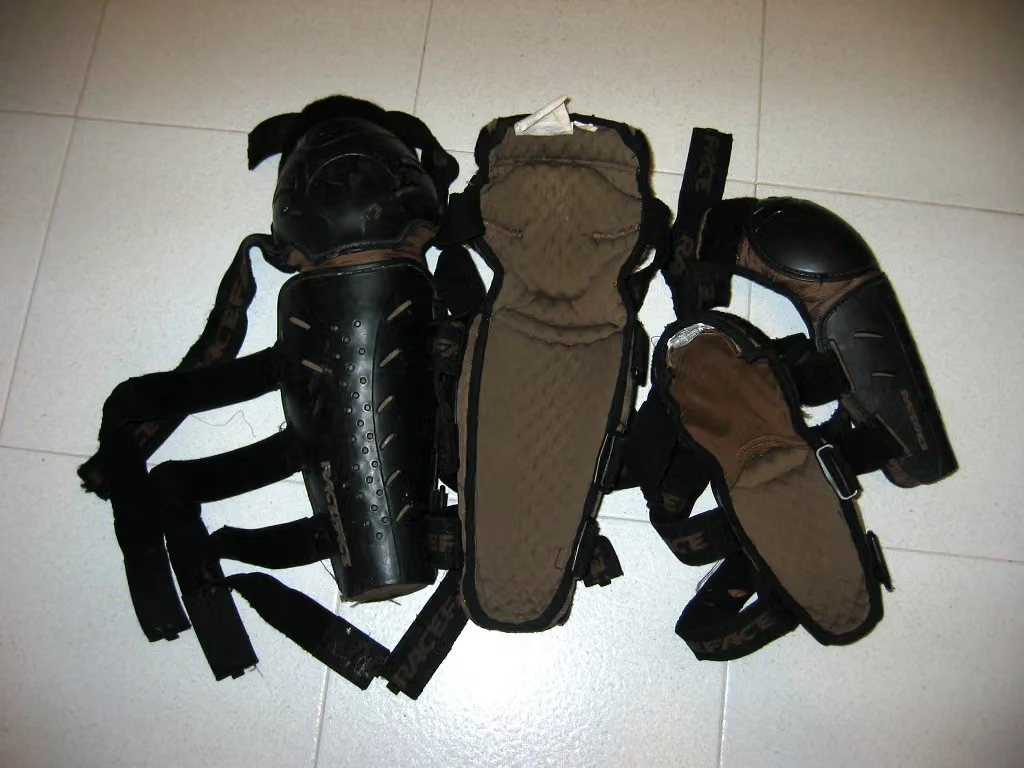
Cycling UK describes two kinds of MTB knee pads:
| Kind | Protects | Downside |
|---|---|---|
| Slim, thin foam | skin against scrapes | no impact protection |
| Shock-absorbing | against impacts | bulkier and warmer |
Knee pads are often mandatory in enduro races. Body armour is usually more than you need outside a bike park or technical trail centre, Cycling UK adds. Forestry England grades green trails for beginners and blue for basic off-road skills; red trails bring large rocks, drop-offs and water crossings, and black trails are for experts. Wear the safety clothing that fits the riding, it says. For youth MTB knee pads as for adults: pads should fit properly and be comfortable.
- Slim pads
- skin protection only
- Bike parks, downhill
- pads, sometimes body armour
- Enduro races
- knee pads often mandatory
MTB jersey, gloves and glasses
An MTB jersey is usually looser than a road jersey and dries quickly. British Cycling's first layer (base layer, short-sleeved jersey, gilet) covers roughly 13 to 30 °C. A long-sleeve MTB jersey puts a layer between you and the brambles.
- Gloves. Padded gloves stop sweaty hands slipping; Cycling UK says your commuting gloves will do. See cycling gloves.
- Glasses. Trails run from sun into dark woods, so Cycling UK calls clear lenses the best all-year choice.
MTB jacket: wet and winter rides
On a mountain bike you warm up fast, so Cycling UK suggests a breathable waterproof jacket, stretchy if you can, and waterproof shorts. For the depths of winter Cycling UK adds a mid-layer, such as a winter jersey, and trousers; British Cycling's deep-winter layer adds a windproof softshell, a hat, winter gloves and overshoes. Carry what you take off in a backpack or hip pack. More in winter cycling clothing.
Which mountain bike kit suits your ride?
What kind of riding do you do?
My first rides
- Your own firm-soled trainers are fine on flat pedals
- A sports top that dries quickly
Red and black trails, enduro
- A helmet that covers more of the back of the head
- Knee pads that do not slip
Bike parks and downhill
- A full-face helmet, usually compulsory
- Knee and elbow pads
Winter riding
- Trousers or leg warmers and a mid-layer
- Winter gloves, a hat and overshoes
Cycling UK's riders give one test for every piece of protective kit: it should fit properly and be comfortable enough that you almost forget you are wearing it.
From our data
Water, public toilets and bike pumps in the United Kingdom
- Water points
- 2,923
- in the United Kingdom
- Public toilets
- 13,915
- in the United Kingdom
- Public bike pumps
- 647
- in the United Kingdom
As of 28 November 2026, from the Outdoor Pitstop database. The whole United Kingdom, from OpenStreetMap and reports by our users.
MTB accessories: water, spares and a stop on the way
Cycling UK says mountain bikers should be self-sufficient: food, drink, a spare inner tube, tyre levers, a pump and a small multi-tool, because punctures are more common off-road.
Fill your bottle at the start: see the water fountains in the United Kingdom, the public toilets in the United Kingdom and the public toilets in Ireland. Mountain bike routes for the UK and Ireland are not in the app yet.
In the app I see 2,923 water points, 13,915 public toilets and 647 public bike pumps in the United Kingdom: places to top up before or after a ride.