Outdoor Pitstop
Short answer
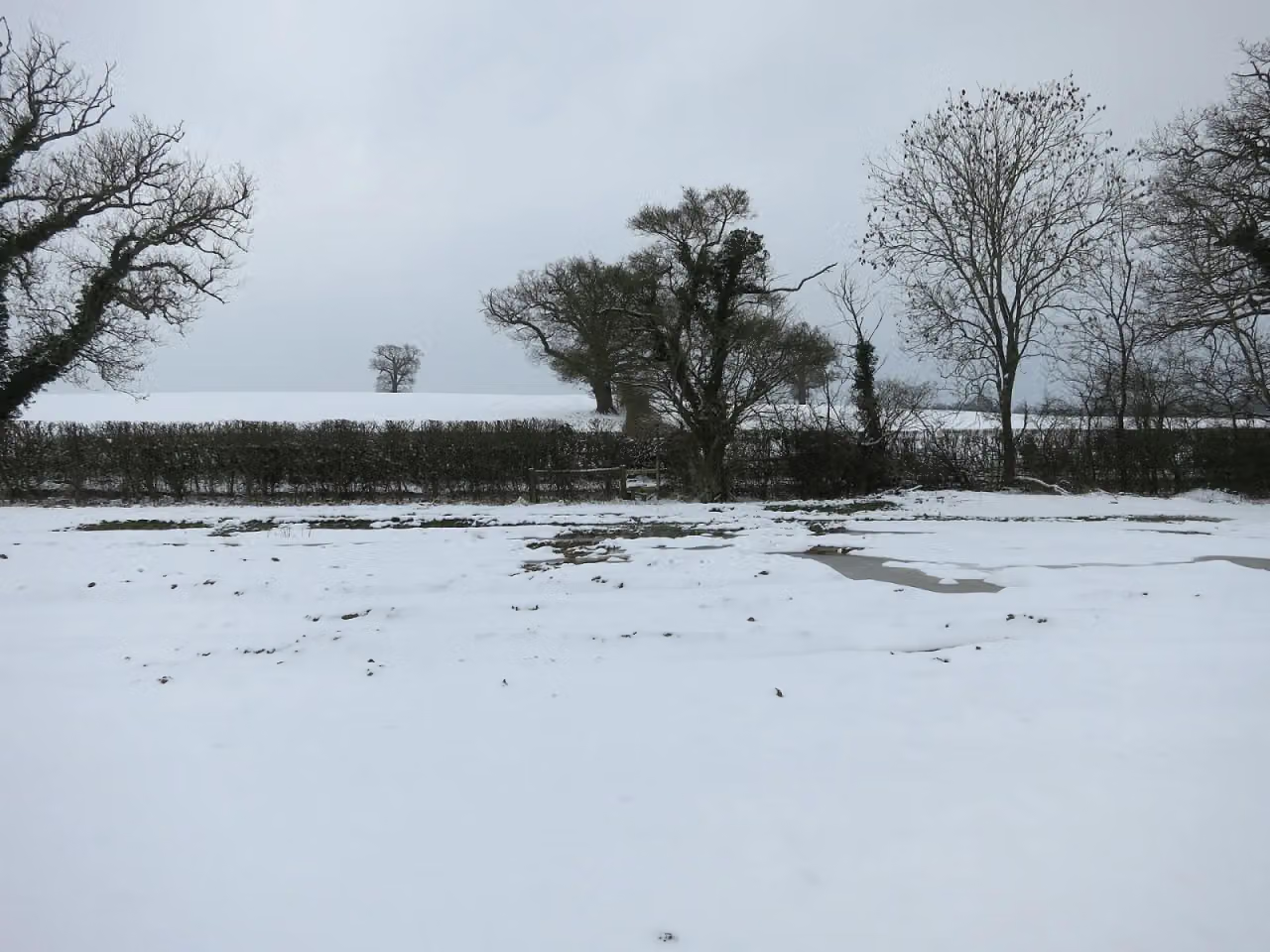
Walking on ice safely comes down to three things: take short, flat steps with your weight over your front foot, keep both hands free for balance, and wear something that grips. On packed ice and frost-covered paths, a pair of slip-on ice grips or microspikes makes a bigger difference than any technique. Where the ice is thick and steep, such as on winter hills, those are not enough and you need crampons and the skills to use them.
How to walk on ice: the basic technique
The advice you hear most often is to "walk like a penguin", and it works because of physics. A long stride puts your heel down at an angle in front of your body, and that is the moment your foot slides away. The penguin walk keeps your feet under you.
- Short steps. Take steps about half your normal length.
- Flat feet. Put your whole sole down at once instead of landing on your heel.
- Weight forward. Keep your body over your front foot and bend your knees slightly.
- Feet slightly apart and turned out. A wider base is more stable.
- Hands free and out of your pockets. You need your arms for balance, and to break a fall.
- Slow down. Rushing for a bus or a train is when most people slip.
Look ahead, not at your feet. Shiny patches, shaded corners, the edges of puddles, drain covers, steps and the bottom of slopes are where ice lasts longest. Walking on fresh snow or the grass verge next to an icy path often gives more grip than the path itself, as long as you can see what is underneath.
Black ice: the ice you cannot see
Black ice is a thin, clear layer of ice through which you see the dark surface underneath, so a path looks wet rather than frozen. It forms when rain, drizzle or melting snow freezes on a cold surface, often early in the morning and after a clear night. The Met Office issues yellow weather warnings for ice in the UK when it expects icy surfaces to cause problems, which is a good moment to rethink your route.
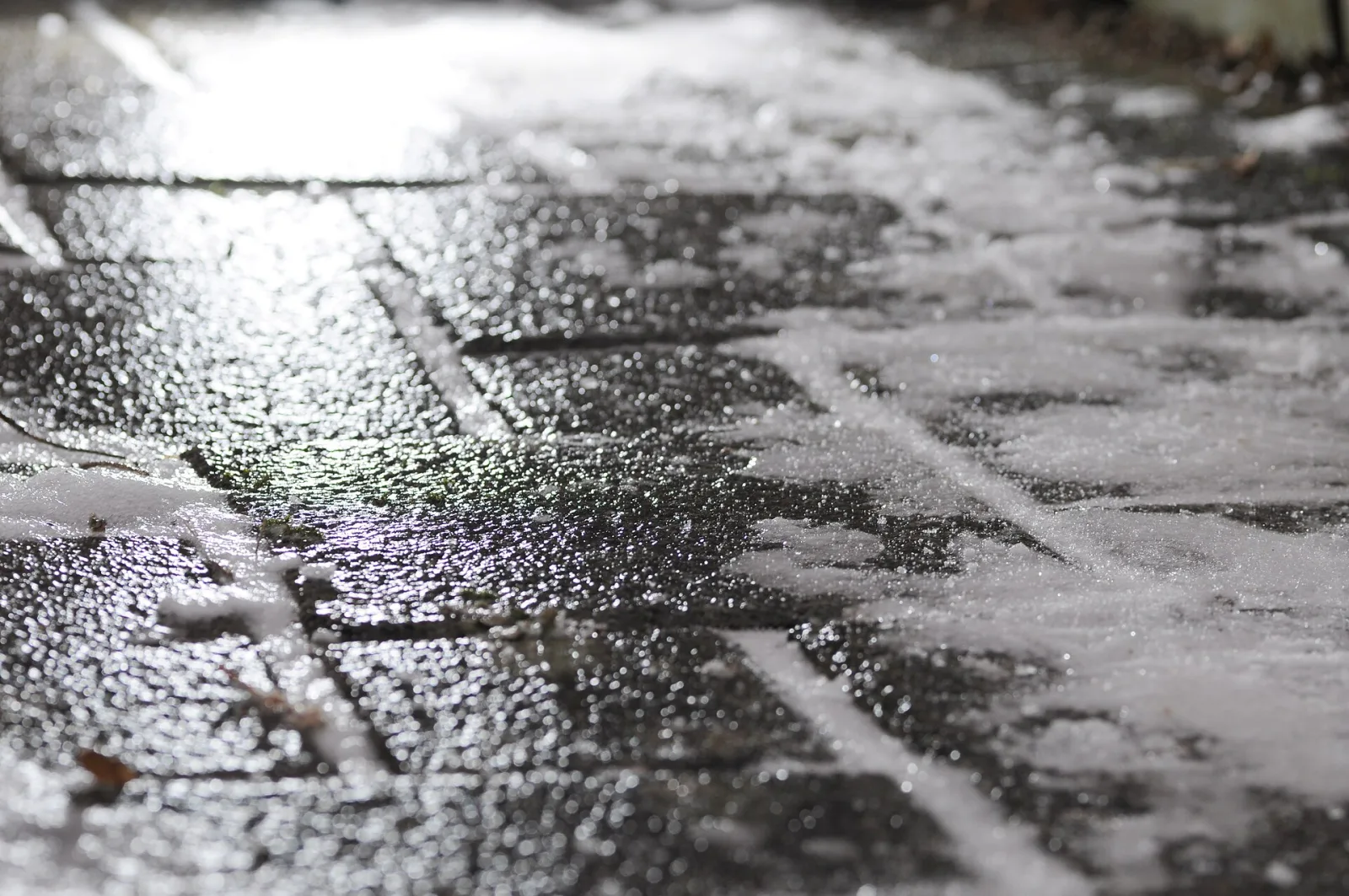
Photo: Simon A. Eugster, CC BY-SA 3.0, via Wikimedia Commons
If a dark path looks wet on a frosty morning, treat it as ice. Tap it with your foot before you trust it, and take the penguin steps described above.
Ice grips, microspikes or crampons?
"Ice grips" is a broad name for anything you pull over your boots to get traction on ice. They come in roughly three types, and choosing the wrong one is the most common mistake.
| Type | What it is | Good for | Not good for |
|---|---|---|---|
| Ice grips (coils or studs) | A rubber frame with steel coils or small studs | Icy pavements, park paths, flat country paths | Steep slopes, deep snow |
| Microspikes | A rubber harness with short chains and spikes of about 1 cm | Icy footpaths, forest tracks, gentle hills with packed snow | Steep, hard snow and ice on mountains |
| Crampons | A rigid steel frame with long points, fitted to stiff boots | Winter mountains with hard snow and ice, with an ice axe | Pavements, indoor floors and rocks without snow |
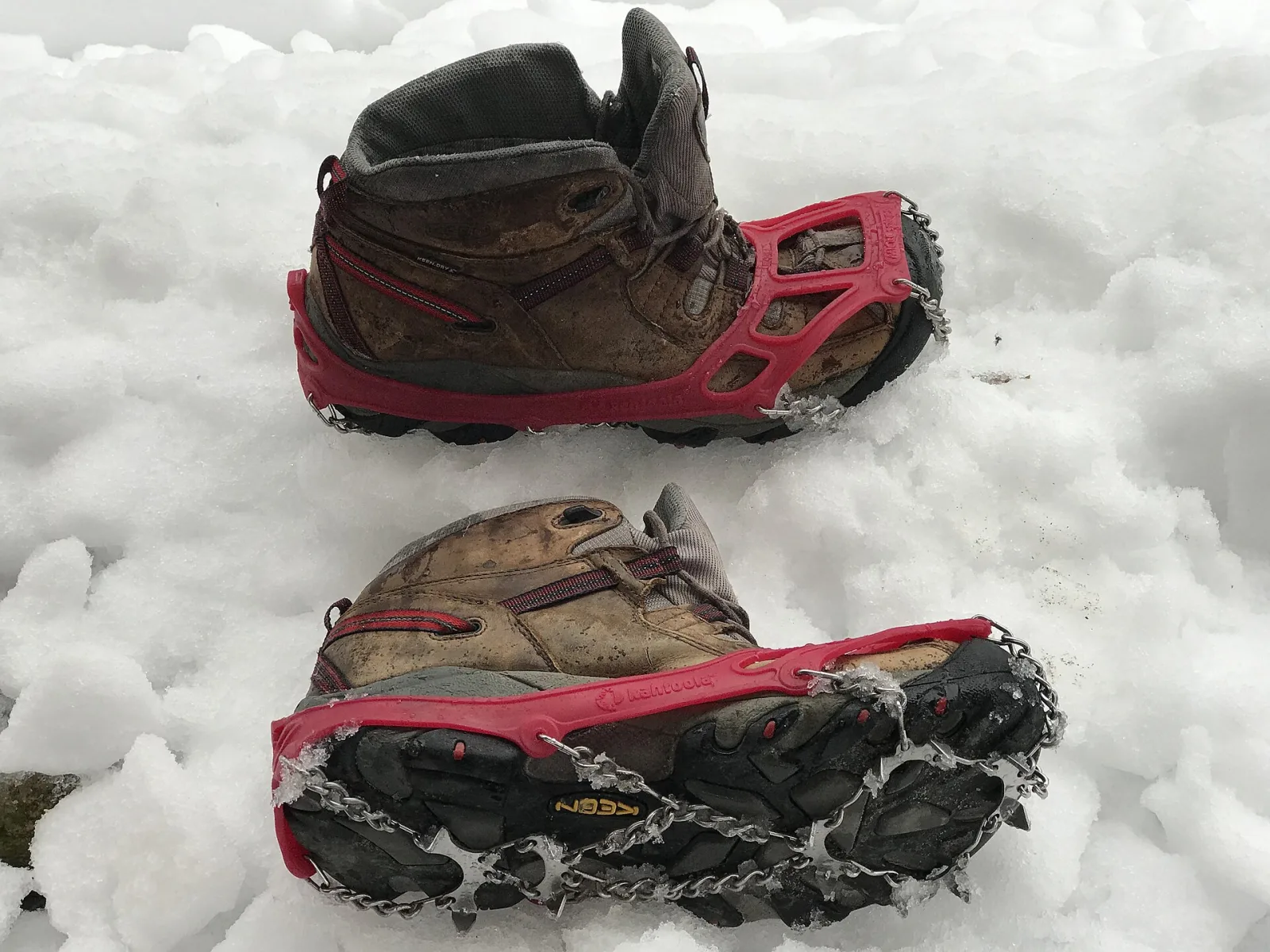
Photo: HopsonRoad, CC BY-SA 4.0, via Wikimedia Commons
A few practical points apply to all of them:
- Take them off on hard floors, in shops and on smooth stone; the steel slides there.
- Check the size against your boot, not your shoe size alone.
- Carry them in a small bag, so they do not tear the rest of your kit.
- On winter mountains in the UK, mountain rescue teams and guides advise crampons and an ice axe plus training, not microspikes. Read our guide on mountain rescue in the UK before a winter hill day.
Plan a winter walk with pitstops
Ice makes every walk slower and more tiring, and daylight in December lasts barely eight hours in the south of England and less in Scotland. Plan a shorter route, start early and know where you can stop.
According to Outdoor Pitstop's data (as of 25 November 2026), these are the public facilities on our map in the UK and Ireland, mainly from OpenStreetMap and additions by our users:
| Country | Public toilets | Benches | Drinking water points |
|---|---|---|---|
| United Kingdom | 13,915 | 188,102 | 2,923 |
| Ireland | 1,465 | 13,034 | 374 |
A bench is where you sit down to pull on your ice grips or take them off when the path clears. A toilet is worth knowing about in winter, because you drink less when it is cold and then still need one. Find them along your route on the map of 13,915 public toilets in the United Kingdom or the 1,465 public toilets in Ireland.


Some outdoor water taps and park toilets are switched off or locked in winter. If you depend on one, check the photos and comments in the app or take enough water with you.
Walking with a dog on frozen paths? Read our tips on walking your dog in snow. For more ideas on where and when to walk this season, see our page on winter walks and when winter starts.
What to wear for walking on ice
Your shoes matter more than your coat. Soles with deep, soft rubber lugs grip better on cold surfaces than hard, smooth soles. Walking boots with a good tread are a solid base for ice grips; our guide to walking boots: choosing and fitting them explains what to look for.
Further tips:
- Wear gloves, so you keep your hands out of your pockets.
- Walking poles with a metal tip give an extra point of contact on icy tracks.
- Carry a small rucksack instead of shopping bags, so your hands stay free.
- In the dark, a head torch shows shiny patches much better than a phone light.
On the map
Benches and public toilets in United Kingdom and Ireland (216,516)
Take Outdoor Pitstop along on your phone
Free · 3.4 million pitstops in 44 countries