Outdoor Pitstop

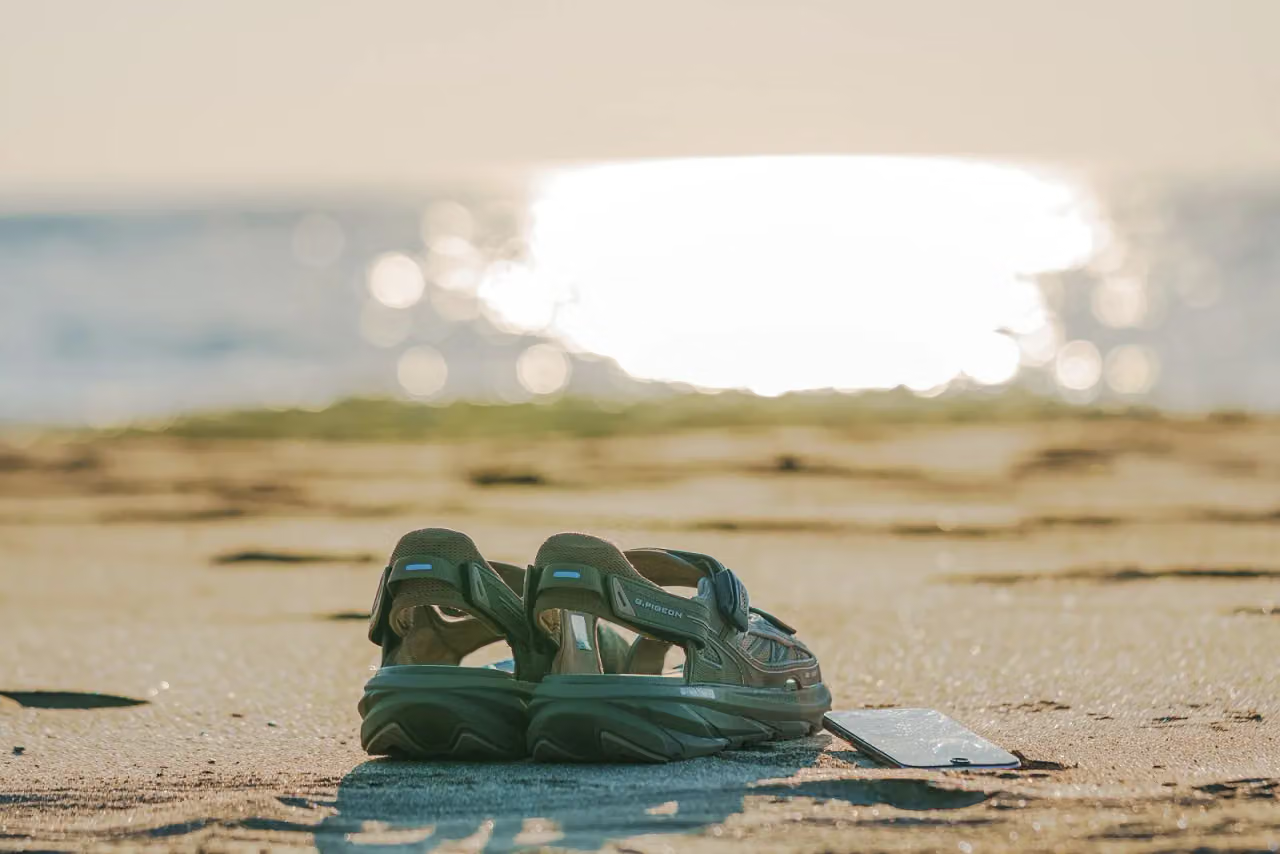
Hiking sandals: which paths suit them?
A walking sandal, or hiking sandal, is a sandal with a grippy tread, a shaped footbed and straps that hold your foot in place. It sits somewhere between a flip-flop and a low walking shoe, and it is at its best on:
- firm, even paths: woodland tracks, canal towpaths, sea walls, cycle paths and town walks;
- walks by the water, where you splash through a puddle, a stream or the edge of the sea;
- warm, dry days, when your feet overheat in a closed shoe. In the Ramblers' footwear guide, the gear testers note that footwear with plenty of airflow is a simple way to keep feet cool on warm, dry walks.
Sand and dry gravel are possible, but grit gets under your foot and you will stop now and then to shake it out.
Where hiking sandals stop working: on loose stones, steep descents and mountain paths. An open sandal leaves your ankle without support and your toes bare to rocks. For those paths you need a walking boot or shoe with a firm sole; how to choose one is in walking boots and walking shoes.
- Good
- Woodland track, towpath, town, beach
- Possible
- Sandy path, dry gravel
- Better not
- Loose stones, steep descents
- No
- Mountain paths, snow
How far can you walk in walking sandals?
There is no fixed limit. In a well-fitting walking sandal with a firm sole, a full day on flat paths is possible. How far it goes for you depends on three things:
- The fit. If your foot slides, the straps rub. The NHS says blisters are mostly caused by friction, and the Ramblers' testers call a lifting heel a classic cause of blisters.
- The surface. On tarmac you miss the cushioning of a shoe; on a soft woodland path you notice little difference.
- Whether your feet are used to it. The NHS advises wearing new shoes for short periods until they are comfortable, and the same goes for sandals.
Start with short walks and build up. If a strap starts to press after a few hours, take a break or change into your shoes.
Comfortable walking sandals: what to look for
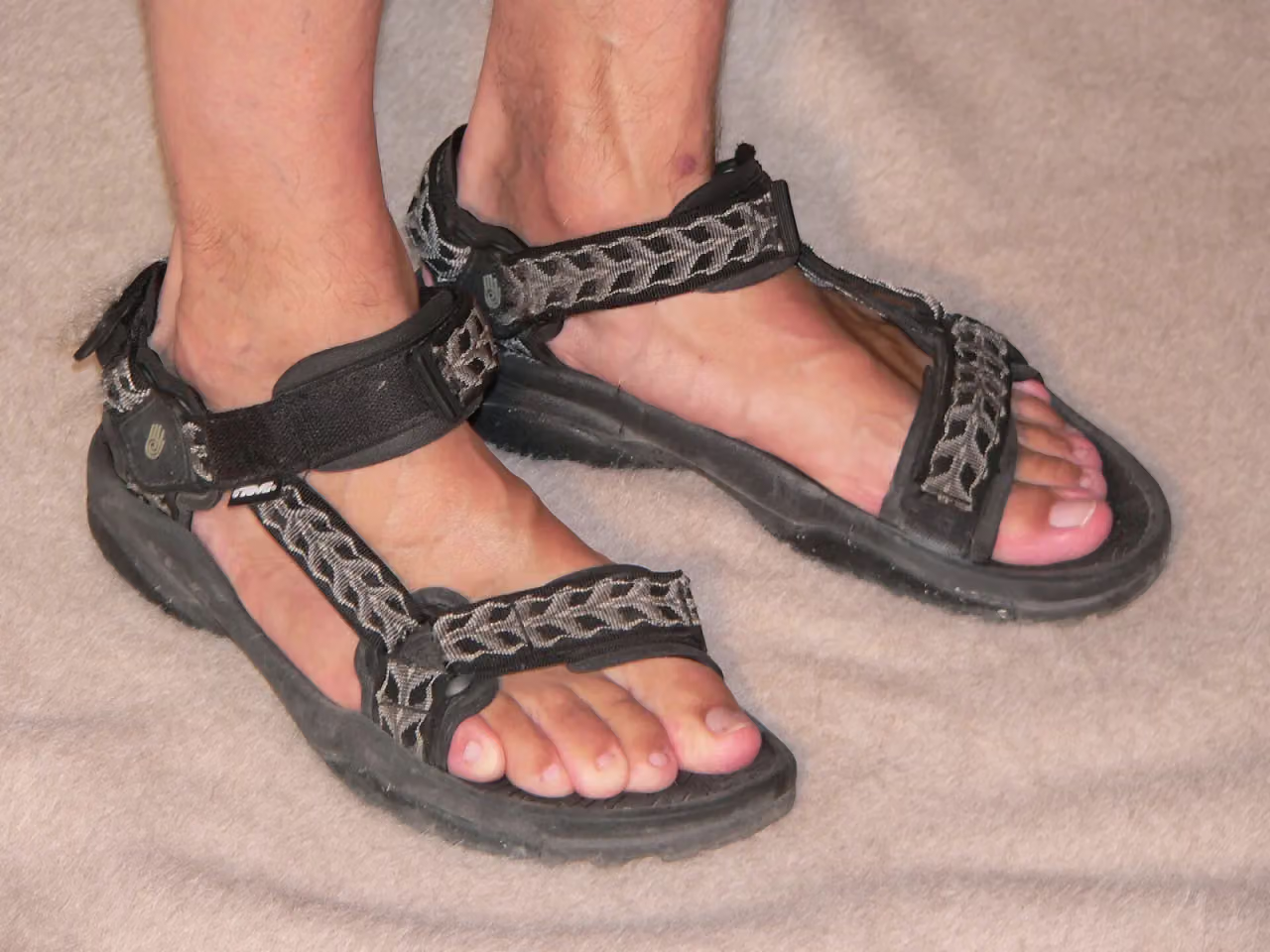
A comfortable walking sandal for longer distances has a few things in common:
- Adjustable straps. Ideally three: over the forefoot, over the instep and behind the heel. Guy's and St Thomas' NHS podiatry team says a shoe should hold on to you, not the other way round; without a fastening your foot muscles have to grip, which can cause pain at the front of the foot.
- A shaped footbed with arch support. A flat footbed is fine for a short stroll, but over a long distance you miss support under the arch and heel. The Ramblers' testers note that heel pain and plantar fasciitis often benefit from supportive, cushioned footwear.
- A thick, cushioned sole with a deep tread. The podiatry team recommends thicker, padded soles for shock absorption on hard surfaces. Deep grooves grip on woodland paths and wet grass.
- A firm heel strap. Your heel should stay in the middle of the sandal, even on a sloping path.
- A low, wide heel. Guy's and St Thomas' advises heels under 4 cm (1.5 inches) and says a wider heel is more stable. Stylish walking sandals are fine, as long as they pass these checks.
- Quick-drying material if you often walk through water. Leather is soft, but dries slowly.
If a podiatrist has given you insoles, the hospital says the ideal shoe has a removable liner. Many sandals have a fixed footbed, so ask your podiatrist whether a sandal works for you.
How to fit walking sandals: the steps
These steps follow the shoe-shopping advice of Guy's and St Thomas' NHS podiatry team and the Ramblers' gear testers:
- Try sandals on at the end of the day, when feet that tend to swell are at their largest.
- Wear the socks you plan to walk in, or none if you will walk barefoot.
- Put your heel against the back, then tighten the heel, instep and forefoot straps, firm but not tight.
- Check the length. For shoes the hospital calls about 1 cm between your longest toe and the end ideal; in a sandal, your toes should not reach the front edge.
- Walk around for a few minutes. Your foot should not slide forward and your heel should not lift.
- Do not count on breaking them in. If a sandal does not feel right, the hospital advises not to rely on it improving. Wear new sandals indoors first, so you can still change them.
Walking sandals for women
Walking sandals for women follow the same rules as any walking sandal, but the shape of the foot matters. The Ramblers' gear testers write that women's feet generally taper more, with a wider forefoot and a narrower heel, while men's feet tend to be straighter. Footwear is built on a last, a model of the foot, and female-specific lasts give more room in the toe box compared with the heel.
For walking sandals and hiking sandals for women this means: look for a heel strap that holds a narrow heel without slipping, and a forefoot strap that leaves room for the wider front of the foot. Every manufacturer uses its own last, so the Ramblers advise trying a few different models and taking them for a short walk.
Foot width can also change. According to the same testers, pregnancy, hot weather, arthritis, bunions and long hours on your feet all affect it, which is one more reason to choose sandals with straps you can adjust on the way.
Men's walking sandals
Men's walking sandals are usually cut straighter, to match a foot the Ramblers' testers describe as generally straighter in shape. Still, choose the sandal that fits your foot, whatever the label.
For broad feet, check the toe box. The Ramblers say room for the toes to spread prevents pinching, which can otherwise lead to pain, blisters and corns, and Guy's and St Thomas' adds that narrow or pointed shoes can squash the feet over time. In a hiking sandal for men, the toes should not hang over the sides of the sole, and the straps should not cut into the top of the foot.
Open or closed-toe walking sandals?
Walking sandals come open at the front or with a closed toe.
| Open sandal | Closed toe | |
|---|---|---|
| Airflow | the most | a little less |
| Toes protected | no | yes, from stones and roots |
| Sand and grit | falls out again | can collect in the toe |
| Walking through water | dries quickly | dries quickly |
| Best for | beach, sea wall, town | woodland paths, riverbanks, pebbles |
If you mostly walk along the beach and in town, an open sandal is the most comfortable. If you also walk on woodland paths with tree roots or over pebbles by a river, closed-toe walking sandals protect your toes.
Looking after your feet in walking sandals
In a sandal, your feet are open to sun, sand and rubbing. A few habits help:
- Put sunscreen on your feet. The NHS lists the feet among the areas to cover with at least SPF30, reapplied every 2 hours and straight after you have been in water. In the UK the sun is strongest between 11am and 3pm from March to October.
- Rinse off sand and grit. Grains under a strap rub like sandpaper. A tap, a stream or a bottle of water is enough.
- Deal with a rub straight away. Loosen the strap or cover the spot before a blister forms. If one does form, the NHS says not to burst it, to cover it with a soft plaster or padded dressing, and to stop wearing the footwear that caused it. More in blisters on a walk.
- Adjust the straps during the day. Hot weather makes feet wider, the Ramblers' testers point out, so loosen the straps a little when your feet swell.
After the walk, rinse the sandals in lukewarm water and let them dry out of direct sun.
Choice helper: sandal or shoe?
What kind of walk are you planning?
Town, sea wall and beach
- Airy on warm days
- Dries quickly after water
- Adjustable straps
Woodland paths and riverbanks
- Protects your toes
- Deep tread for grip
- Quick-drying material
Sand, heath and hills
- Keeps sand and grit out
- More support on uneven paths
- Breathable for summer
Mountain paths
- Stiff sole on loose stones
- Toe bumper for protection
- Sandals only for the hut or campsite
Not sure? Wear your walking shoes and carry the sandals in your rucksack, so you can swap when the path or the weather changes.
Sandals as a second pair on a multi-day walk
Even if you walk in boots, light sandals are worth carrying on a walk of several days. After a long day they are pleasant at the campsite, the hostel or the pub, and they let your feet and your boots dry out. Some walkers put on sandals to cross a stream and keep their boots dry; a sandal with straps around the heel and instep stays on far better than a flip-flop.
Choose a light pair that takes up little room in your rucksack. What else to take is in the packing list for a walk.
From our data
Drinking water and public toilets in the United Kingdom
- Water points
- 2,923
- in the United Kingdom
- Public toilets
- 13,915
- in the United Kingdom
As of 29 November 2026, from the Outdoor Pitstop database. The whole United Kingdom: in towns, villages, parks and along paths.
Refilling water on a warm walking day
The warm days when you put on your sandals are also the days you drink more. With a water point on the way you do not need to carry litres, and you can rinse the sand from between the straps.
All the taps and refill points we know of are on water fountains in the United Kingdom, and the toilets on public toilets in the United Kingdom. Walking in Ireland? See the public toilets in Ireland. For coastal walks, read walking on the beach.
In our data the United Kingdom has 2,923 drinking water points. In the app I can see which ones are along my walk, so I know where to refill my bottle.