Outdoor Pitstop

Hiking bag: start with the walk, not the model
The first question is not which rucksack, but what you are going to do. How many days you are out and where you sleep decide the volume, and the volume decides how sturdy the carrying system needs to be. Walking and mountaineering clubs in the UK, the Netherlands and Germany give roughly these sizes:
| Kind of walk | Litres | Who says so | Carrying system |
|---|---|---|---|
| A day on the moors or low hills | about 30 litres | BMC, DAV | shoulder straps, chest strap, often a hip belt |
| A summer day on the Scottish hills | about 35 litres | Mountaineering Scotland | shoulder straps, chest strap and hip belt |
| A winter day on the Scottish hills | about 45 litres | Mountaineering Scotland | padded hip belt |
| A few nights in huts or B&Bs | 30 to 50 litres, 40 is the middle | NKBV | load lifters, chest strap, solid hip belt |
| Five nights or more, indoors | 50 to 70 litres | NKBV | adjustable back, sleeping bag compartment |
| Five nights or more, with a tent | 70 litres and more | NKBV | frame, adjustable back, rain cover |
The Dutch mountaineering club NKBV puts day and weekend packs between 10 and 40 litres, carrying roughly 2 to 12 kg. For a few nights between huts it advises against much more than 15 kg; a fully self-sufficient trek can mean 15 kg to well over 20 kg.
How to pack and how to adjust the straps have their own guides: how to pack a rucksack and fitting and adjusting a rucksack. This page is about the choice itself.
- Day on the hills
- about 30 litres (BMC, DAV)
- Scottish summer day
- about 35 litres
- Scottish winter day
- about 45 litres
- Packed weight
- at most a quarter of your body weight (DAV)
Which hiking backpack suits you?
What kind of walk do you do most?
A few hours near home
- Room for a waterproof, a snack and a bottle of water
- Shoulder straps are enough when there is little in it
- A side pocket for your bottle saves taking the pack off
A full day in the hills
- A hip belt and chest strap keep it steady
- Room for a waterproof jacket and trousers, a warm layer, food, water, map and first aid kit
- Go up to about 45 litres for a winter day in the Scottish hills
Hut to hut or B&B to B&B
- A padded hip belt: you carry it day after day
- The NKBV calls 40 litres the middle of the range
- Try it on with weight inside and your waterproof on
A trek with a tent
- An adjustable back set to your back length
- A separate sleeping bag compartment at the bottom
- A rain cover belongs with it, says the NKBV
Torn between two sizes? Take your own kit to the shop and see what fits. A rucksack that is too big tends to get filled, and then you carry more than you need.
Small hiking backpack: a day pack for a few hours
For a walk of a few hours you hardly notice a small day pack. Simple ones have only two shoulder straps, sometimes with a chest strap, and that works as long as there is little in it. The NKBV notes that day packs for more demanding walks usually add a hip belt, and that a rain cover is often missing on small packs.
Even for a short walk, the AdventureSmart kit list includes a waterproof jacket, a first aid kit, a charged phone in a dry bag, water and snacks. So check that those fit before you choose the smallest size.
On a day pack, look at the small things you use on the way: one or two stretchy side pockets for a bottle, a small pocket for your phone and keys, and loops for walking poles. The more serious day packs also have a sleeve for a hydration bladder; the NKBV says it belongs close to the back panel, where you feel the weight least.
Walking rucksack: the hip belt carries the load
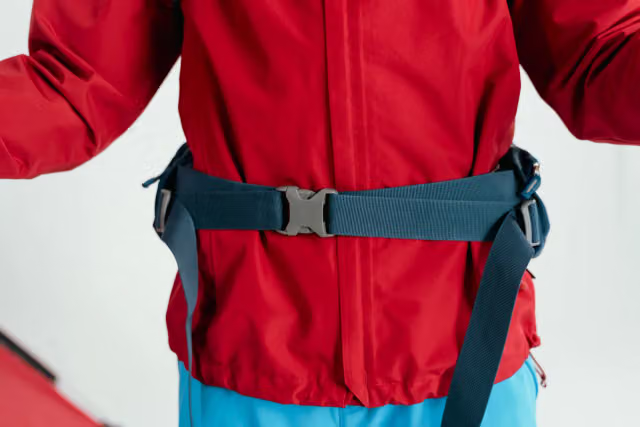
With a bigger walking rucksack the question shifts from space to carrying. The NKBV is clear about it: on a well-adjusted rucksack the hip belt carries most of the load, not the shoulder straps. A good one is wide, with soft but firm padding, and on large packs slightly shaped to the hips. The shoulder straps mainly keep the rucksack steady.
A rucksack for longer walks usually also has:
- Load lifters: short straps from the top of the shoulder straps to the back panel. Tighten them going uphill to pull the pack close; loosen them going downhill so you walk more upright, says the NKBV.
- A chest strap: it links the shoulder straps so they do not slide off, and it is usually adjustable in height. Many have a whistle in the buckle.
- An adjustable back: so the hip belt sits on your hips. Serious makers also produce one model in several sizes.
- A frame: most rucksacks have one inside, of aluminium, carbon or plastic, to give stiffness and spread the load.
- Pockets: a lid with an outer and inner pocket, side pockets for bottles, hip belt pockets for snacks and, on trekking packs, a separate sleeping bag compartment at the bottom.
How to tighten all those straps in the right order is in fitting and adjusting a rucksack.
The parts of a walking rucksack
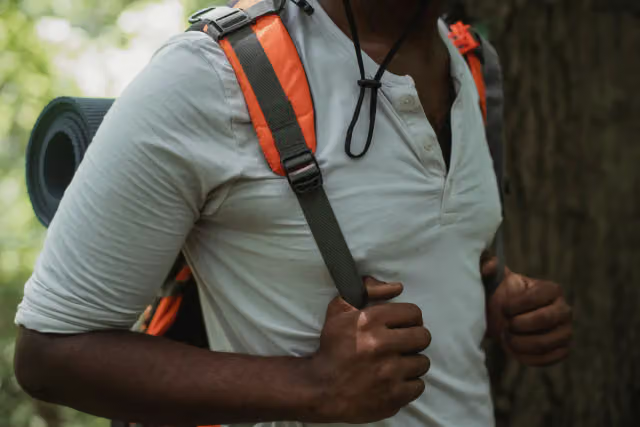
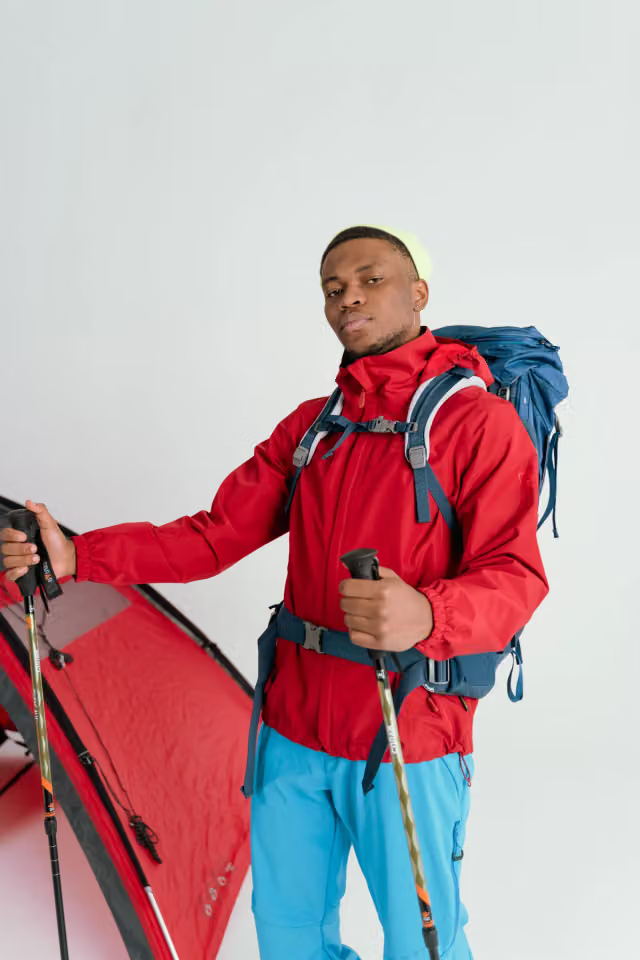
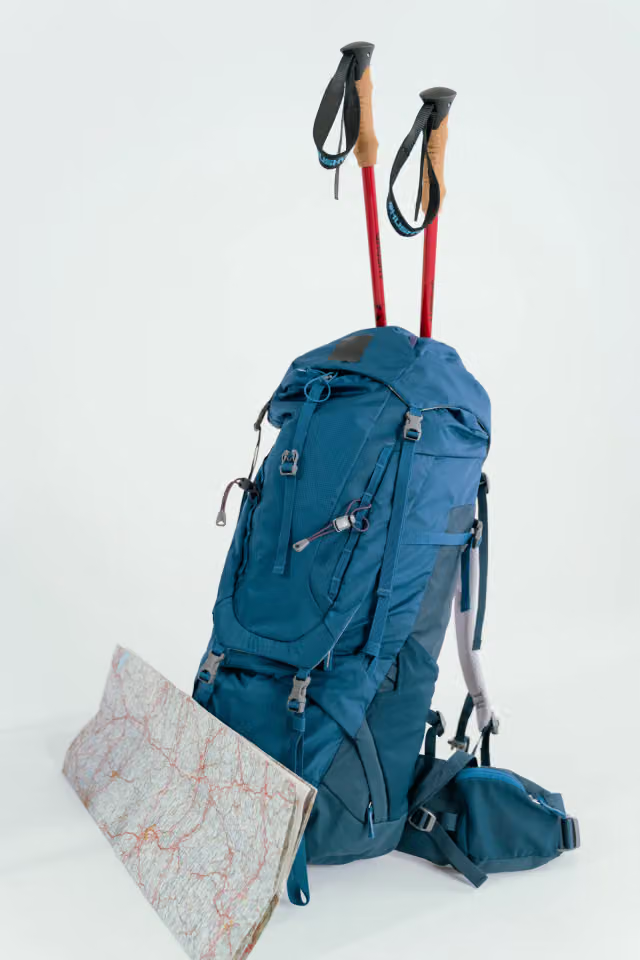
Hiking rucksack, women's or men's?
You do not have to buy a women's model, but it is worth trying one. According to the NKBV, women's and men's rucksacks differ in three places:
- The hip belt, because women's and men's hips have a different shape.
- The shoulder straps: fairly straight on men's models, more S-shaped on women's models so they stay clear of the chest and fit wider shoulders.
- The chest strap: on women's rucksacks the NKBV calls trying it on crucial.
The German Alpine Club (DAV) adds that back length and cut must match your own body, and that versions for smaller people with a short back often hold a few litres less. That is not a problem, it says, because their clothes take up less room too. So pick a rucksack on fit first, then on litres, whichever label it carries. The same goes for hiking backpacks for men: the back length matters more than the name.
Mesh back or a back panel that sits close
There are two kinds of back panel, and each has its own advantage, says the NKBV:
- A mesh back. A tensioned net holds the pack away from your back, so air can pass. Pleasant in warm weather.
- A back panel that sits close. It ventilates less, but the pack moves with you and your balance is better, which helps on awkward mountain paths.
For summer walks in the lowlands a ventilated back is the obvious choice. On rocky ground, scrambles or with a heavy load, stability often counts for more than a dry back.
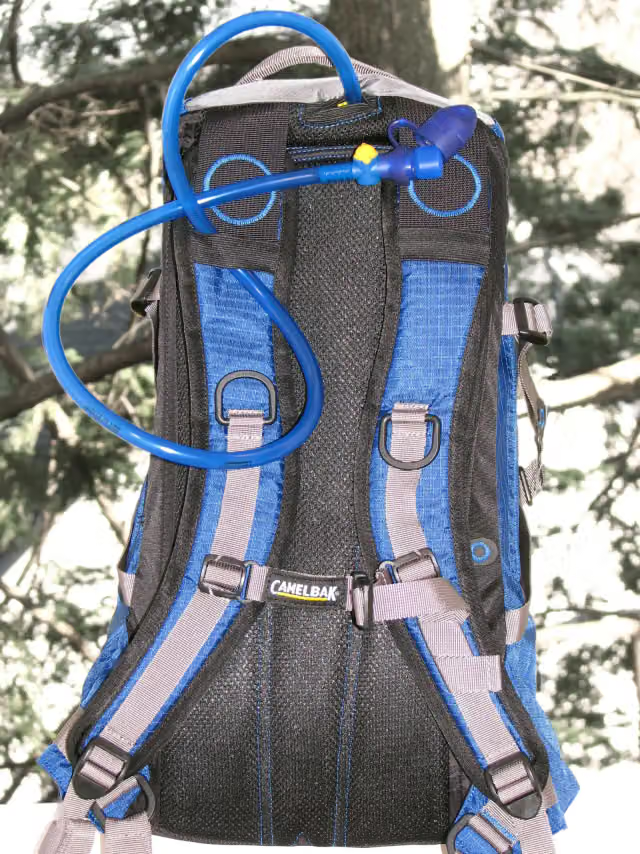
Hiking rucksack, waterproof or with a rain cover?
Most rucksacks are not waterproof, writes the NKBV, though they will stand a decent shower. The DAV explains why: the fabric is usually nylon or the lighter polyester with a polyurethane coating on the inside, which makes it water-repellent, and many makers tape the seams. A few packs use laminates that are waterproof in themselves.
In long rain you need a rain cover. Many rucksacks come with one, and the NKBV says a trekking rucksack should always have one. Inside the pack, the BMC calls a set of dry bags the best way to keep kit dry, and ordinary carrier bags will do the job too. AdventureSmart suggests a ziplock freezer bag as a cheap dry bag for your phone.
Lightweight hiking bag: mind the empty weight
An empty rucksack weighs something too. According to the DAV, a mountain rucksack of 30 litres weighs between 500 and 1,500 grams, depending on fabric and features. A frame, a thick hip belt, padding and a lid make it more comfortable but heavier. On some models you can take the frame, hip belt or padding off; ultralight packs leave the extras out on purpose.
That is fine when your kit is light as well. With more than a few kilos, a thin hip belt without a frame soon starts to press. Choose light when your load is light, and a solid carrying system as soon as you carry more.
The DAV's limit for health and safety: a packed rucksack should not weigh more than a quarter of your body weight.
How to try on a hiking backpack
You choose a hiking backpack on your back, not from a photo. The DAV's checklist for buying one:
- Decide what it is for: a day on the hills, hut to hut or a trek with a tent.
- Try it on loaded, with your own kit or weight from the shop. An empty pack always feels fine.
- Check the back length: the hip belt should sit on your hips.
- Put your waterproof jacket on and check that the straps do not slip on the smooth fabric.
- Try a women's and a men's model, as the NKBV suggests, and compare the hip belt and shoulder straps.
The step-by-step adjustment of the straps is in fitting and adjusting a rucksack.
From our data
Water points and public toilets in the United Kingdom
- Water points
- 2,923
- in the United Kingdom
- Public toilets
- 13,915
- in the United Kingdom
As of 28 November 2026, from the Outdoor Pitstop database. The whole United Kingdom. Water points and public toilets come from OpenStreetMap and from reports by our users.
A smaller rucksack with water on the way
Water is often the heaviest thing in a day pack: a litre weighs a kilo. If you can refill on the way, you can set off with less and everything fits in a smaller rucksack. Check where the taps are before you go, and take enough when there are none on your route.
The public taps we know of are on water fountains and refill points in the United Kingdom, and the toilets on public toilets in the United Kingdom. Walking in Ireland? See the public toilets in Ireland. Prefer drinking from a tube to a bottle? Read the guide to hydration bladders.
In the app I see 2,923 water points and 13,915 public toilets in the United Kingdom. With a tap halfway along a walk, a half-full bottle and a smaller rucksack can be enough.