Outdoor Pitstop

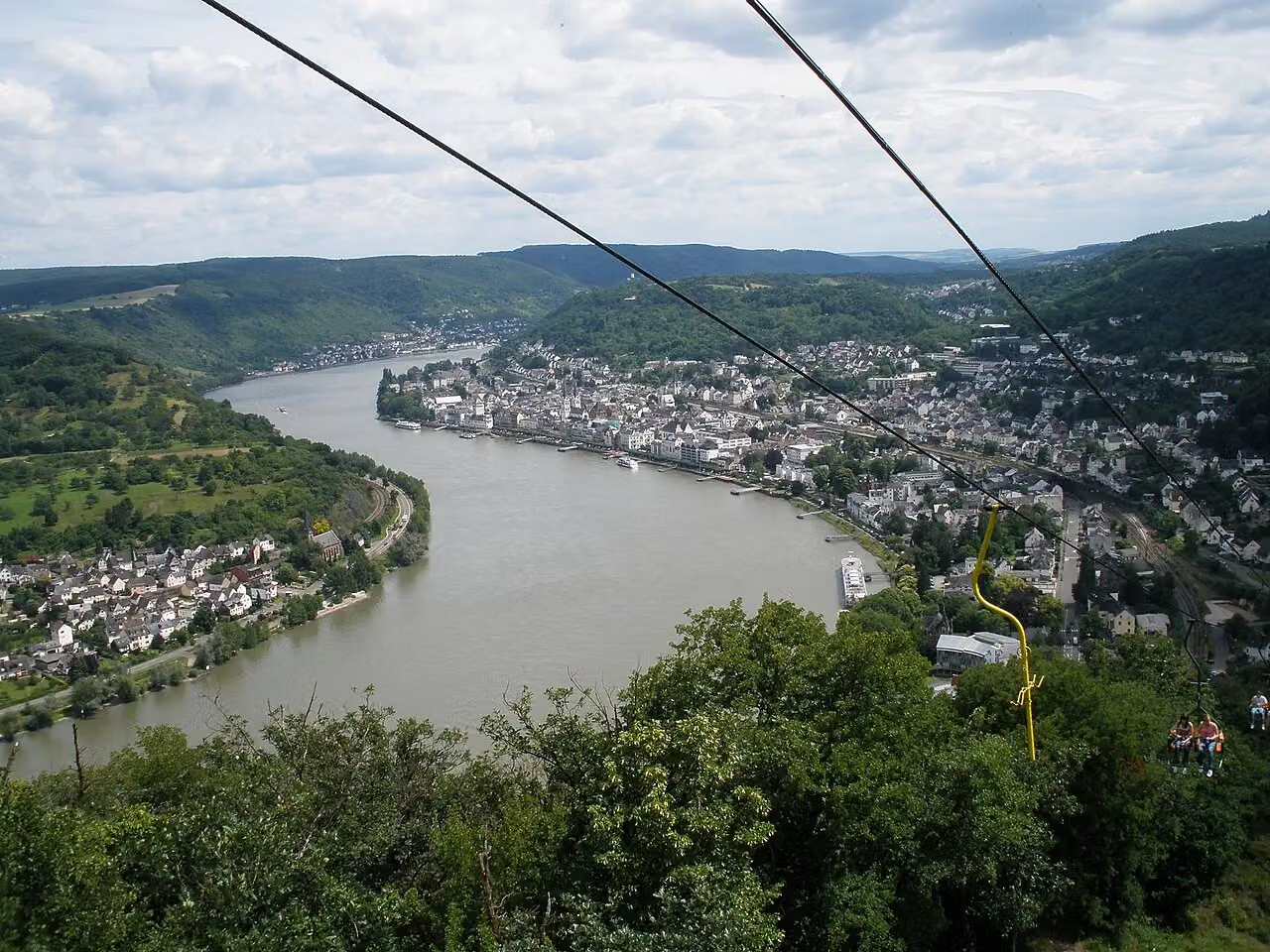
What is a via ferrata?
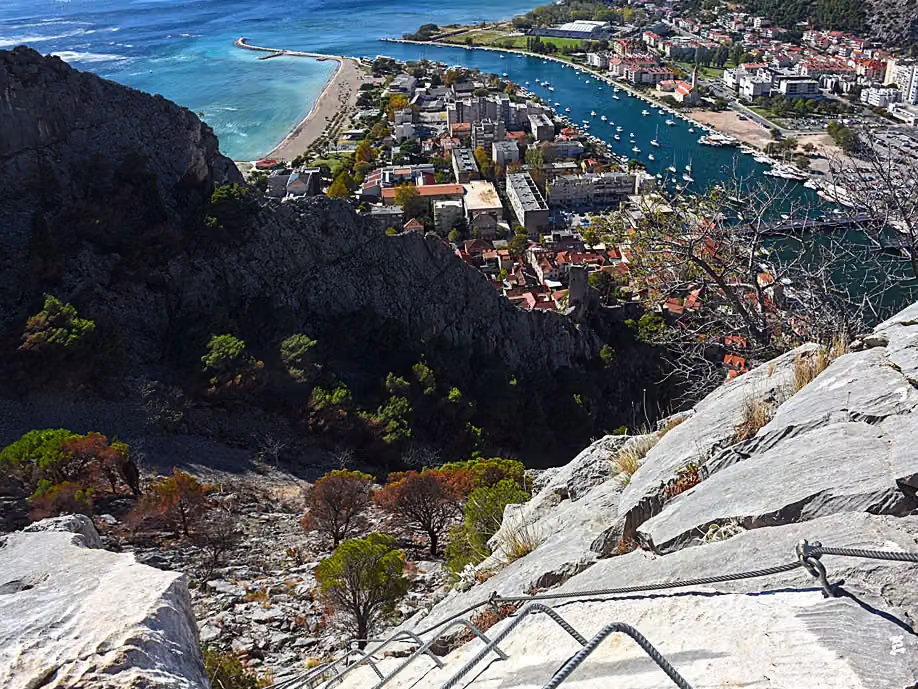
Via ferrata is Italian for "iron way". It is a route up rock with a steel cable running alongside you, and iron rungs, staples, ladders and sometimes suspension bridges on the steep parts. In Germany and Austria the same thing is called a Klettersteig.
You do the climbing yourself, but you cannot fall far: a via ferrata set links your harness to the cable. The cable is bolted to the rock every few metres. At each bolt you move your two carabiners across one at a time, so at least one is always clipped in. Honister Slate Mine in the Lake District runs a via ferrata itself. It says that if you fall, the carabiners slide down the cable until a bolt stops them.
That puts via ferrata climbing somewhere between a mountain walk or scramble and rock climbing. You need no rope and no partner to belay you, but you do need strong arms, decent fitness and a head for heights.
- Meaning
- "iron way" in Italian
- Also called
- Klettersteig (German)
- Grades
- A to E (Schall) or K1 to K6 (Hüsler)
- Basic kit
- harness, via ferrata set, helmet
- In the UK
- Honister, Lake District
Via ferrata climbing: clipping on, step by step
The technique is the same on every via ferrata. These steps follow the safety advice of the Deutscher Alpenverein (DAV) and the clipping method Honister describes.
- Check the route before you go: the grade, length, height gain, the way down and the weather forecast. Use the topo (route sketch) if there is one.
- Do not start if thunderstorms are likely. The DAV warns that lightning can kill, and that rain and cold make a fall more likely.
- Put on your harness, via ferrata set and helmet. Before you start, check each other's buckles and connections.
- Clip both carabiners to the cable.
- At each bolt, move one carabiner past it, then the other, so you are never unclipped.
- Keep your distance: only one person on the cable between two anchor points.
- Climb carefully so you do not knock stones down, and agree with others before you overtake.
The Alpine clubs also advise taking a course with qualified instructors before your first via ferrata. Carry a phone and a first-aid kit, and know the European emergency number, 112.
Via ferrata grades: A to E and K1 to K6
The DAV explains that most via ferrata routes in the Alps are graded on one of two scales:
- The Schall scale (A to E, very rarely F), common in Austria and used by many guidebooks and topos.
- The Hüsler scale (K1 to K6), still used mainly in Switzerland.
France and Italy have their own scales, but route descriptions there increasingly give a Schall or Hüsler grade too. The Schall scale also has in-between grades such as B/C.
What the Schall letters mean, in short:
- A, easy: protected paths with short exposed sections that are well secured.
- B, moderately difficult: steeper, exposed rock in places, with longer vertical ladders and rungs.
- C, difficult: steep to very steep rock and exposed passages with small footholds.
- D, very difficult: vertical, often overhanging ground with rungs far apart. You need a lot of arm strength.
- E, extremely difficult: mostly overhanging, only for very experienced via ferrata climbers.
The hardest section sets the grade. The DAV gives an example: a C route with one short steep pitch at the start is a very different day from a C route that stays steep for 400 metres of height gain. It advises choosing cautiously, a grade well within what you can manage.
Which via ferrata grade suits you?
How much experience do you have?
Never done one
- A short route with little height gain
- Ideally with a mountain guide, an instructor or a course
- Check the topo for an escape route along the way
Hillwalker
- You are used to steep paths and exposure
- Try a short B route first
- Mind the length: a long B can be harder than a short C
A few routes done
- C needs arm strength and good footwork
- Choose a route with a clear description and topo
- Allow plenty of time: queues and weather cost hours
Experienced
- Vertical and overhanging sections
- Only when C routes feel easy
- Often long stretches with nowhere to rest
No brands and no prices. When in doubt, choose a route one step easier rather than one step harder.
Honister via ferrata in the Lake District
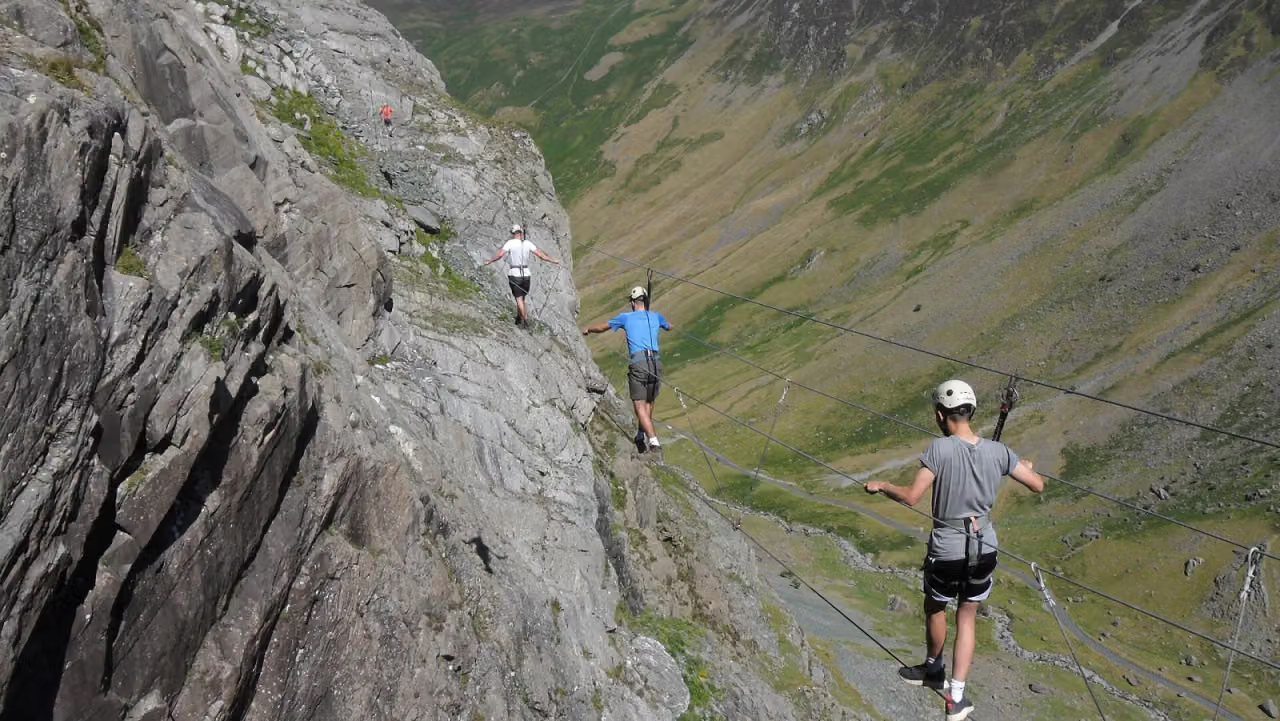
The Honister via ferrata starts at Honister Slate Mine, on Honister Pass in the Lake District, so the Honister mine via ferrata and the Honister via ferrata are the same thing. According to Honister, the routes follow paths that Victorian miners used to reach the slate workings high on Fleetwith Pike. They climb the natural rock of that fell.
Honister offers two routes:
- Via Ferrata Classic, the gentler route, which Honister describes as suitable for beginners.
- Via Ferrata Xtreme, with more exposure, vertical climbs and ladders along the cliff edge.
Honister gives a briefing on the kit and safety before you start. It says you need no climbing experience, but you should be comfortable with heights and steep drops. The minimum age is 10, and anyone under 16 must come with an adult who also takes part. The routes run in all weathers, so bring waterproofs. For times and booking, see Honister's own website.
Via ferrata UK: England, Scotland and Wales
The UK has only a handful of via ferrata routes, and I found no national list from a public body. The overview below follows the one Honister publishes, so treat it as the view of one operator.
- England, Lake District: Honister Slate Mine, with the Classic and Xtreme routes above.
- England, Yorkshire: How Stean Gorge in North Yorkshire has a course in the style of a via ferrata, with beams, bridges and cables above a limestone gorge. It is aimed at families and beginners.
- Scotland: the Grey Mare's Tail via ferrata at Kinlochleven climbs beside a high waterfall, with iron rungs and traverses. Vertical Descents runs it as a guided trip.
- Wales: according to Honister, Wales has no official via ferrata at the moment. Adventure centres there offer underground and high-ropes activities instead.
An operator runs each of these sites, so check opening times, age limits and what kit is provided with them before you travel.
Kit for a via ferrata: what you need
Tick off what you have. There is more detail on our page about via ferrata kit.
Set via ferrata: the EN 958 standard
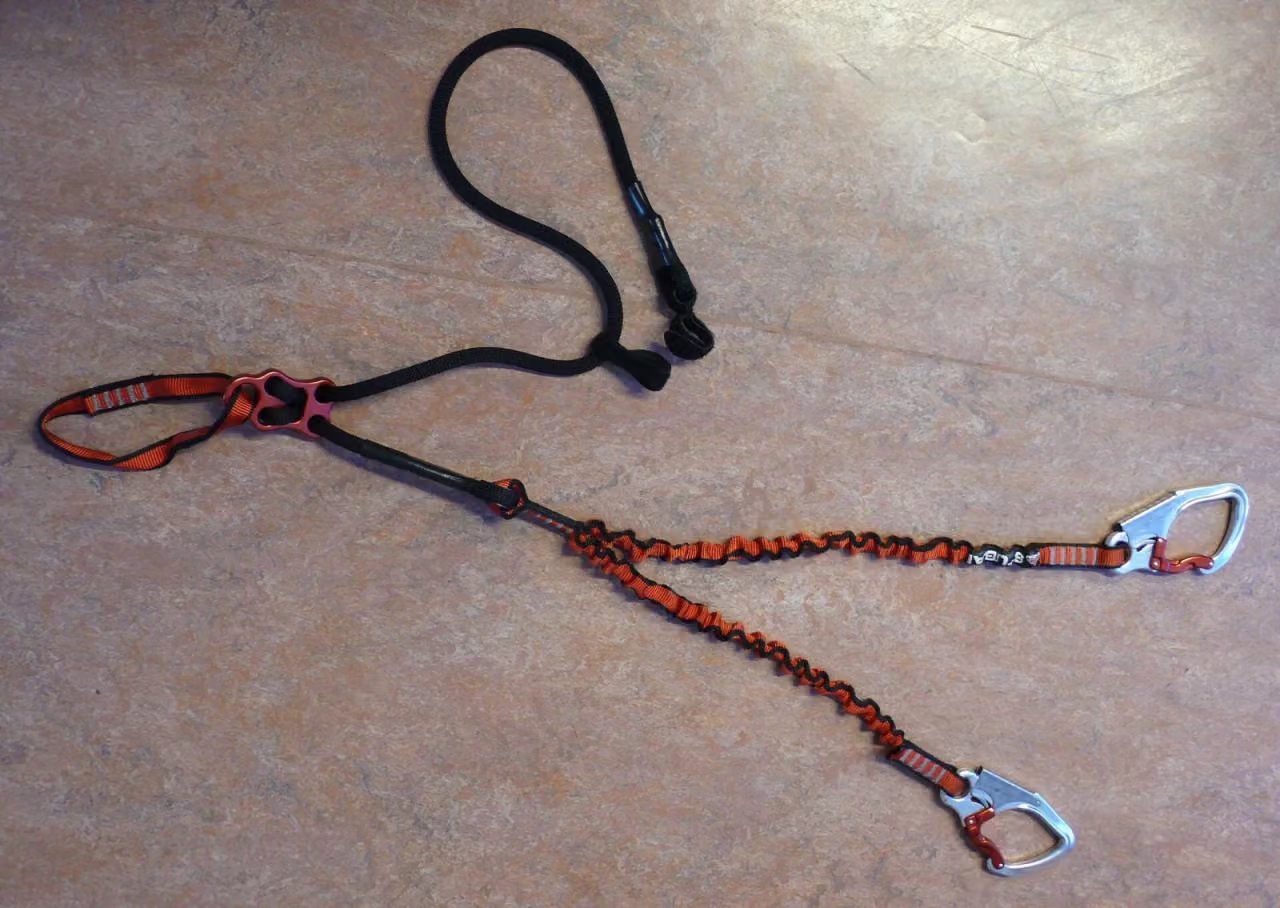
A via ferrata set has two arms, each with a carabiner, and an energy absorber that slows a fall. A plain sling or a length of rope does not do that, so never make a set yourself.
The European standard for sets is EN 958. The DAV explains that the current version, EN 958:2017, has applied since mid-2017. It tests sets with falling weights of 40 and 120 kilograms instead of only 80. For an older set, check that it is within the maker's stated lifespan, in good condition and not recalled. The UIAA sets the safety standards for harnesses (UIAA 105) and helmets (UIAA 106).
Our page about via ferrata kit covers choosing and checking kit, and what to wear for a via ferrata.
Via ferrata in the Dolomites
The Dolomites in northern Italy are where many people first hear of via ferrata. Honister notes that in the First World War, Austro-Hungarian and Italian troops fixed lines and ladders to the rock to move through the high mountains. After the war, the network was restored for public use.
Around Cortina d'Ampezzo, the local tourist board Dolomiti.org describes several routes. They include the Ivano Dibona with its 30-metre suspension bridge, the Via Ferrata degli Alpini near the Falzarego Pass, the Lagazuoi tunnels and routes up the Tofane. Several of them pass positions from the war. They range from medium difficulty to routes for experts, so look up the grade in the route description before you choose. For a first time, a guided via ferrata in the Dolomites is the safer start.
You can fill your bottle at huts and in the villages, but not on the route. The pitstops we know of in Italy are on our page for Italy.
From our data
Water taps in the Alpine countries
- Water points in Austria
- 8,690
- Of which off in winter
- 150
- Austria
- Water points in Italy
- 70,384
- Of which off in winter
- 671
- Italy
- Water points in Switzerland
- 17,462
- Of which off in winter
- 86
- Switzerland
As of 28 November 2026, from the Outdoor Pitstop database. Whole countries, not just the mountains. There are no taps on a via ferrata itself: fill up in the valley or at a hut.
From our data
Water, toilets and benches in the United Kingdom
- Water points
- 2,923
- in the United Kingdom
- Public toilets
- 13,915
- in the United Kingdom
- Benches
- 188,102
- in the United Kingdom
As of 28 November 2026, from the Outdoor Pitstop database. The whole United Kingdom, from OpenStreetMap and reports by our users.
Water, a toilet and a bench around your via ferrata
On a via ferrata your arms work for hours, often in the sun against warm rock. Honister advises taking plenty of water and food. You cannot refill along the cable, so fill your bottle before the start: in the valley, at a hut or in the village. The pitstops we know of in the Alps are on our pages for Austria and Italy.
After the descent, a bench at the car park or on the edge of the village is a good place to take off your set, eat and look back up at the rock face you have just climbed. Public toilets are mostly in villages and at car parks. See the public toilets in the United Kingdom and the water fountains and refill points in the United Kingdom.
In the app I can see 8,690 water points, 13,915 public toilets and 188,102 benches in the United Kingdom.