Skip to content
Outdoor Pitstop logoOutdoor Pitstop

Trail guide · Walking · Snow

Crampons or microspikes? Winter walking in snow and ice

Crampons, micro-spikes or just good boots: which you need for a winter walk depends on the slope and on what happens if you slip. Snow and ice turn a familiar hill into different terrain, with shorter days and slower going. This guide follows the advice of the British Mountaineering Council and Mountaineering Scotland: the boot and crampon ratings, when micro-spikes are enough, how to walk in crampons and what to wear and carry.

Summary

Crampons are for steep or icy hills where a slip could become a fall; they need stiff, crampon-compatible boots (B1 or higher). Micro-spikes fit almost any footwear but are only for compacted snow and ice on paths with gentle slopes. Below: the ratings, the steps for walking in crampons and a winter kit list.

· Founder of Outdoor Pitstop

Published · Last updated · 8 min read

Checked in November 2026

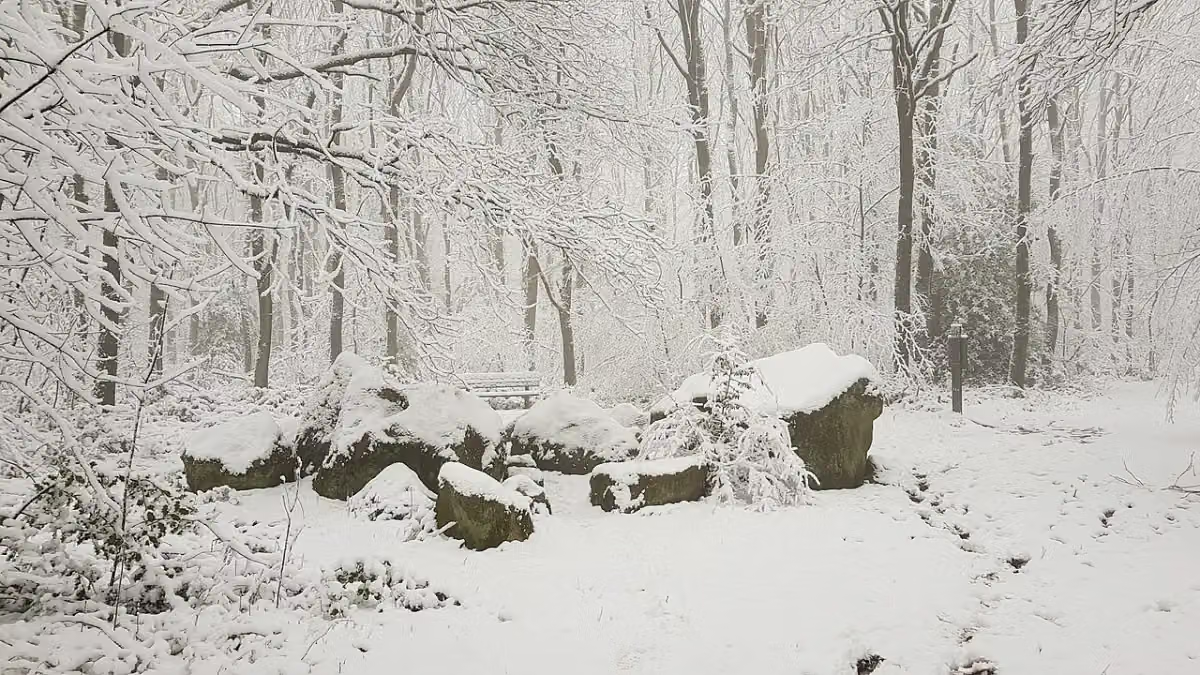
A snowy wood with large sandstone blocks and footprints in the snow
Snow in the Vijlenerbos near Vaals, South Limburg (the Netherlands) · Photo: Romaine via Wikimedia Commons, CC0

Crampons for hiking: C1, C2 and C3, and the boots they need

Crampons are a frame of metal spikes that you fix under your boots for grip on hard snow and ice. The British Mountaineering Council (BMC) and Mountaineering Scotland both use a simple rating system: B for boots, C for crampons. Your boots decide which crampons you can use, never the other way round.

Boots

  • B0: most summer walking boots. They flex too much in the midsole and are not suitable for crampons; a crampon on a bending sole can fall off.
  • B1: stiffer three- or four-season boots. The BMC calls B1 the absolute minimum for crampons, for short stretches of snow or ice rather than a whole day in them.
  • B2: stiff mountaineering boots that you can wear with crampons all day; they can usually take a crampon with a heel clip.
  • B3: rigid boots for mountaineering and ice climbing.

Crampons

  • C1: flexible walking crampons with straps or a cradle at toe and heel, usually 10 or 12 points. They suit moderately angled snow and ice and go with a B1 boot.
  • C2: articulated crampons, hinged below the instep, with two forward-facing points; often a toe cradle with a heel clip. For a B2 boot.
  • C3: rigid technical crampons for steep ice, for a B3 boot.

A stiffer boot takes the softer crampon too: according to the BMC a B3 boot works with C1, C2 and C3, while a B1 boot only goes with C1. The BMC advises steel for hill walking in the UK and anti-balling plates on every pair, so wet snow does not build up underfoot. Mountaineering Scotland suggests taking your own boots along when you have crampons fitted, so boot and frame are adjusted to each other.

B1 boot
C1 crampon
B2 boot
C1 or C2
B3 boot
C1, C2 or C3
Material
steel for UK hills
Always
anti-balling plates
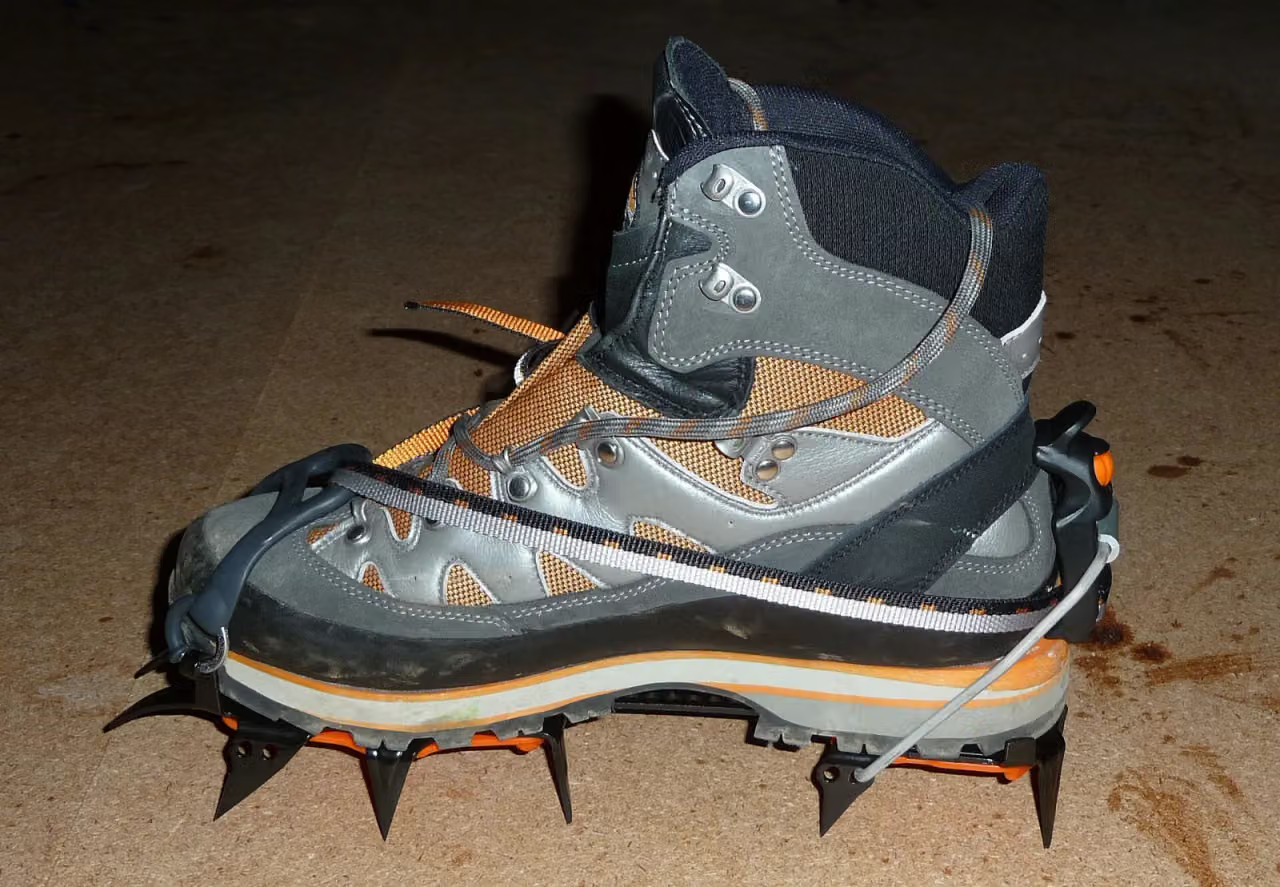
A stiff mountain boot with a twelve-point crampon fitted underneath
A crampon fitted to a stiff mountain boot · Photo: Johnny.m76 via Wikimedia Commons, CC BY-SA 3.0

Microspikes or crampons?

Microspikes, ice grippers and other traction devices are small steel spikes or coils linked by chains, held to your footwear by a flexible harness. Mountaineering Scotland describes them as much lighter and cheaper than crampons, easy to walk in and usable on almost any shoe, including trainers.

Their limit is the slope. Mountaineering Scotland says micro-spikes are made for icy paths and tracks with gentle inclines of around 15 to 20 degrees. The BMC adds that their short spikes cannot bite into snow that is not compacted, that they are unsuitable for steep or consequential ground, and that, unlike walking crampons, they do not have to meet a PPE strength standard.

The BMC's test is the consequence of a slip. If a slip would mean no more than a bruise, micro-spikes are probably fine. If it could become a long slide or a fall over a drop, they often are not secure enough, and you need crampons with stiff boots, or a different route. Some hill walkers carry both and choose on the day.

Micro-spikes
icy paths, gentle slopes
Crampons
steep or consequential ground
Slope limit spikes
around 15-20 degrees
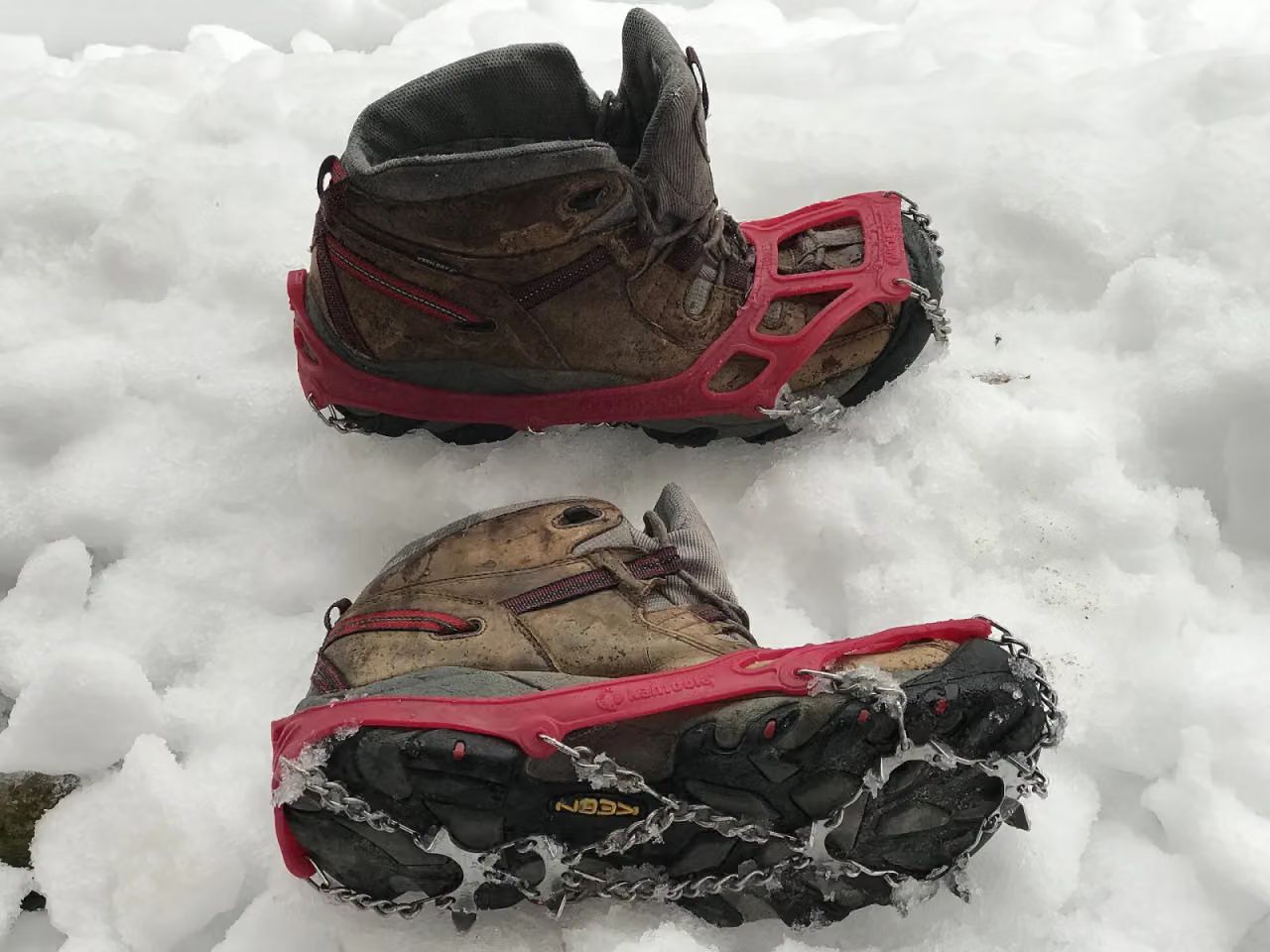
Two walking shoes in the snow with stretch-on traction devices of chains and small spikes
Microspikes stretched over walking shoes · Photo: HopsonRoad via Wikimedia Commons, CC BY-SA 4.0

Kahtoola Microspikes: a brand name, not a type

Many walkers say "microspikes" for any stretch-on traction device. Strictly, MICROspikes is a registered trademark of the American maker Kahtoola, which says the name refers only to its own product. The BMC and Mountaineering Scotland write "micro-spikes" for the whole group of chains-and-spikes devices, and that is how I use the word on this page. We do not test or recommend brands: the advice above about slopes and consequences applies whatever the label says.

How to walk in crampons: the steps

Mountaineering Scotland and the BMC give the same basic technique. Practise it on a safe, gentle slope first, or better, on a winter skills course.

  1. Carry them whenever there is snow on the hills, even if you do not expect to need them.
  2. Put them on early, before you reach ground where you would feel insecure without them. The BMC warns that accidents often happen to people who leave it too late.
  3. Keep your clothing clear. Avoid baggy trousers and anything hanging from your waist that the points can snag.
  4. Walk with your feet a little wider apart than usual.
  5. Flex your ankles so all the downward points bite, and place each foot firmly and confidently. Do not stamp or drag your feet.
  6. Check the fit a few minutes after setting off. Loose crampons cause accidents, so tighten the straps where needed.

An ice axe for hiking

On snowy hills crampons and an ice axe go together. The BMC calls the axe the essential piece of winter kit: for balance on steep slopes, for cutting steps and, in an emergency, for stopping a fall. For most walkers it suggests a straight-shafted walking ice axe of about 50 to 60 cm.

Learning the ice axe arrest is part of every winter skills course, but the BMC is clear that it is no guarantee: a real slip happens fast, so your attention should go to not falling in the first place. The Lake District fell top assessors put it simply in their winter tips: take an ice axe and crampons in winter conditions, and know how to use them.

Winter walking: short days and slower going

Winter walking asks more of you than the same route in summer. The BMC points out that the cold uses energy just to keep you warm, that breaking a trail through snow is tiring, and that snow can hide the paths and walls you would normally follow. Progress is slower, so plan a shorter day, know where you could cut the route short, and make plan B before you leave.

Get an early start, check when the sun sets and always pack a head torch. Eat often on the move and choose snacks that will not freeze hard. Check the mountain weather forecast and, in Scotland, the Scottish Avalanche Information Service: the BMC notes that avalanches can happen anywhere in the UK where snow lies on a steep enough slope. In the Lake District, the national park's fell top assessors climb Helvellyn each winter, usually from December to March, and add a report on the conditions to the Weatherline forecast. Their last tip: if in doubt, turn back.

Walking through deep, soft snow off the paths is a different activity; see the guide to snowshoeing.

What to wear for winter walking, and what to carry

Based on the winter kit list of Mountaineering Scotland. Leave out what does not suit a low-level walk, but not the spare gloves.

Wear
Carry

From our data

Water points and public toilets in the United Kingdom in winter

Water points
2,923
in the United Kingdom
Water points off in winter
2
in the United Kingdom
Public toilets
13,915
in the United Kingdom

As of 28 November 2026, from the Outdoor Pitstop database. The whole United Kingdom. Where we know a water point is off in winter, the app says so; for many taps we do not know.

Water and public toilets on a winter walk

Mountaineering Scotland's kit list includes a hot drink in a flask, and on a winter walk that is also the safest plan for water: fill up at home rather than counting on a tap on the way. In our data some water points are marked as off in winter; for many others we simply do not know, so treat every outdoor tap as a bonus.

Plan your stops around villages and car parks, where most public toilets are. All the ones we know are on public toilets in the United Kingdom, the taps on water fountains and refill points in the United Kingdom and the places to sit on benches in the United Kingdom. Walking in Ireland? See the public toilets in Ireland.

In our data 2 of the 2,923 water points in the United Kingdom are marked as off in winter, and I see 13,915 public toilets.


Key takeaways

  • Your boots decide your crampons: a B1 boot only takes flexible C1 crampons, while a rigid B3 boot takes C1, C2 and C3.
  • Summer walking boots (B0) flex too much for crampons, which can then come off.
  • Micro-spikes suit icy paths and gentle slopes of around 15 to 20 degrees, not steep or exposed ground.
  • The BMC's rule for choosing between micro-spikes and crampons is the consequence of a slip, not the weather alone.
  • Put crampons on before you reach ground where you would feel insecure, and check the straps a few minutes later.
  • On a winter walk, carry your own hot drink: in our data some water points are marked as off in winter.

Frequently asked questions

What to wear for winter hiking?

Layers: a thermal base layer, an insulating fleece, warm windproof trousers and a waterproof jacket and over-trousers on top. Add a warm hat, gloves, gaiters and boots with good socks, and carry a spare layer, spare gloves and a spare hat.

What pants to wear for winter hiking?

Warm, windproof trousers or leggings, with thermal leggings underneath when it is cold and waterproof over-trousers in your rucksack. Mountaineering Scotland advises against baggy trousers with crampons, because the points can snag them.

What to wear for snow hiking?

Rigid-soled winter boots with suitable socks, stiff enough for any crampons you carry, with gaiters over them, and clothing in layers. Bring sunglasses and goggles too: the Lake District fell top assessors call goggles essential when snow and wind combine.

What do I need for winter hiking?

Besides warm layers: map, compass, a head torch with spare batteries, spare gloves, a survival bag, a whistle, a small first aid kit, a charged phone, food and a hot drink. For snowy hills add crampons and an ice axe, and the skills to use them.

Can you wear crampons with normal walking boots?

Not with flexible summer boots. The British Mountaineering Council rates them B0, unsuitable for crampons; you need at least a stiffer B1 boot, which takes flexible C1 crampons.

Are microspikes enough for winter hills in the UK?

Only on compacted snow and ice on paths with gentle slopes. On steep or exposed ground, where a slip could turn into a long slide, the BMC and Mountaineering Scotland advise crampons with stiff boots.

Sources

  1. British Mountaineering Council, Walking boots, crampons and micro spikes · thebmc.co.uk · B0-B3 boots, C1-C3 crampons and which fit together, steel, anti-balling plates, micro-spikes: not compacted snow, no PPE standard, the consequence-of-a-slip test
  2. Mountaineering Scotland, Micro spikes or crampons? · mountaineering.scot · what micro-spikes are, icy paths and slopes of about 15-20 degrees, crampons for steep ground, winter skills courses
  3. Mountaineering Scotland, Which crampons are suitable for me? · mountaineering.scot · C1, C2, C3 and matching boots, anti-balling plates, fitting with your own boots, when and how to walk in crampons
  4. Mountaineering Scotland, ThinkWINTER: Clothing and equipment · mountaineering.scot · winter kit list: what to wear and what to carry, hot drink in a flask
  5. British Mountaineering Council, Ten things you need to know before you go hill walking in winter · thebmc.co.uk · fitness, food, short days and head torch, navigation, ice axe of 50-60 cm, ice axe arrest, crampons on early, route planning, avalanches, SAIS
  6. Lake District Weatherline, About us · lakedistrictweatherline.co.uk · fell top assessors on Helvellyn from December to March, top 10 winter tips
  7. Kahtoola, Patents and trademarks · kahtoola.com · MICROspikes is a registered trademark of Kahtoola
  8. Outdoor Pitstop · outdoorpitstop.com · water points, those marked off in winter, and public toilets in the United Kingdom (live numbers)

Last checked in November 2026. Outdoor Pitstop figures come from our own database; the date is with each block.

Written by

Robin

Founder of Outdoor Pitstop

Robin started Outdoor Pitstop to always know where the next toilet, water tap or bench is on the way.

About this guide

What I write here comes from what we keep track of in Outdoor Pitstop: the pitstops, routes and photos in the app, and what users report on the way. I check rules, opening times and facts about nature with the official sources. Spotted something that is not right? Let me know and I will correct it.

Checked in November 2026 · Last updated

How we work

More about soorten en terreinen

  • Snowshoeing
  • Themed and children's trails
  • Via ferrata
  • Woodland and forest walks
  • Hut-to-hut walking
  • Walking holidays: how to plan one
  • Circular walks: how to find and plan one
  • Coastal walking
  • Scrambling
  • Beach walks and tides
  • Long-distance walking: how to start
  • Walking in the mountains
  • Nordic walking
  • Pilgrim routes
  • Hiking: what it is and how it differs from walking
  • Walking in Europe: where to go
  • Barefoot walking and barefoot trails
  • Trekking and multi-day treks
  • Walks from a railway station
  • Mindful walking
  • Muddy walks and wellie walks
  • Pub walks
  • Moorland and heath walking
  • Mudflat walking (wadlopen)

In the app

Winter stops on the map

Open the map of pitstops before a winter walk to see where you can warm up, use a toilet or refill, and download the app to take it with you.

  • Water points marked as off in winter
  • Public toilets in the villages and car parks along your walk
  • Navigate to the nearest public toilet or bench
Download on the App StoreGet it on Google Play

More from Trail guide

The free app

All of Outdoor Pitstop, in your pocket

Find the nearest pitstop, navigate there, listen to audio tours, earn XP and make routes and lists together.

Download on the App StoreGet it on Google Play
How Outdoor Pitstop works →
The map of the app with pitstops nearby
A pitstop in the app, with a photo, a review and Navigate
Your profile in the app, with level and XP