Outdoor Pitstop
Short answer
For cycling in the dark in the UK, the Highway Code says your bike must have a white front light and a red rear light lit, plus a red rear reflector and amber pedal reflectors. In the Netherlands the front light may be white or yellow, and lights must not flash. Beyond the law, cycling in the dark goes best when you plan for the things that are harder to sort out at night: a flat tyre, a cold stop and the way home.
Bike lights in the UK: what the Highway Code says
Rule 60 of the Highway Code, published on gov.uk, covers cycling at night. It says that at night your cycle must have:
- a white front light and a red rear light, both lit;
- a red rear reflector;
- amber pedal reflectors, if the bike was made after 1 October 1985.
White front reflectors and spoke reflectors are not required, but the Highway Code says they help you to be seen. Flashing lights are allowed. Where there is no street lighting, though, the Highway Code advises a steady front lamp, because a flashing light alone does not show you the road.
Rule 59 adds advice on clothing: wear light-coloured or fluorescent clothing in daylight and poor light, and reflective clothing or accessories, such as a belt, arm or ankle bands, in the dark.
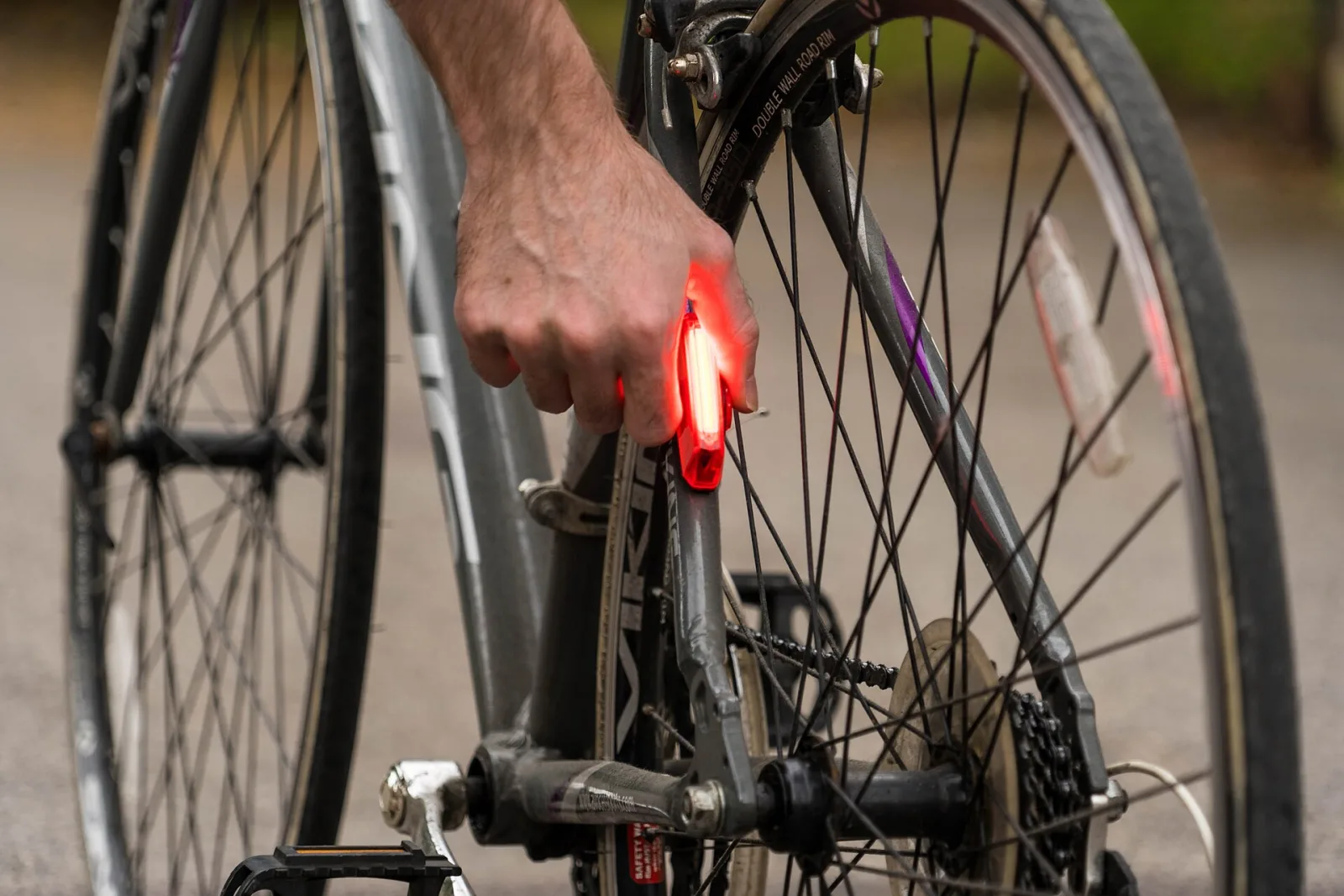
Photo: Alextredz, CC BY-SA 4.0, via Wikimedia Commons
Bike lights in the Netherlands: the Dutch rules
If you ride in the Netherlands, the Dutch government (Rijksoverheid) lists slightly different rules for cycling in the dark and in poor visibility:
- a white or yellow front light and a red rear light, fixed or clip-on;
- lights must not flash, and must point at the road so they do not dazzle others;
- a clip-on light may be worn on your clothing or bag, on your chest or back, but not on your head, arms or legs;
- a red rear reflector (not a triangle), white or yellow reflectors on the wheels or tyres, and yellow reflectors on both pedals.
The no-flashing rule is the one that catches visitors out: a flashing rear light that is legal in the UK is not allowed on a Dutch cycle path. According to a 2025 count published by the Dutch Ministry of Infrastructure and Water Management, 75 per cent of cyclists had both their front and rear light on as required.
| Rule | United Kingdom (Highway Code) | Netherlands (Rijksoverheid) |
|---|---|---|
| Front light | White, lit at night | White or yellow |
| Rear light | Red, lit at night | Red |
| Flashing allowed | Yes (steady front lamp advised on unlit roads) | No |
| Rear reflector | Red | Red, not a triangle |
| Pedal reflectors | Amber, bikes made after 1 October 1985 | Yellow, on both pedals |
| Wheel or tyre reflectors | Advised, not required | White or yellow, required |
| Lights worn on the body | Not covered | Chest or back only |
How early it gets dark: plan your ride around sunset
In December the dark comes early. The Dutch weather service KNMI gives a sunset of 16:30 Central European Time for De Bilt in the middle of the Netherlands on the shortest day, 21 December 2026, with 7 hours and 44 minutes of daylight. In Scotland the day is shorter still. Our page on the winter solstice and the shortest day of the year has the times for the UK and Ireland.
A ride that would be easy in summer can end in the dark in winter. Two habits help:
- Work back from sunset. If you want the off-road part of the ride in daylight, put it first and ride the lit roads home.
- Charge the night before. Battery lights last less long in the cold. Check the run time at the setting you use, and carry a small spare rear light.
What to carry when cycling in the dark
A puncture on an unlit lane at 5pm in December is a real problem, so carry a small kit.
| Take with you | Why it matters after dark |
|---|---|
| Spare inner tube, levers and a mini pump | Fixing a flat by torchlight is slow; a spare tube is quicker than a patch |
| A small head torch | Two hands free for the repair; the law does not cover it, but it helps |
| Spare rear light or batteries | A dead rear light is the one you do not notice |
| A reflective band or vest | The Highway Code advises reflective accessories in the dark |
| Phone with charge and the route | To find the nearest lit road, station or pitstop |
| An extra warm layer | You cool down fast when you stop to fix a puncture |
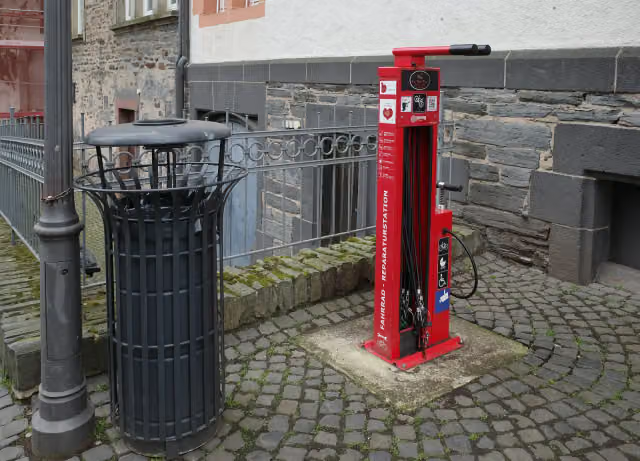
If your pump fails, a public bike pump or repair stand is a good thing to know about. According to Outdoor Pitstop's data (as of 25 November 2026), there are 647 public bike pumps and repair stands in the United Kingdom and 96 public bike pumps in the Netherlands on our map. Our guide to bike repair at home, from the M-check to the tools explains how to check your bike before a winter ride.
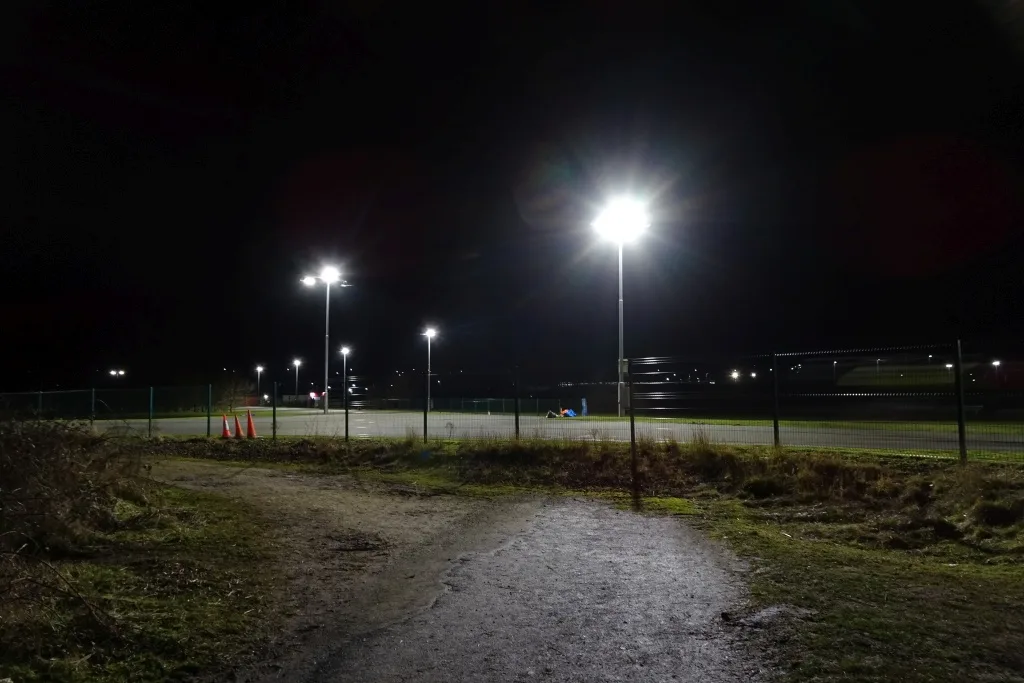
Photo: DS Pugh, CC BY-SA 2.0, via Wikimedia Commons
Choosing a route for cycling in the dark
On unlit lanes, potholes can hide in the shadow of your own light, so for a first ride after dark a route on lit roads or cycle paths is easier. In the Netherlands, many long-distance cycle routes follow separate cycle paths; you can find them on our map of cycle routes in the Netherlands.
Toilets are harder to find in the evening too, because many in parks close at dusk. According to Outdoor Pitstop's data (as of 25 November 2026), 223 public toilets in the UK and 123 in the Netherlands on our map are recorded as open 24 hours a day. On a toilet's page in the app you can see its opening hours where they are known.


On the map
Public toilets and bike pumps in United Kingdom and Netherlands (17,913)
Take Outdoor Pitstop along on your phone
Free · 3.4 million pitstops in 44 countries