Outdoor Pitstop

Bike tyre sizes: reading the numbers on your tyre
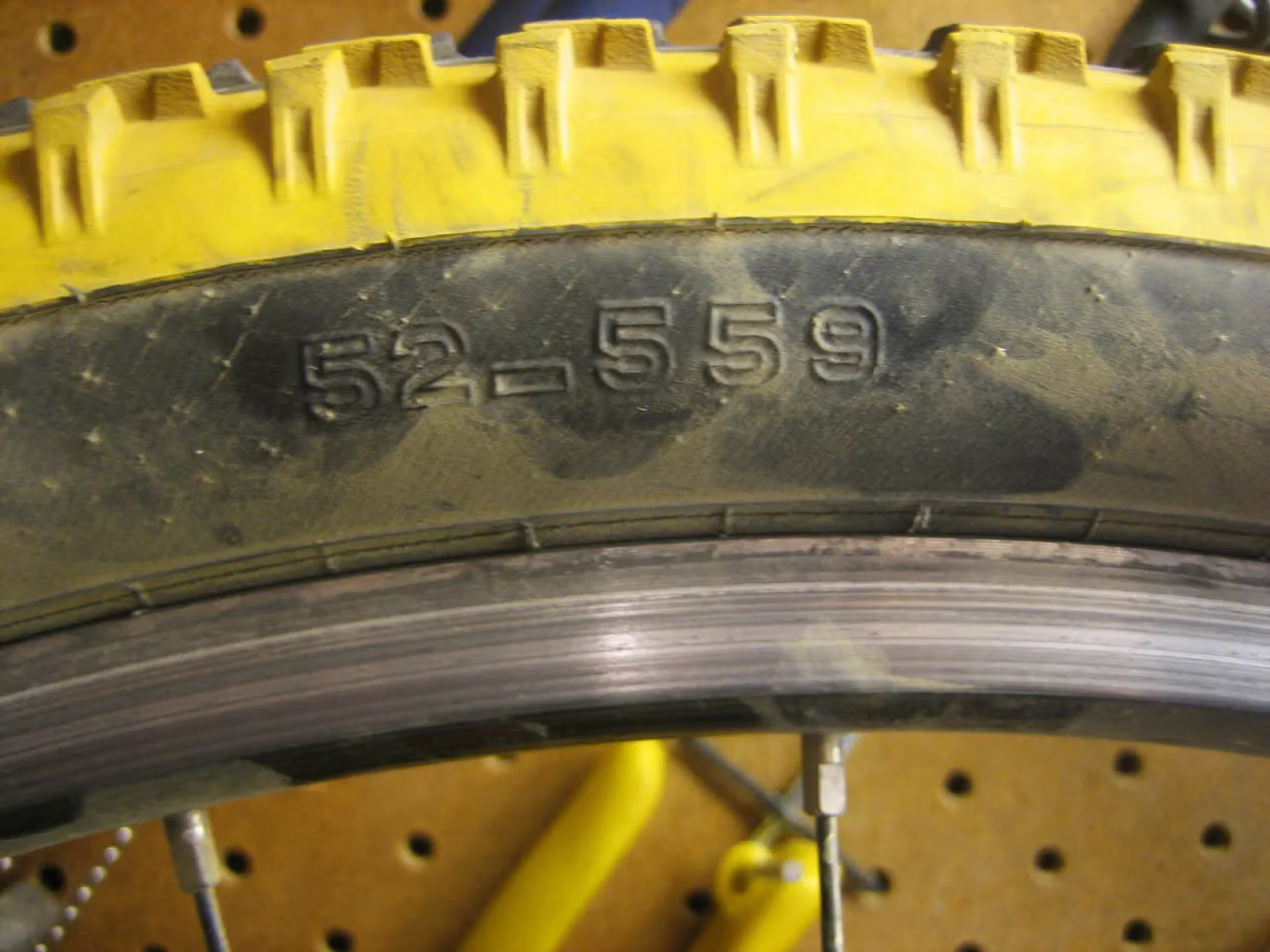
Which bike tyres fit your bike is printed on the tyre you have now. On the sidewall you will almost always find two numbers joined by a dash, such as 37-622 or 47-559. That is the ETRTO or ISO size. The first number is the tyre width in millimetres; the second is the inner diameter of the tyre, which has to match the bead seat of the rim.
The second number must be exactly right. Park Tool, the American tool maker, warns never to mix tyres and wheels with different bead seat diameters. Inch sizes do not help here: Schwalbe points out that 559 mm (mountain bike), 571 mm (triathlon) and 590 mm (Dutch touring bikes) are all sold as "26 inch". In French sizes such as 700 x 35C, the C stands for 622 mm. The width may vary a little, within what rim and frame allow.
| ETRTO (ISO) | Inch | French | Typical bike |
|---|---|---|---|
| 25-622 | 28 x 1.00 | 700 x 25C | Road bike |
| 28-622 | 28 x 1.10 | 700 x 28C | Road bike |
| 37-622 | 28 x 1.40 | 700 x 35C | Hybrid, touring bike |
| 47-559 | 26 x 1.75 | - | Older mountain bike |
| 57-584 | 27.5 x 2.25 | 650B | Mountain bike |
| 57-622 | 29 x 2.25 | - | Mountain bike (29 inch) |
| 406 | 20 inch | - | Children's bikes, BMX, recumbents |
Sources: the size lists of Schwalbe Tech Info and Park Tool. 28 inch, 29 inch and 700C all share the same 622 mm bead seat; only the width differs.
- First number
- width in mm
- Second number
- bead seat diameter in mm
- 700C = 28 in = 29 in
- 622 mm
Bike tires: width, tread and puncture protection
Bike tires, as American shops spell it, differ in three ways besides the size: width, tread and puncture protection.
Width. According to Schwalbe, a wide tyre does not roll worse than a narrow one at the same pressure: the narrow tyre flattens into a longer contact patch and loses more of its roundness. Park Tool gives a loose rule for the rim: the tyre width should be about one and a half to two times the inner rim width, so a 25 mm rim suits a tyre of roughly 37 to 50 mm. Check the clearance in your frame and fork before you go wider.
Tread. On a smooth road the grip comes almost entirely from the rubber, says Schwalbe, even in the wet: a bicycle does not aquaplane. Off road the tread matters a lot.
Puncture protection. Many touring and city tyres have a belt under the tread against glass and thorns; more in the guide to puncture-proof tyres.
The parts of a bike tyre
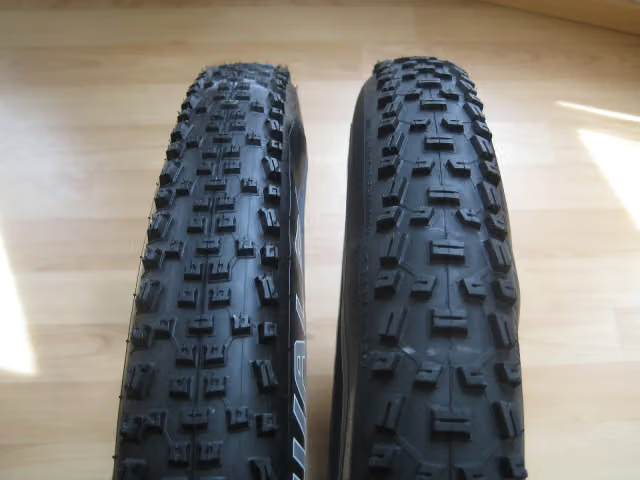
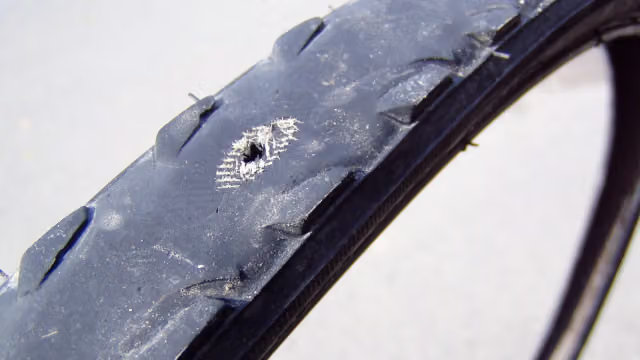
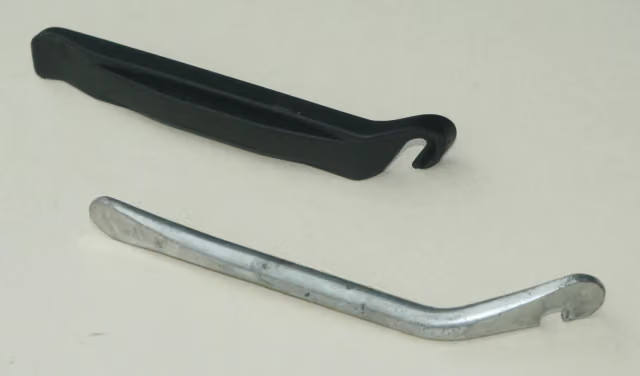
Inner tubes: size, valve and material
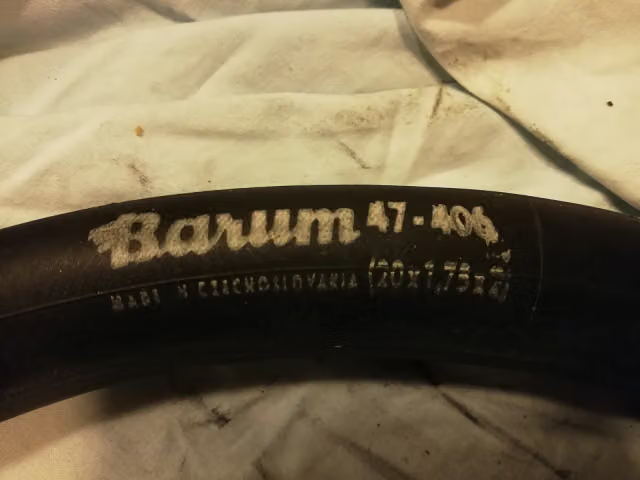
Most bike tyres hold their air in an inner tube. You buy bike tubes on three things.
- The size. An inner tube is elastic, so one tube fits a range of widths on the same bead seat; the box shows that range. Park Tool warns that a tube too narrow for the tyre stretches thin and punctures more easily, and one too wide is hard to fit and can blow out. A 700c inner tube is a 622 tube; Park Tool adds that a tube for 630 (27 inch) also fits 622.
- The valve. There are three kinds: Presta (narrow, with a small locknut), Schrader (the car valve) and Dunlop, also called Woods. The valve must match the hole in your rim, and deep rims need a longer valve, 60 or 80 mm according to Park Tool. More in the guide to bike valves.
- The material. Ordinary tubes are butyl rubber: elastic and airtight. Latex tubes are harder to puncture, but Schwalbe says they lose air so quickly that you have to pump them before every ride.
Check the rim tape too: Schwalbe says it must cover every spoke hole completely. A tubeless tyre has no inner tube at all; see the guide to tubeless tyres.
Air pressure in a bike tyre: how hard to pump
The right air pressure in a bike tyre depends mostly on the load: your weight and your luggage. The permitted range is printed on the sidewall, in bar and often in psi (1 bar is about 14.5 psi), and Schwalbe says you should never go above the maximum or below the minimum. Narrower tyres and heavier loads need more pressure. As a rough guide, Schwalbe's table gives a rider of about 85 kg 6.5 bar (about 94 psi) in a 28 mm tyre and 4 bar (about 58 psi) in a 47 mm tyre.
Too little air makes punctures much more likely and is the usual cause of cracked sidewalls, says Schwalbe, so check the pressure at least once a month with a gauge. The full table per width and rider weight is in the guide to bike tyre pressure.
- Limits
- on the sidewall
- Check
- at least once a month
- 1 bar
- about 14.5 psi
How to pump a tyre to the right pressure
Animatie, 9 seconden, herhaalt zich
Stilstaand beeld: je apparaat staat op minder beweging
- 1
Read the range printed on the side of the tyre.
- 2
Pump up with a pump with a gauge.
- 3
Stop when the gauge is within the range, not above it.
Bekijk als video
Road bike tyres: narrow, light and firm
Road bike tyres are narrow and light, with little or no tread. Common sizes are 25-622 and 28-622 (700 x 25C and 700 x 28C). They come in three kinds:
- Clincher, the ordinary tyre with an inner tube. A folding version has a Kevlar bead instead of a wire one, which Schwalbe says saves about 50 to 90 grams.
- Tubeless, without a tube and with sealant, on a rim made for it.
- Tubular, with the tube sewn inside the tyre, which is glued to a special rim. Schwalbe calls it awkward to fit and hard to repair.
Narrow tyres need a higher pressure, which Schwalbe says makes them less comfortable, but they accelerate more easily.
MTB tyres and gravel bike tyres
MTB tyres come in three diameters: 26 inch (559 mm), 27.5 inch (584 mm, the old French 650B) and 29 inch (622 mm, the same bead seat as 700C). Park Tool lists 26 inch tyres from 1.0 to 4.8 inches wide, which includes fat bike tyres. So 26 inch MTB tyres only fit 559 rims, and 29 inch mountain bike tyres fit 622 rims.
Off road the tread does the work. Many MTB tyres have separate FRONT and REAR arrows on the sidewall. Schwalbe notes that a worn tread hardly matters on a road tyre, but it does on a mountain bike.
Gravel tyres have no size system of their own: they carry the same ETRTO numbers, so read the second number on the tyre you have. The same rules apply as for MTB tyres: match the bead seat, follow Park Tool's rule of thumb for rim width, and check the frame clearance before choosing a wider tyre.
Which bike tyre suits your riding?
Where do you ride most?
Town and commuting
- Comfortable on rough tarmac and cobbles
- A belt under the tread against glass and thorns
- Reflective sidewall stripes help in the dark
Road bike on tarmac
- 25 or 28 mm, or wider if your frame allows it
- Light and supple, with less puncture protection
- Check the pressure more often
Gravel and trails
- Tread for grip on gravel, mud and grass
- Check rim width and frame clearance first
- Tubeless lets you ride without an inner tube
Touring with luggage
- Wide enough for the weight of your bags
- A thick protection belt helps far from home
- Carry a spare inner tube of the same size and valve
Always start with the size on your current tyre: the second number has to stay the same.
How to change a bike inner tube
These steps follow the guides of Cycling UK, Park Tool and Schwalbe.
- Take the wheel out. For the rear wheel, shift to the smallest sprocket first. Release a rim brake, then open the quick release, or undo the wheel nuts (usually with a 15 mm spanner).
- Let all the air out. On a Presta valve, unscrew the small locknut and press it; on a Schrader valve, press the pin in the centre; on a Dunlop valve, loosen the nut a few turns and pull the tip.
- Push both beads into the centre of the rim all the way round. That gives you slack.
- Lever one side off. Hook a tyre lever under the bead and over the rim, clip it to a spoke and use a second lever 5 to 7.5 cm (2 to 3 inches) further on. Never use a screwdriver or knife. One side can stay on the rim.
- Pull the tube out, starting opposite the valve, and push the valve out of the rim last.
- Find the cause. Run a cloth carefully round the inside of the tyre and remove anything sharp, and check that the rim tape covers every spoke hole.
- Fit the new tube. Pump it just enough to take a round shape, put the valve through the rim hole and tuck the tube into the tyre.
- Put the bead back by hand, making sure the tube is not pinched between tyre and rim. Cycling UK advises not to leave the valve area until last.
- Inflate slowly. Pump to a soft pressure, flex the tyre on both sides so it seats evenly, check the valve stands straight, then pump to a pressure within the range on the sidewall.
- Refit the wheel and check that the brakes work and the wheel turns without rubbing.
A new tyre goes on the same way: take both beads off, check the rotation arrow on the new tyre and fit one side before the tube.
- Tools
- tyre levers, pump, spare tube
- Wheel nuts
- usually 15 mm
- Never
- screwdriver or knife
Tyre levers: getting the bead off
Animatie, 9 seconden, herhaalt zich
Stilstaand beeld: je apparaat staat op minder beweging
- 1
Let all the air out and push both beads into the centre of the rim, all the way round.
- 2
Hook the spoon end of a tyre lever under the bead, lever it over the rim and clip the lever to a spoke.
- 3
Put a second lever in 5 to 7.5 cm further on and lift; the rest of the bead now comes off by hand.
Bekijk als video
Putting the tyre back on the rim
Animatie, 9 seconden, herhaalt zich
Stilstaand beeld: je apparaat staat op minder beweging
- 1
Pump the tube up just a little and put the valve straight through the rim.
- 2
Push the second bead over the rim with your hands: start opposite the valve and work round both sides towards it.
- 3
Check that the line on the tyre sits evenly above the rim all the way round, then pump up.
Bekijk als video
What to carry for a flat on the way
Cycling UK's list for a puncture on the road:
When to replace your bike tyres
A smooth tread is not a reason on its own to replace a road tyre. According to Schwalbe, a bike tyre is worn out when the puncture protection belt or the casing threads show through the tread, though replacing it a little earlier keeps more puncture protection. On a mountain bike a worn tread is a reason in itself.
Look at the sidewalls too. Schwalbe says sidewalls often fail before the tread, mostly because the tyre has been ridden too soft for a long time: that gives a few large cracks high on the sidewall. Fine cracks all over come from age. Replace a tyre with a bulge, a cut or visible threads straight away.
How long bike tyres last depends on pressure, load, road surface, temperature and the rider. Schwalbe names a rough 2,000 to 5,000 km (about 1,250 to 3,100 miles) for its standard tyres, and more for sturdy touring tyres.
From our data
Public bike pumps in the United Kingdom
- Public bike pumps
- 647
- in the United Kingdom
- Bike repair stations
- 274
- in the United Kingdom
As of 28 November 2026, from the Outdoor Pitstop database. A repair station is a public bike pump with tools attached, for small repairs on the way.
A soft or flat bike tyre on the way
Too little air makes a puncture much more likely, says Schwalbe, and so does a sliver of glass or flint left in the tread. Its advice: check the pressure at least once a month and pick out anything stuck in the tread before it works its way through.
If a tyre goes soft on a ride, a public bike pump gets you going again, and a repair station also has tools for a quick fix. All the ones we know of are on bike pumps in the United Kingdom and bike pumps in Ireland.
In the app I see 647 public bike pumps and 274 repair stations with tools in the United Kingdom.