Skip to content
Outdoor Pitstop logoOutdoor Pitstop

Nature areas · National parks

New Forest National Park: where it is, ponies, parking and rules

The New Forest is a national park in the south of England. Most of it is in Hampshire, opposite the Isle of Wight, and it has woodland, open heath and 26 miles of coast. Ponies, cattle, donkeys and pigs roam freely across it. Entry is free, but the rules are strict: no fires, no wild camping and no feeding the animals.

Summary

The New Forest is a free national park in Hampshire, south England, between Southampton and Bournemouth. Brockenhurst station is in its heart, 90 minutes from London Waterloo. Ponies and other livestock roam freely: keep your distance and never feed them. Fires, barbecues and wild camping are banned, and Forestry England car parks have charged since April 2026.

· Founder of Outdoor Pitstop

Published · Last updated · 9 min read

Checked in November 2026

Two ponies and a foal grazing on heathland with shrubs under a grey sky
Ponies with a foal on Hampton Ridge in the New Forest · Photo: Jim Champion via Wikimedia Commons, CC BY-SA 2.0

The New Forest, England: where it is and what it is

The New Forest is in the south of England, mostly in Hampshire, on the coast opposite the Isle of Wight. Southampton lies to the east and Bournemouth to the west, and a ferry links Lymington with Yarmouth on the island.

It became a national park in 2005 and covers 220 square miles (about 570 square kilometres) of woodland, open heathland, wetland and 26 miles of coastline. According to the National Park Authority, the landscape is shaped by grazing: ponies, cattle and pigs roam freely and keep it open. Around 34,000 people live inside the boundary. The authority counts some 20,000 species of plants and animals and more than 600 listed buildings.

The land is owned or managed by several organisations and private landowners. Forestry England manages the Crown Lands: the woods, heaths and grassland that most visitors call the open Forest.

Country
United Kingdom (England)
County
Hampshire
Managed by
New Forest National Park Authority; Crown Lands by Forestry England
National park since
2005
Area
220 sq miles (about 570 km²)
Entry
Free, no gates or tickets
Main station
Brockenhurst
Dogs
Under close control, away from the animals
Fires and barbecues
Banned on the open Forest
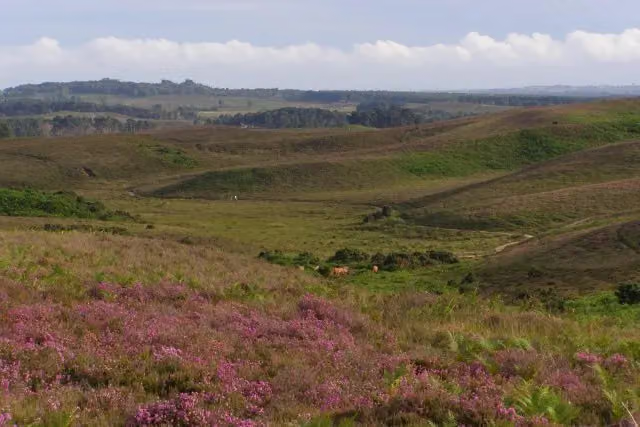
Rolling heathland with purple heather in the foreground and woods on the horizon
Heathland over Broad Bottom in the New Forest · Photo: Jim Champion via Wikimedia Commons, CC BY-SA 2.0

New Forest National Park UK: tickets, trains and buses

You do not need tickets for the park itself. National Parks UK says every national park in the UK is free to enter, and there are no gates. You only pay at attractions that charge their own entry fee.

By train. Brockenhurst station is in the heart of the park, about 90 minutes from London Waterloo. South Western Railway runs there from London, Winchester, Southampton, Bournemouth, Poole and Weymouth, and CrossCountry links the area with Reading, Oxford and Birmingham. There are also stations at Ashurst, Beaulieu Road, Sway, New Milton, Lymington Town and Lymington Pier. In Brockenhurst, Sway and Ashurst you can start walking or cycling straight from the village.

By bus. The New Forest Breezer 86 runs from Totton through Lyndhurst and Brockenhurst to Lymington. The Breezer 81 and 82 link Lymington with New Milton, Christchurch and Bournemouth. Bluestar buses run from Totton and Hythe to Fawley and Calshot. In summer the open-top New Forest Tour runs three hop-on, hop-off routes on one ticket, and you can bring bikes and well-behaved dogs.

By ferry. Car and foot ferries cross between Lymington and Yarmouth on the Isle of Wight. Lymington Pier station is right next to the terminal.

New Forest parking: car parks and charges

The National Park Authority does not own any car parks. Forestry England has more than 130 car parks on the open Forest, which you can spot by their green signs, and since April 2026 it has charged for parking at all of them. The authority's page does not give the prices. Forestry England publishes them on its own site, along with a list of the larger car parks and which ones have toilets.

New Forest District Council runs more than 50 car parks in towns, villages and along the coast. The National Trust has car parks at Bramshaw, Rockford, Hale Purlieu and Hightown Commons. Hampshire County Council runs Lepe Country Park, which has toilets.

At busy times some car parks are full by mid-morning. If yours is full, drive on to another one. Never park on a verge or block a gateway: the verges are protected habitats, and gateways must stay clear for the people who look after the animals and the woods and for emergency services. Each year a few Forestry England car parks close between February and August to protect ground-nesting birds, and some close in winter for maintenance.
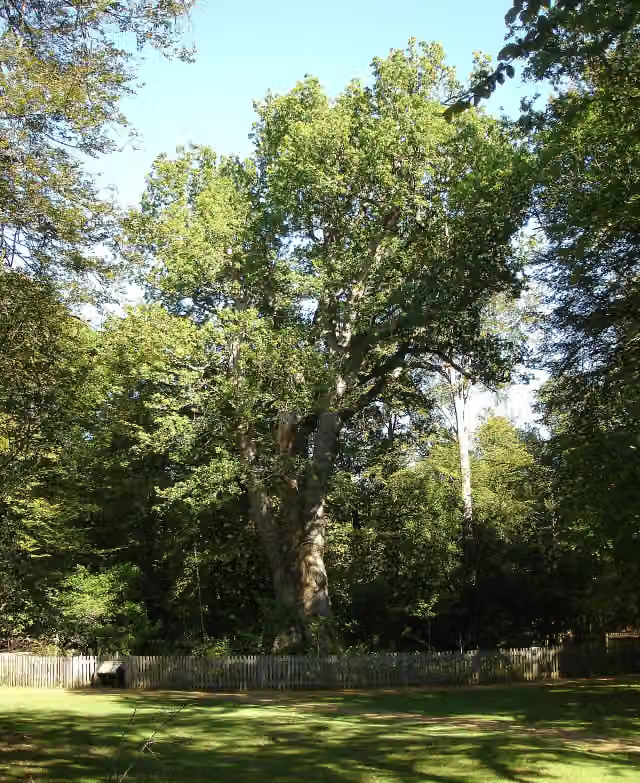
A tall, broad oak with a thick trunk in a clearing in the woods
The Knightwood Oak, an old oak in the New Forest · Photo: MalcolmGould via Wikimedia Commons, CC BY-SA 3.0

New Forest wildlife: ponies, deer and birds

The best-known animals here are not wild at all. Around 5,000 New Forest ponies graze the park, and they are owned by commoners: local people who keep animals on the Forest. Cattle and donkeys roam freely too. Their grazing creates the rare habitats the park is known for. In autumn, pigs are let out for pannage, an old custom in which they eat up the acorns, which can poison ponies and cattle.

Keep your distance and do not feed or touch the ponies and donkeys. In restricted areas this is also the law: a Public Spaces Protection Order from New Forest District Council bans feeding, petting and touching them. Foals have no road sense and their mothers are protective, so give them extra room.

The truly wild animals include five species of deer: fallow, muntjac, roe, red and sika. Young deer are born in summer. If you find one on its own, leave it alone and stay back: its mother has hidden it while she feeds and will come back. During the autumn rut, stags can be dangerous. Rare birds such as the curlew nest on the ground from March to August. Hen harriers roost on the heath from October to April, and birds from Siberia and the Arctic spend the winter on the coast. The adder, Britain's only venomous snake, also lives here and only bites when disturbed.

Where to go in the New Forest: sights with their own page

Besides the heath and the ponies, the park has old trees, an abbey and a maritime museum. These places have their own page with us.

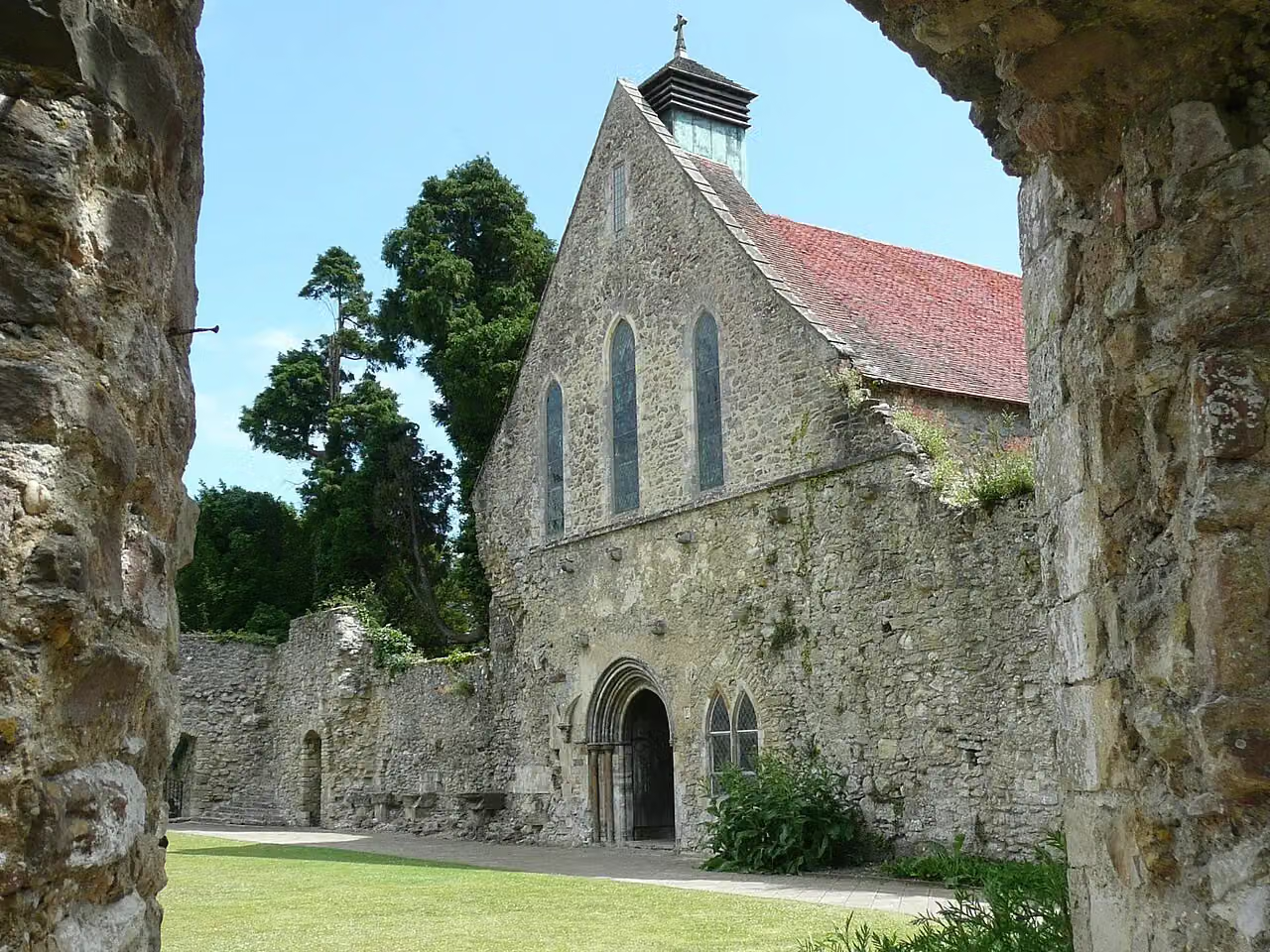
Ruined stone walls and arches of a medieval abbey on a lawn
The remains of Beaulieu Abbey in the New Forest · Photo: This photo was taken by Przemysław JahrAutorem zdjęcia jest Przemysław JahrWykorzystując zdjęcie proszę podać jako autora:Przemysław Jahr / Wikimedia Commons via Wikimedia Commons, Public domain

Things to do in the New Forest: walking, cycling and the coast

Most visitors come to walk. The National Park Authority says there is a large network of paths across the heath, through the woods and villages and along the coast. Many of them are suitable for wheelchairs, mobility aids and pushchairs. If you cycle, keep to the waymarked cycle routes and the roads that link them; the New Forest Code asks you to stay on permitted cycle tracks.

The coast is 26 miles long. New Forest District Council has car parks along the coast, and Lepe Country Park has toilets and an information point. The New Forest Heritage Centre is the other main place to get information. In summer the open-top New Forest Tour is an easy way to see the villages without a car, and from Lymington you can take the ferry to the Isle of Wight.

The park is one of the most important places in Britain for fungi, with an estimated 2,700 species, and autumn is when you see most of them. Look at them and take photos, but do not pick them.

The New Forest Code: dogs, fires, camping and drones

The park asks every visitor to follow the New Forest Code. In short:

  • Keep your distance from the animals and do not feed or touch them.
  • Dogs: keep them under close control and never let them go up to or chase the animals. From March to August, stay on the main tracks so you do not disturb ground-nesting birds.
  • No fires or barbecues. On the open Forest, fires of any kind, barbecues (disposable ones included) and outdoor cooking equipment are banned. So is dropping anything that could start a fire, such as a lit cigarette. If you see a fire or an unattended barbecue, get to a safe place and call 999.
  • No wild camping: stay on a campsite.
  • Park only in car parks, and drive with care: animals can be on the roads at any time, and accidents peak in autumn.
  • Take your litter and dog waste home. In autumn, never leave pumpkins out: they can harm the ponies.

Drones are not allowed in much of the park. On the Crown Lands you need a permit from Forestry England. Permits are given only for filming, operational or research purposes, and never during the ground-nesting season from February to August. The National Park Authority cannot give permission itself.

The best time to visit the New Forest

  1. Jan
  2. Feb
  3. Mar
  4. Apr: good
  5. May: at its best
  6. Jun: at its best
  7. Jul: good
  8. Aug: good
  9. Sep: at its best
  10. Oct: at its best
  11. Nov
  12. Dec
  • SpringFoals are born, and from March curlews nest on the ground, so stay on the main tracks. Ticks are most common in late spring and summer.
  • SummerYoung deer hide in the grass. In dry weather the heath catches fire easily, so never light a barbecue. Car parks can be full by mid-morning.
  • AutumnThe deer rut, pannage pigs and fungi. Darker evenings bring the most road accidents involving animals.
  • WinterHen harriers on the heath and migrant birds on the coast. Maintenance work can close car parks for a while.


Map of New Forest National Park

  • Boundary of New Forest National Park
  • Parking
  • Water point
  • Toilet
  • Bench
  • Bike pump

In and around New Forest National Park: 648 car parks (61 paid), 279 pitstops. Tap a point for its name and whether parking is paid.

Car parks and entrances with a name
  • Abbots Well · free
  • Acres Down · free
  • Anderwood
  • Andrew's Mare · free
  • Andrew's Mare · free
  • Appleslade · free
  • Appleslade · free
  • Appletree Court · free
  • Appletree Court · free
  • Ashley Walk · free
  • Ashley Walk · free
  • Barrow Moor · paid
  • Barrow Moor · paid
  • Bath Road · paid
  • Bath Road · paid
  • Beaulieu Heath · free
  • Beaulieu Heath · free
  • Beaulieu Road · free
  • Beaulieu Road · free
  • Beechern Wood · free
  • Beechern Wood · free
  • Blackwater · paid
  • Blackwater · paid
  • Blackwell Common · free
  • Blackwell Common · free
  • Bolderwood · free
  • Bolderwood · free
  • Boltons Bench · free
  • Boltons Bench · paid
  • Boltons Bench · free

From our data

Pitstops in New Forest National Park

Pitstops
279
in New Forest National Park
Car parks
648
in New Forest National Park
Benches
211
in New Forest National Park
Public toilets
44
in New Forest National Park
Water points
21
in New Forest National Park
Public bike pumps
3
in New Forest National Park

As of 28 November 2026, from the Outdoor Pitstop database. Pitstops inside the national park boundary as OpenStreetMap draws it. Benches, public toilets and water points come from OpenStreetMap and from reports by our users.

Benches, public toilets and water in the New Forest

Benches are by far the most common pitstops in the park. You find them in the villages, at car parks on the edge of the woods and at spots with a view over the heath. They are handy for a rest on a walk or a bike ride.

Public toilets are mostly in the villages and at the larger car parks, such as Lepe Country Park. Forestry England's list of larger car parks shows which of its sites have toilets. Our data also includes water points and a few bike pumps, mainly in the villages, so fill your bottle there before you head out onto the heath. See the pitstops on our map of the New Forest, all benches in the United Kingdom, the public toilets in the United Kingdom and the water fountains and refill points in the United Kingdom.

In the app I see 211 benches and 21 water points inside New Forest National Park.

New Forest walking and cycling

The app does not have walking or cycling routes for the United Kingdom yet. You can find the pitstops of the New Forest on our page for the area, and every region of the UK has its own page.

Open the map with pitstops in the New Forest →Pitstops in the United KingdomBenches in the United Kingdom

Key takeaways

  • New Forest National Park was created in 2005 and covers 220 square miles of woodland, heath, wetland and coast.
  • Around 5,000 New Forest ponies, owned by local commoners, graze the park and keep the landscape open.
  • Feeding or touching the ponies and donkeys is banned by law in restricted areas of the New Forest.
  • Fires and barbecues of any kind, including disposable barbecues, are banned on the open Forest, and wild camping is not allowed.
  • Forestry England has introduced parking charges at all of its more than 130 car parks in the New Forest from April 2026.
  • In the data of Outdoor Pitstop, benches are by far the most common pitstop inside New Forest National Park.

Frequently asked questions

Where is the New Forest?

In the south of England, mostly in Hampshire, between Southampton and Bournemouth and opposite the Isle of Wight. It has been a national park since 2005.

How to get to the New Forest?

Take the train to Brockenhurst, about 90 minutes from London Waterloo, or to Ashurst, Sway, Beaulieu Road or Lymington. The Breezer buses link Lymington, Brockenhurst and Lyndhurst with Totton and Bournemouth.

What to do in the New Forest?

You can walk or cycle on the waymarked tracks, watch ponies, deer and birds from a distance, and visit the 26 miles of coast. In summer you can also ride the open-top New Forest Tour bus.

Where to go in the New Forest?

Brockenhurst, Lyndhurst and Lymington are good places to start, and the New Forest Heritage Centre and Lepe Country Park have visitor information. Well-known sights include Beaulieu, Buckler's Hard and the Knightwood Oak.

Do you need tickets for the New Forest?

No. Like all UK national parks, the New Forest is free to enter. You only pay for parking and at attractions that charge their own entry fee.

Can you feed the New Forest ponies?

No. The New Forest Code asks you to keep your distance and not feed or touch them. In restricted areas a Public Spaces Protection Order makes it illegal.

Sources

  1. New Forest National Park, homepage · newforestnpa.gov.uk · national park since 2005, 220 square miles, 20,000 species, 5,000 ponies owned by commoners, 600+ listed buildings, 34,000 residents
  2. New Forest National Park, The New Forest code · newforestnpa.gov.uk · the code, dogs, fires and barbecues, wild camping, cycle tracks, PSPOs on fires and on feeding or touching ponies and donkeys, call 999
  3. New Forest National Park, Seasonal guidance · newforestnpa.gov.uk · curlew March to August, foals, ticks, adders, young deer, five deer species, rut, pannage, 2,700 fungi species, pumpkins, winter work, 26 miles of coast, hen harriers
  4. New Forest National Park, Car parking · newforestnpa.gov.uk · car park owners, 130+ Forestry England car parks with charges from April 2026, closures, verges, NFDC, National Trust and Lepe (November 2026)
  5. New Forest National Park, Sustainable travel · newforestnpa.gov.uk · buses, New Forest Tour, trains and stations, ferry to Yarmouth, cycling and walking (November 2026)
  6. New Forest National Park, Visitor information · newforestnpa.gov.uk · New Forest Heritage Centre and Lepe Country Park as information points
  7. New Forest National Park, Flying drones · newforestnpa.gov.uk · landowners, Forestry England manages the Crown Lands, drone permits, February to August ban
  8. National Parks UK, FAQs · nationalparks.uk · UK national parks are free to enter

Last checked in November 2026. Outdoor Pitstop figures come from our own database; the date is with each block.

Written by

Robin

Founder of Outdoor Pitstop

Robin started Outdoor Pitstop to always know where the next toilet, water tap or bench is on the way.

About this guide

What I write here comes from what we keep track of in Outdoor Pitstop: the pitstops, routes and photos in the app, and what users report on the way. I check rules, opening times and facts about nature with the official sources. Spotted something that is not right? Let me know and I will correct it.

Checked in November 2026 · Last updated

How we work

More about vk en ierland

In the app

The New Forest in the app

Open the map with pitstops around the New Forest and see where the benches, public toilets, water points and bike pumps are. Download the app to have them with you on the way.

  • The nearest water point in a village before you head onto the heath
  • Benches at car parks and viewpoints
  • A public toilet or bike pump on the way
Download on the App StoreGet it on Google Play

More from Nature areas

The free app

All of Outdoor Pitstop, in your pocket

Find the nearest pitstop, navigate there, listen to audio tours, earn XP and make routes and lists together.

Download on the App StoreGet it on Google Play
How Outdoor Pitstop works →
The map of the app with pitstops nearby
A pitstop in the app, with a photo, a review and Navigate
Your profile in the app, with level and XP