Outdoor Pitstop
Short answer
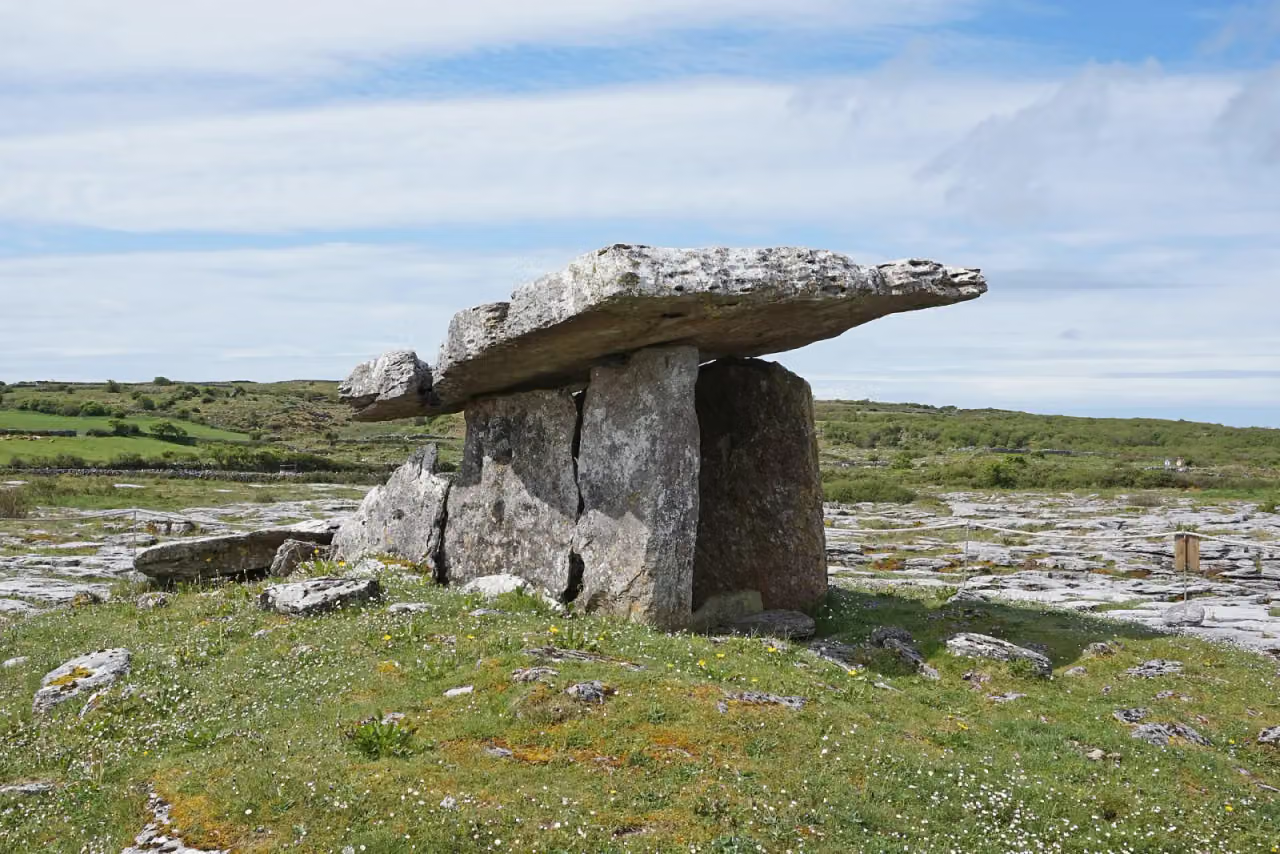
Dolmens are prehistoric stone tombs, usually two or more upright stones carrying one large flat capstone, and in Europe most of them were built between about 4000 and 3000 BC. According to Outdoor Pitstop's data (as of 25 November 2026), Europe has around 2,470 mapped dolmens, with the most in France, Germany and Spain. Many lie in open countryside, so the best way to see dolmens is on foot, from a short stroll at Poulnabrone in Ireland to a full day around Carnac in Brittany.
Figures from the Outdoor Pitstop database on 25 November 2026, based on OpenStreetMap. We count points tagged as a dolmen, passage grave or chamber tomb, plus points with dolmen, hunebed or portal tomb in their name.
What is a dolmen?
A dolmen is a single-chamber megalithic tomb. According to the English Wikipedia article on dolmens, many were originally covered by a mound of earth or stones, and in a lot of cases that cover has worn away, leaving the bare stone "table". The name differs by country: portal tomb in Ireland, quoit in Cornwall, cromlech in older English texts and in Wales, hunebed in the Netherlands, Hünengrab in Germany and anta in Portugal and Galicia.
Dolmens are found far beyond Europe too. Wikipedia gives about 40,000 for Korea alone, roughly 40% of the world's total.
Where are the most dolmens in Europe?
According to Outdoor Pitstop's data (as of 25 November 2026), these countries have the most dolmens mapped:
| Country | Dolmens in our data |
|---|---|
| France | 724 |
| Germany | 642 |
| Spain | 498 |
| Denmark | 220 |
| Portugal | 142 |
| Netherlands | 57 |
| Ireland | 46 |
| United Kingdom | 41 |
The numbers follow what volunteers have mapped in OpenStreetMap, so regions with active mappers score higher.
Carnac and the dolmens of Brittany
Carnac in Brittany is the best-known megalithic landscape in Europe. According to Wikipedia, there are more than 3,000 standing stones, probably erected around 3300 BC, with some possibly as early as 4500 BC. In 2025 UNESCO listed the "Megaliths of Carnac and of the shores of Morbihan" as World Heritage.
The stone rows of Ménec, Kermario and Kerlescan are the famous part, but Carnac also has dolmens. The Tumulus-dolmen de Kercado in Carnac is a passage tomb under its mound that Wikipedia dates to around 4600 BC. Since 1991 the main stone rows have been fenced to let the vegetation recover, and visits are mostly by guided tour; Wikipedia notes they are open in winter. Walking between the alignments and the dolmens on the small roads and paths around Carnac is an easy half-day.
Antequera: the dolmens of Menga, Viera and El Romeral
In Andalusia, the Antequera Dolmens Site became a UNESCO World Heritage Site in 2016. It brings together the Menga and Viera dolmens, the Tholos of El Romeral, and two natural landmarks: the Peña de los Enamorados and El Torcal de Antequera.
According to Wikipedia, Menga is unusual because it does not face a point in the sky but the Peña de los Enamorados, a mountain shaped like a face. Viera is aligned with sunrise at the equinoxes. Menga and Viera lie side by side on the edge of Antequera, so you can walk from the town centre; El Romeral is a few kilometres further out.
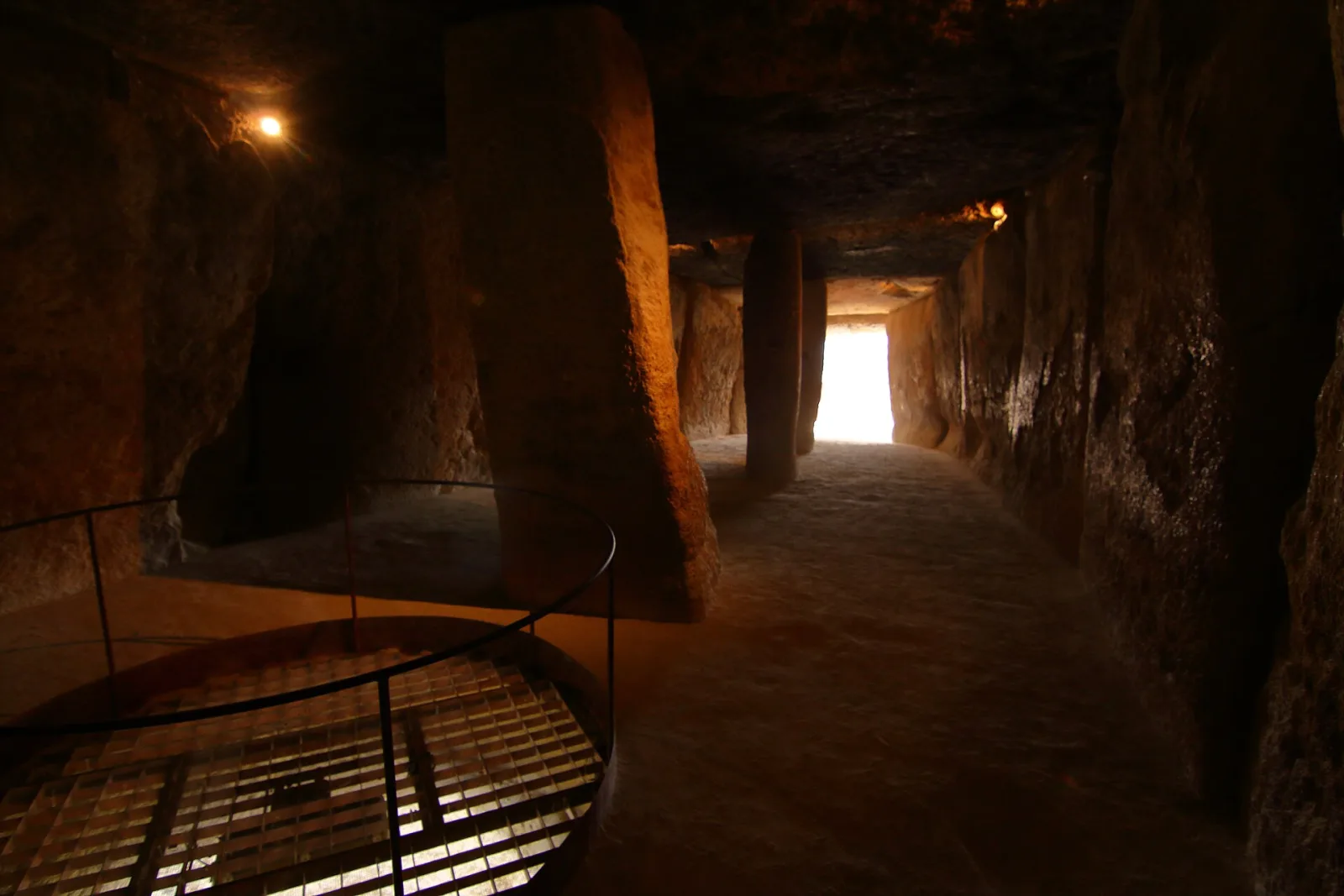
Photo: Malopez 21, CC BY-SA 4.0, via Wikimedia Commons
Dolmens in Ireland and Britain: Poulnabrone, Brownshill and Pentre Ifan
Ireland's portal tombs are among the most photographed dolmens in Europe.
- Poulnabrone Dolmen, in the limestone landscape of the Burren in County Clare, is a short walk from the road. See Poulnabrone Dolmen in County Clare.
- Brownshill Dolmen, 3 km (2 miles) east of Carlow, has a capstone of an estimated 150 tonnes, which Wikipedia says is reputed to be the heaviest in Europe. It is visible from the R726 road. See Brownshill Dolmen near Carlow.
- Pentre Ifan in Pembrokeshire is the best-known dolmen in Wales, on a hillside above the Nevern valley.
- Trethevy Quoit and Lanyon Quoit in Cornwall are the local "quoits". Wikipedia dates Trethevy Quoit to around 3500 to 2500 BC.
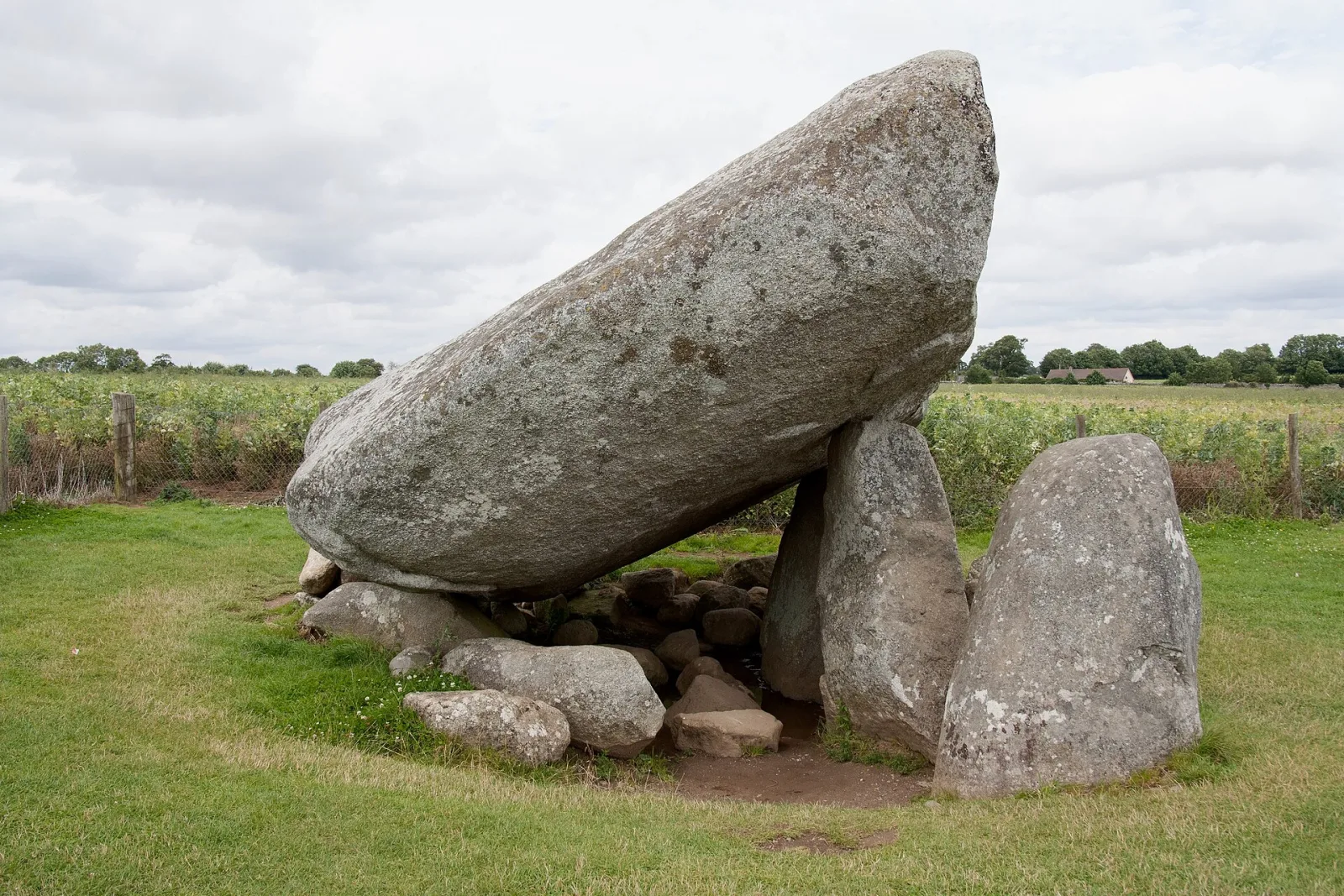
Photo: Elliot Tucker, CC BY-SA 4.0, via Wikimedia Commons
Hunebedden in the Netherlands
The Dutch dolmens, called hunebedden, are concentrated in Drenthe on the Hondsrug ridge. The largest is Hunebed D27 in Borger, next to the Hunebedcentrum museum. Several long-distance walking routes on the Hondsrug pass a string of hunebedden, which makes Drenthe one of the easiest places in Europe to see many dolmens in one walk.
Toilets and water near famous dolmens
Most dolmens stand in fields or on moorland, far from facilities. According to Outdoor Pitstop's data (as of 25 November 2026), this is what is mapped within 2 km (1.2 miles) of some of the best-known sites:
| Dolmen | Public toilets | Drinking water | Benches |
|---|---|---|---|
| Antequera Dolmens Site, Spain | 6 | 16 | 20 |
| Poulnabrone Dolmen, Ireland | 2 | 0 | 0 |
| Brownshill Dolmen, Ireland | 1 | 0 | 6 |
| Pentre Ifan, Wales | 1 | 0 | 0 |
| Tumulus-dolmen de Kercado, France | 0 | 0 | 20 |
| Hunebed D27 Borger, Netherlands | 0 | 1 | 78 |
A missing toilet in our data does not always mean there is none: a museum or café may have one that is not on the map yet. Take water with you on rural walks, especially in Andalusia in summer.


Visiting dolmens with respect
Dolmens are graves and protected monuments. Do not climb on the capstones, move stones or light fires near them. Several sites, including the Carnac alignments, close parts of the site to protect the ground and plants, so follow the signs and paths. In fields, close gates behind you and keep dogs on a lead near livestock.
On the map
Pitstops in France, Spain, Ireland, United Kingdom and Netherlands (998,621)
Take Outdoor Pitstop along on your phone
Free · 3.4 million pitstops in 44 countries