Outdoor Pitstop
The story
Audio tour · Collégiale Notre-Dame
1:50
- en
- nl
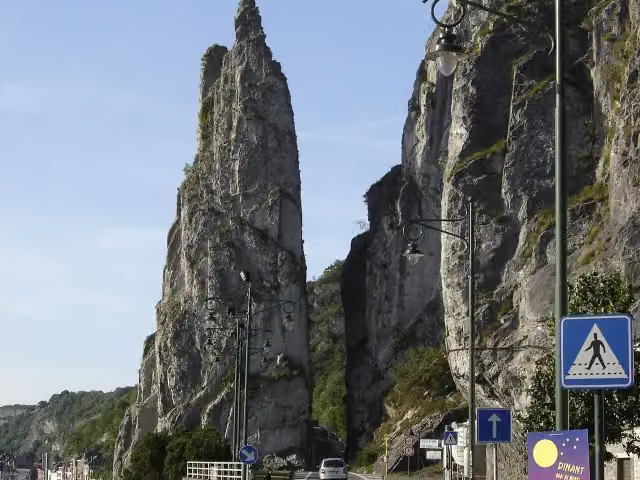
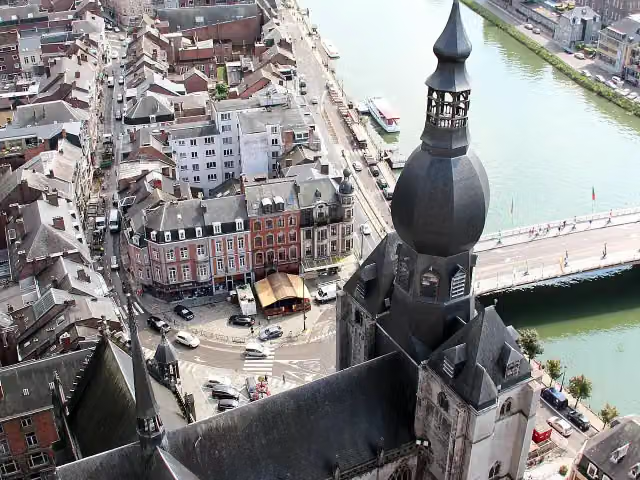
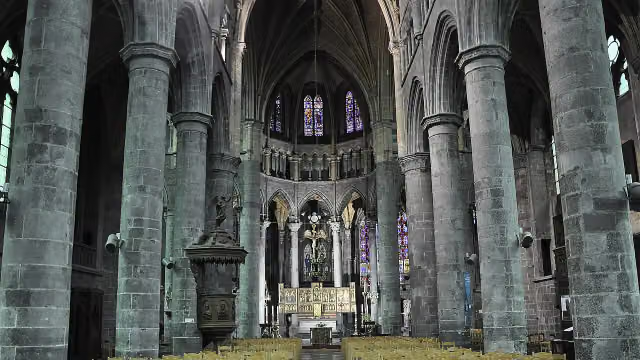
You're standing at the Collegiate Church of Our Lady in Dinant, right on the banks of the river Meuse. Start with the bell tower. It's pear-shaped, a bit like a giant onion. It's so unusual that it has become the symbol of Dinant's skyline. It was added in 1566, and it was originally meant for the town hall.\n\nNow look at the walls. The whole building is made of the grey limestone of Dinant, taken from the region itself. The church is a fine example of Meuse Gothic, the style of the old Prince-Bishopric of Liège. Behind the three short aisles, the transept juts far out to the sides, which gives the church a strikingly wide shape.\n\nThe story of this spot is dramatic. A Romanesque church stood here as early as the 10th century. In 1227, a chunk of overhanging rock fell from the cliff straight onto it. Thirty-six people died. Only the Romanesque north portal survived. Try to find it, because it's the oldest part of the church.\n\nThe town then rebuilt the church in Gothic style. The choir and transept were finished around 1250. The nave and towers followed around 1280. When the town was destroyed in 1914, the church was restored once more.\n\nSo what's inside? The choir has an impressive ambulatory, but no chapels. Look for the huge stained glass window in the transept as well. It was made by Gustave Ladon, a glass artist from Ghent, and shows scenes from the Bible. It's among the largest stained glass windows in Europe.\n\nWant to take your time? Plan on about half an hour for the church and its surroundings. Check the opening times on the spot.
Listen to the first 30 seconds
0:00 / 0:30
Read and hear the whole story in the Outdoor Pitstop app: check in at this place and it is yours (with Pro; new users are Pro for the first 4 weeks).